Green finance does not industrialise Africa on its own. More than 80% of renewable energy investment comes from private sources, making the structure of a project central to attracting capital. In South Africa, attracting green investment for industrial projects means aligning industrial policy, environmental funds and private finance with bankable operations, credible revenue and the skills and infrastructure needed to deploy technology.
Investors scrutinise more than a project’s environmental credentials. Cash flow, delivery risk and operational capacity determine whether capital can support durable industrial growth. For businesses attracting green investment for industrial projects, the practical question is how to reduce these barriers and build an investable proposition.
You’ll see how environmental funds can mobilise private investment, how green finance relates to industrialisation across Africa, and why local capabilities matter alongside capital. The focus is commercial: the mechanisms that can turn industrial opportunities into investable projects, and the conditions that support scale and long-term performance.
Key Takeaways
- Align industrial investment with South Africa’s green policy priorities, while accounting for the skills, infrastructure and supplier capacity needed to deliver projects.
- Structure environmental funds to mobilise private and donor capital, with revenue streams designed to support long-term project viability.
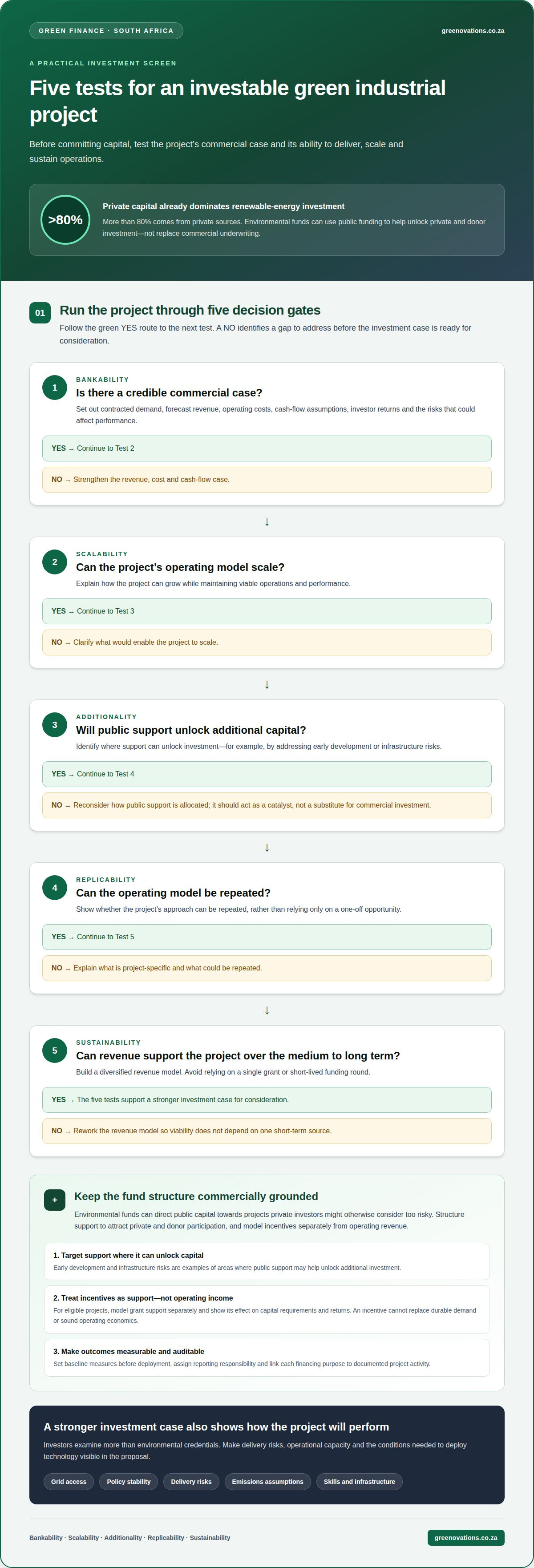
- Assess green-finance opportunities against bankability, scalability, additionality, replicability and sustainability before committing capital.
- Consider Drone-Powered Industrial Intelligence (GII) when industrial project decisions require better operational insight.
Green industrial policy and sustainable industrialisation
South Africa’s green industrial policy links industrial development with economic opportunity, structural change and reduced environmental harm. Investment must build productive capacity, not simply install renewable technology.
Policy also needs to preserve governments’ ability to shape development priorities. More than one third of existing investment treaty relationships restrict some measures intended to strengthen domestic industries. Poorly designed local-industry requirements can raise costs or deter investment instead of building lasting supplier networks. The National Cleaner Production Centre South Africa, hosted by the CSIR on behalf of the Department of Trade, Industry and Competition, promotes resource-efficient production and local green-economy skills.
Project approvals and tax incentives
Project approvals and tax incentives determine whether an industrial investment can proceed within applicable environmental and energy requirements. In South Africa, the relevant approvals, regulations and licensing depend on the project’s activity, site and operating model. Section 12B is a tax consideration for qualifying renewable-energy assets; eligibility and deductions depend on the provision’s requirements and the asset’s circumstances. These factors matter because unresolved approval conditions or tax assumptions can weaken project economics before financing is secured.
Project economics and investor proposals
Project economics connect capital expenditure and operating performance with forecast revenue and investor returns. Investors assess contracted demand, operating costs, grid access, delivery risks and the asset’s ability to perform over time. There is no single return that applies across South African industrial projects: the asset, revenue structure and allocation of risk shape each investment case. A bankable proposal sets out the technical scope, cash-flow assumptions, approval status, counterparties and risk controls. It also explains how the project can scale and develop local skills.
Investment risks and uncertainty
Investment risk is the exposure that could disrupt delivery, revenue or operating performance. Grid capacity can constrain a project’s connection or energy supply, while policy uncertainty can affect long-term planning and financing assumptions. Carbon-tax exposure may change forecast operating costs; carbon credits may contribute revenue when emissions reductions are measurable and qualify under applicable mechanisms. Investors therefore examine grid access, policy stability, emissions assumptions and who carries delivery risks. South African policy must enable clean investment while retaining flexibility to build domestic capability without undermining project viability.
Environmental funds and private investment
Environmental funds can direct public capital to projects that private investors might otherwise consider too risky. Their effectiveness depends on the investment structure, not the environmental label.
Incentives for green investment
Incentives reduce defined project costs or risks, potentially improving the viability of eligible industrial investment. In South Africa, assess support against the asset, retrofit scope and funding conditions before including it in a financial model. One example is a cash grant for retrofitting industrial facilities to use renewable energy. Model grant support separately from operating revenue and show its effect on capital requirements and returns. An incentive can strengthen a viable project, but it cannot replace durable demand or sound operating economics.
ESG investors and green finance standards
ESG-focused investors assess environmental, social and governance performance alongside financial risk. To attract them, present a clear use of funds, measurable outcomes, accountable governance and consistent performance reporting. Green finance standards help define eligible activities and how results should be evidenced. An auditable record helps investors distinguish operational improvements from unsupported claims. Set baseline measures before deployment, assign reporting responsibility and link each financing purpose to documented project activity.
Private capital already dominates renewable-energy investment: more than 80% comes from private sources. Environmental funds can use government funding to attract private and donor investment, rather than carry the full financing burden themselves. The structure should allocate public support where it unlocks additional capital, such as early development or infrastructure risks. This approach makes the fund a catalyst, not a substitute for commercial underwriting.
Build a diversified revenue model for the medium to long term. Potential sources depend on the project, but the fund should avoid reliance on a single grant or short-lived funding round. For each investment, assess bankability, scalability, additionality, replicability and sustainability. These criteria test whether capital can support a viable project and whether its operating model can be repeated. Better operational investment data can also help make project performance more legible to capital providers.
This approach can broaden the funding base and help environmental funds sustain their work beyond individual financing rounds, drawing on both private and donor participation.
Green finance and industrialisation in Africa
Across Africa, attracting green investment for industrial projects depends on productive assets and measurable outcomes. Sector selection and funding structure must fit the project’s commercial case.
Comparing incentives across African countries
Compare incentives by assessing how each country’s support affects project viability, rather than ranking headline offers. South African investors can compare eligibility, funding form, project stage and the obligations attached to support. These distinctions matter because grants, tax treatment and financing facilities affect different parts of the capital structure. Across African economies, local infrastructure, skills and domestic supplier capacity also influence whether an incentive translates into industrial development.
Renewable energy and manufacturing are relevant opportunity areas for South African industrial investment. A study covering 41 African countries from 2000-2020 found positive estimated green-finance coefficients for industrial value added: 0.206 in static panel results and 0.319 in dynamic panel results. These are study estimates, not project returns. They indicate an association to assess alongside local demand, operating conditions and execution capability.
Grants, tax incentives and loans
Grants, tax incentives and loans are distinct ways to finance renewable energy and industrial decarbonisation. Their suitability depends on eligible activities, project stage, repayment capacity and the costs each instrument can address. South African project teams should integrate them into one capital plan, separating repayable finance from non-repayable support and tax effects. This gives investors a clearer view of funding needs and projected cash flow.
Accessing development bank funding
Development bank funding is institutional finance assessed against a project’s development impact and commercial structure. For the Industrial Development Corporation or Development Bank of Southern Africa, prepare a coherent proposal covering technical scope, funding needs, revenue logic, delivery risks and expected industrial outcomes. Link climate benefits to measurable project performance, not general claims. A credible case also explains how the project can operate, scale and strengthen domestic productive capacity.
Public procurement can also create demand for green projects: public-sector regulations can require at least 30% of procurement in a jurisdiction to be allocated to green projects or used as green finance. Project sponsors should distinguish this policy mechanism from a grant or loan, then assess whether procurement demand supports their revenue model. Attracting green investment for industrial projects requires alignment with South African infrastructure and supplier capacity.
What incentives are available in South Africa for green industrial investment?
South African industrial projects should treat incentives as components of the capital structure, not substitutes for commercial viability. Available support depends on the project’s activities, financing needs and eligibility conditions. Separate grants, tax treatment and loans in the financial model, then test how each affects capital requirements, cash flow and investor exposure.
A host-country incentive example provides a cash grant of up to 30% for retrofitting industrial facilities for renewable energy use. For a South African project, treat this as a potential funding mechanism, not automatic revenue. The retrofit scope, qualifying expenditure and applicable conditions determine its relevance. Keep the grant distinct from operating income when presenting project economics.
Section 12B is another consideration for renewable-energy investment in South Africa. Its relevance depends on the asset and applicable tax requirements, so the project model should separate any anticipated tax effect from grants and debt. This prevents projected returns from relying on support that does not match the project’s structure. Establish the asset scope and tax assumptions before finalising the investor case.
Public procurement can also influence demand. Public-sector regulations can require at least 30% of procurement in a jurisdiction to be allocated to green projects or used as green finance. This is a demand-side mechanism, not a direct grant to an individual project. Its value depends on whether procurement creates a credible route to revenue for the project’s output or services.
Development finance is a further route to assess. The Industrial Development Corporation and Development Bank of Southern Africa can be considered alongside commercial capital, with the funding structure tied to project cash flows and delivery risks. Present funding requirements, technical scope, revenue assumptions and environmental outcomes together. Assess industrial project intelligence as part of building a clearer operational case for investment.
The host-country incentive example also specifies a cash grant of up to US$3 million or 30% for retrofitting industrial facilities for renewable energy use. For South African investors, the stated ceiling can be recorded alongside the existing 30% reference, while keeping the amount conditional rather than treating it as committed funding. This keeps the grant assumption visible in the capital plan and preserves a distinction between potential support and the project’s underlying commercial case.
Greenovations Venture Studio: Drone-Powered Industrial Intelligence (GII)
Greenovations Venture Studio offers Drone-Powered Industrial Intelligence (GII) to industrial projects where operational insight can inform investment and execution decisions. GII is relevant when sponsors need intelligence to assess operations, identify constraints and plan with greater precision. Its value is clearer decision-making, not a substitute for project economics, approvals or a credible financing structure.
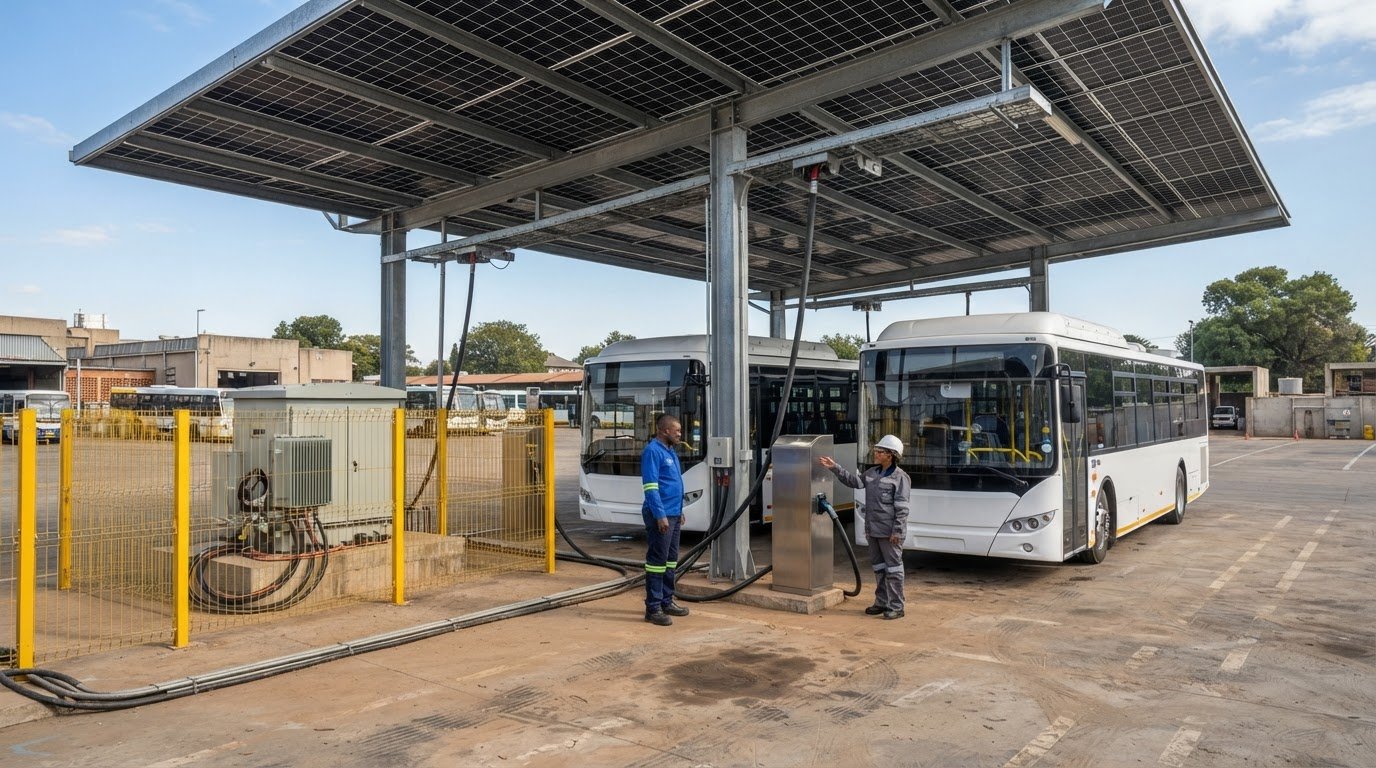
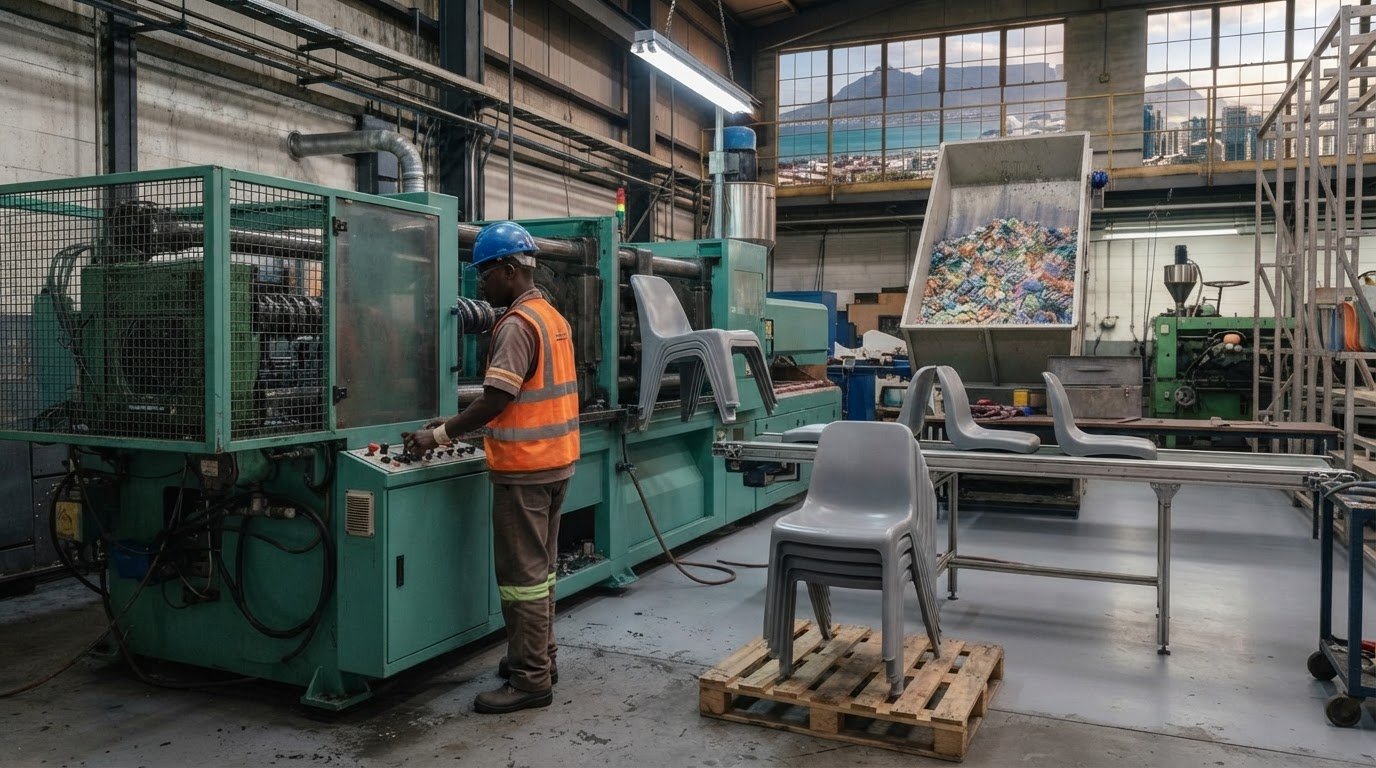
Consider GII when developing or operating an industrial asset where operational visibility is central to the investment case. Greenovations also works across related infrastructure and circular-economy offerings, including an Electric Vehicle Ecosystem, Sustainable Seating Infrastructure-as-a-Service and Solar PV Recycling. Each addresses a different project need, so the right fit depends on the intended outcomes.
Contact Greenovations Venture Studio to discuss your industrial project and its operational intelligence needs.
Move from investment case to execution
The next decision is operational: identify the assets, capabilities and delivery arrangements that will turn an investment thesis into a functioning industrial project. A credible capital plan needs an execution model that connects infrastructure choices with measurable operating requirements. Capital alone cannot resolve poor operational visibility or an unclear deployment model.
Where operational insight can inform planning, Greenovations offers Drone-Powered Industrial Intelligence (GII), alongside an Electric Vehicle Ecosystem and Sustainable Seating Infrastructure-as-a-Service. Each supports a different infrastructure need. Match the offering to the project’s intended outcomes and operating context.
Attracting green investment for industrial projects is ultimately a matter of aligning capital with delivery. If you’re advancing an industrial project and want to discuss its execution requirements, contact Greenovations Venture Studio. Take the next step with a clear view of what the project must deliver.
Visual summary
Planning a project like this?
Talk to the Greenovations venture desk about a No-CAPEX structure.