Weight reduction is a practical advantage of biocomposites, not just a materials claim. Biocomposite materials for industrial use combine natural fibres with a resin matrix to create components that can be lighter than conventional alternatives. A flax-linen composite prototype for a Land Rover Defender door was 60% lighter than its production counterpart while remaining just as rigid.
That example raises the commercial question: where can these materials meet an industrial application’s performance demands? Their value depends on how the fibres and resin work together and on the component’s requirements for strength, rigidity, weight and moisture resistance. This article explains how natural-fibre reinforcement and resin matrices function, outlines potential benefits and limitations, and maps applications across transport, aircraft, construction and infrastructure. It gives South African businesses a practical basis for assessing where biocomposites may fit into material selection and production planning.
Key Takeaways
- Assess biocomposites by matching fibre reinforcement and resin matrix to the component’s performance requirements.
- Compare potential weight, insulation and mechanical benefits against moisture sensitivity and other application-specific demands.
- Understand how material composition and processing influence whether a biocomposite can replace a conventional material.
- Identify potential applications across transport, construction and infrastructure, including components beyond vehicle interiors.
- See how Greenovations Venture Studio’s industrial intelligence offering can support decisions about industrial assets and operations.
Biocomposites in automotive components
Biocomposites combine biological components, such as natural fibres, with a resin matrix. In automotive manufacturing, they can be used for door panels, dashboards, centre consoles and seats, where weight and component performance are key considerations.
Flax composites in vehicles
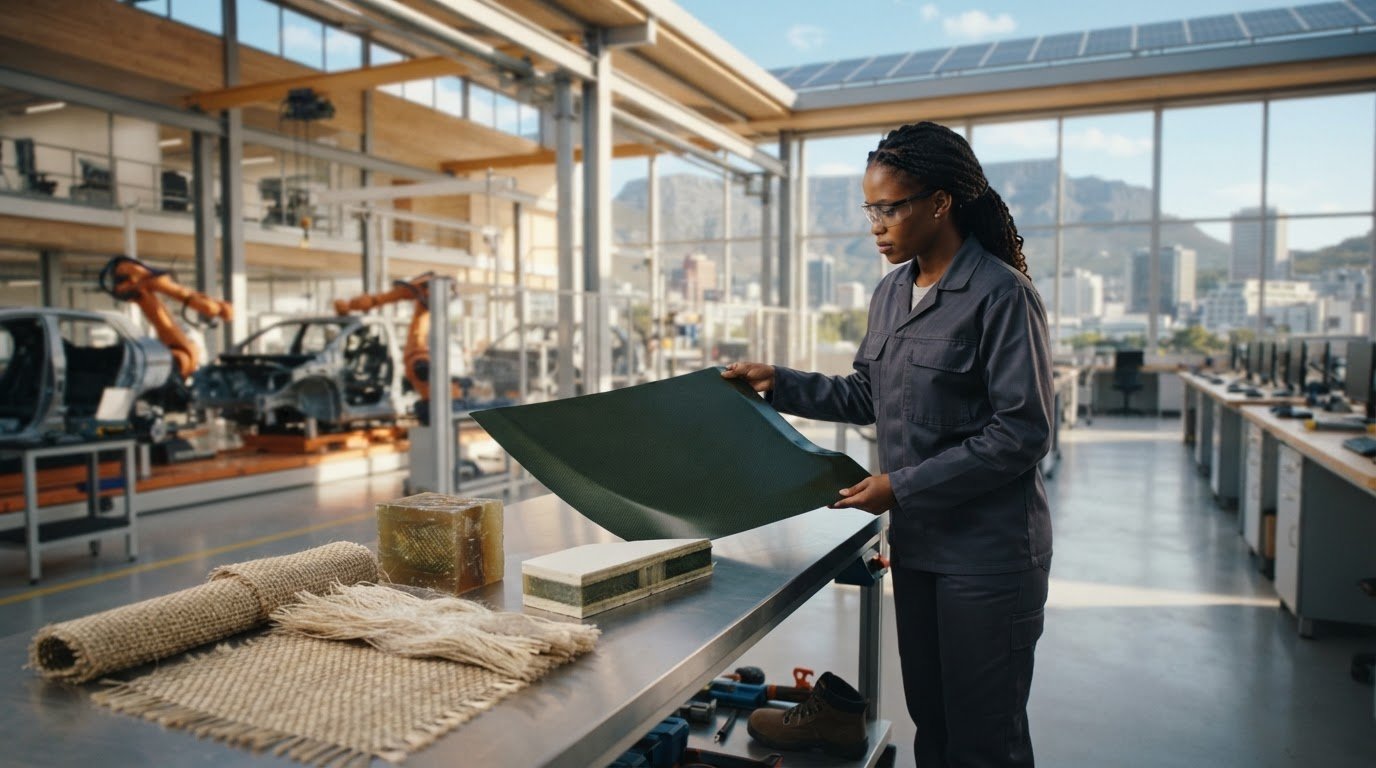
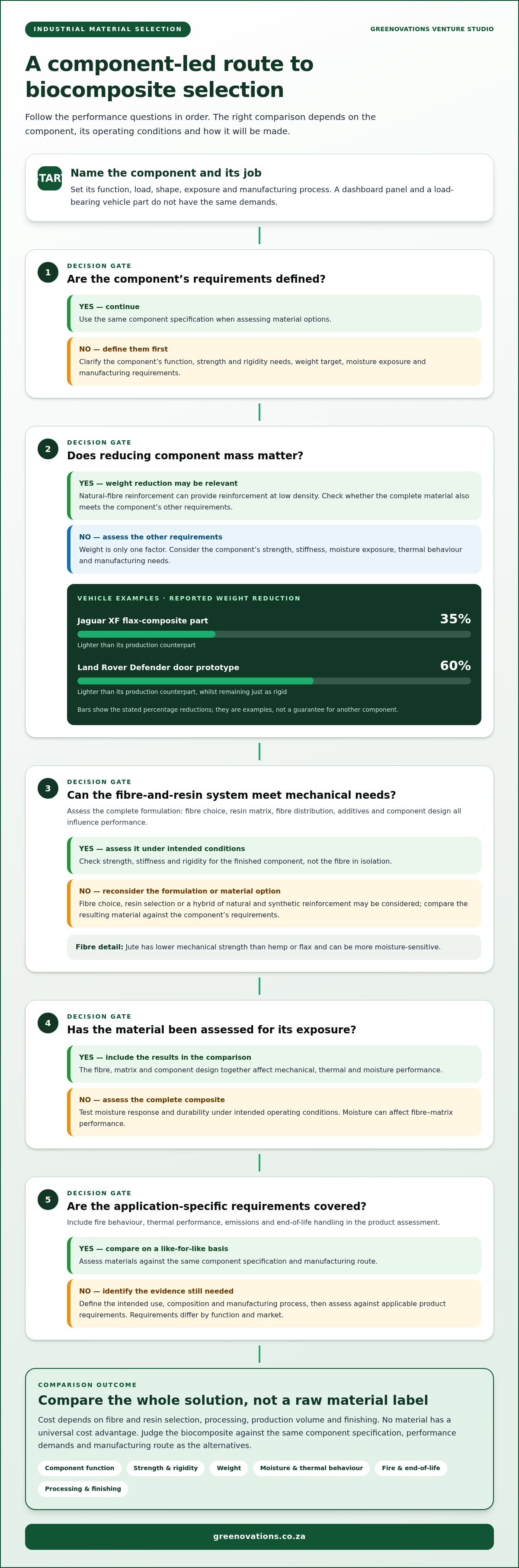
Automotive flax composites reinforce resin with flax fibres to form lightweight vehicle components. Their relevance lies in reducing component mass whilst retaining required rigidity. A flax composite part used in the Jaguar XF was 35% lighter. A flax-linen composite prototype for a Land Rover Defender door was 60% lighter than its production counterpart while remaining just as rigid. These examples show why engineers assess each component against its design requirements, rather than treating natural fibres as a direct, universal replacement.
Comparing material cost and performance
Biocomposites are a material option, not a fixed-cost replacement for glass-fibre composites, plastics or metals. Cost depends on fibre and resin selection, processing, production volume and finishing, so no material has a universal cost advantage. Performance also depends on the component: density, stiffness, strength, moisture exposure and manufacturing requirements all shape the comparison. A dashboard panel and a load-bearing vehicle part have different demands. For procurement, compare materials against the same component specification and manufacturing route, rather than comparing raw material categories alone.
Material properties and durability risks
A biocomposite’s mechanical, thermal and moisture performance depends on its fibre, matrix and component design. Natural fibres can provide reinforcement at low density, but fibre choice matters: jute has lower mechanical strength than hemp or flax and can be more moisture-sensitive. The resin matrix also affects thermal behaviour, so assess the complete composite under its intended operating conditions. Moisture can affect fibre-matrix performance and durability. Fire behaviour and end-of-life handling need assessment too: a natural-fibre composite is not automatically fire-safe or readily recyclable. Component testing should address these factors together.
Standards for biocomposite products
In South Africa, requirements depend on the product’s intended function and market. An automotive interior component, for example, needs assessment against relevant vehicle, material and component requirements; a structural part has different performance criteria. Define the intended use, composition and manufacturing process, then assess mechanical performance, moisture response, fire behaviour and emissions against applicable specifications. Include end-of-life handling in the product assessment. This application-led approach helps manufacturers set evidence requirements for a specific component without assuming one material standard covers every biocomposite product.
Technical and automotive applications
Beyond vehicle interiors, biocomposites are used in technical products where fibre reinforcement, low density or insulation matters. Jute is used in packaging, furniture parts and technical textiles, while wood-fibre-reinforced plastics have long been used in decking boards and fences. Automotive components are part of this broader industrial field, but each application has its own performance demands. For a vehicle part, engineers match fibre, resin and processing to its load, exposure and function before making production decisions.
What is the potential of bio composites?
A composite’s performance depends on its ingredients and how they are combined. For industrial applications, assess each material phase and production method against the finished component’s function.
Reinforcement, matrix and additives
A composite combines reinforcement with a matrix; additives can also adjust processing or the finished material’s behaviour. Natural fibres, such as flax or wood, provide reinforcement, while the matrix surrounds and binds them into a component. Fibre choice alone does not determine performance. Resin selection, fibre distribution and additives also influence the final material. Manufacturers get a more useful comparison by assessing the complete formulation rather than fibres in isolation.
Hybrid natural and synthetic fibres
A hybrid composite combines natural fibres with synthetic reinforcement in one material. This allows designers to balance the properties of different fibres rather than rely on a single reinforcement type. The value depends on where each fibre is positioned and what the component must do. A vehicle panel, for example, has different requirements from a technical enclosure. Hybrid design offers another formulation option, but the finished composite still needs assessment against its intended loads and operating conditions.
Natural-fibre vehicle components
Natural-fibre composites can be used for vehicle components such as door panels, dashboards, centre consoles and seats. These applications show how reinforcement can be used beyond a vehicle’s exterior structure. Material selection must account for the component’s function, shape and production process. A seat component, for instance, has different design demands from a dashboard panel. This helps engineers identify where natural-fibre reinforcement suits a vehicle, rather than treating it as a uniform substitute for every part.
Flax composites beyond vehicles
Flax composites can be used in furniture components and musical-instrument parts, extending their use beyond transport. In furniture, designers can assess flax reinforcement for panels or shaped components; instrument makers can consider suitable body or structural parts. These uses depend on the component’s stiffness, finish and intended handling. Flax is not suited to every product, but the same reinforcement can be evaluated against different design briefs.
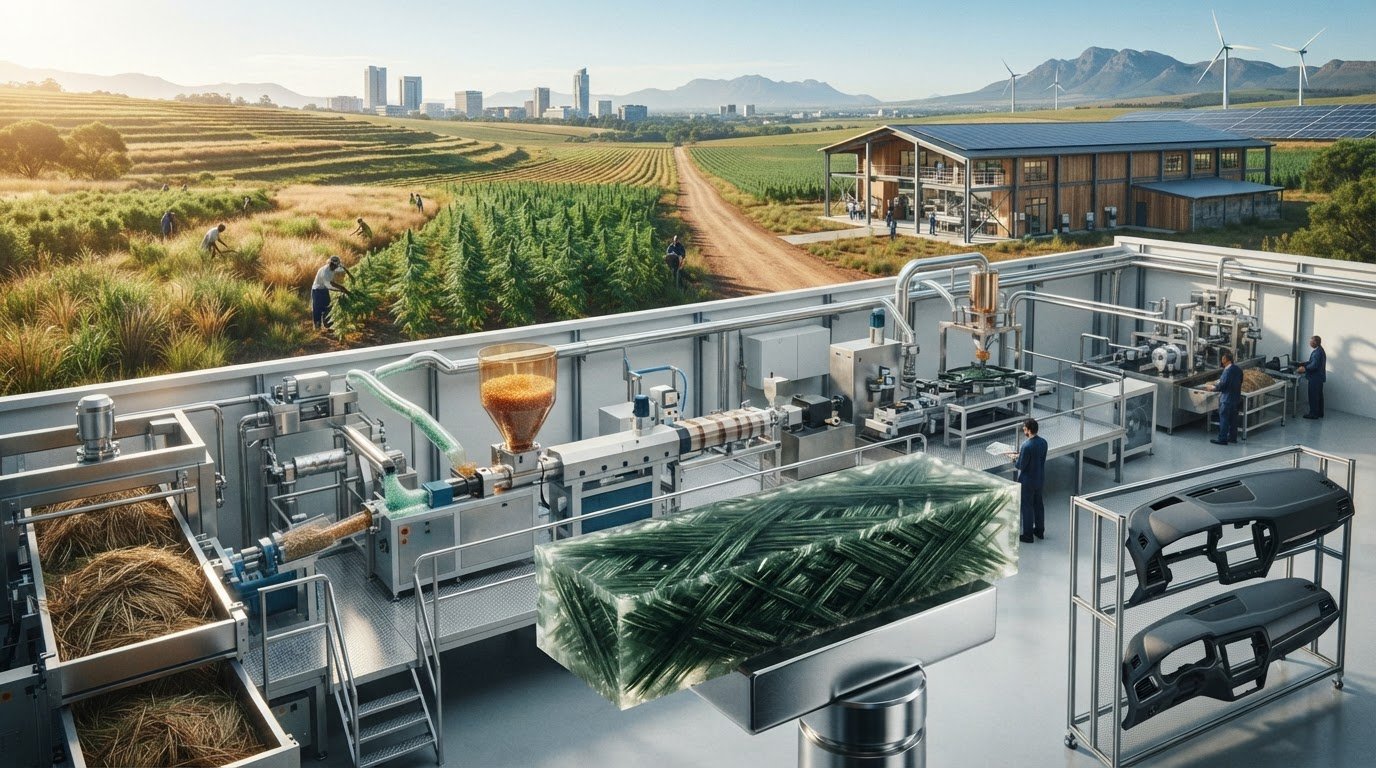
Manufacturing method also affects the result. Extrusion is the most widely used processing technique for biocomposites, principally for green biocomposites. The process forms material by pushing it through a shaped opening, so the formulation and profile are central to the output. Other product designs may need a different forming method. In each case, fibre compatibility, matrix behaviour and component geometry shape production decisions. An AZL Institute study found that biocomposites can replace standard fibres in many technical products, making formulation and processing key to assessing potential applications.
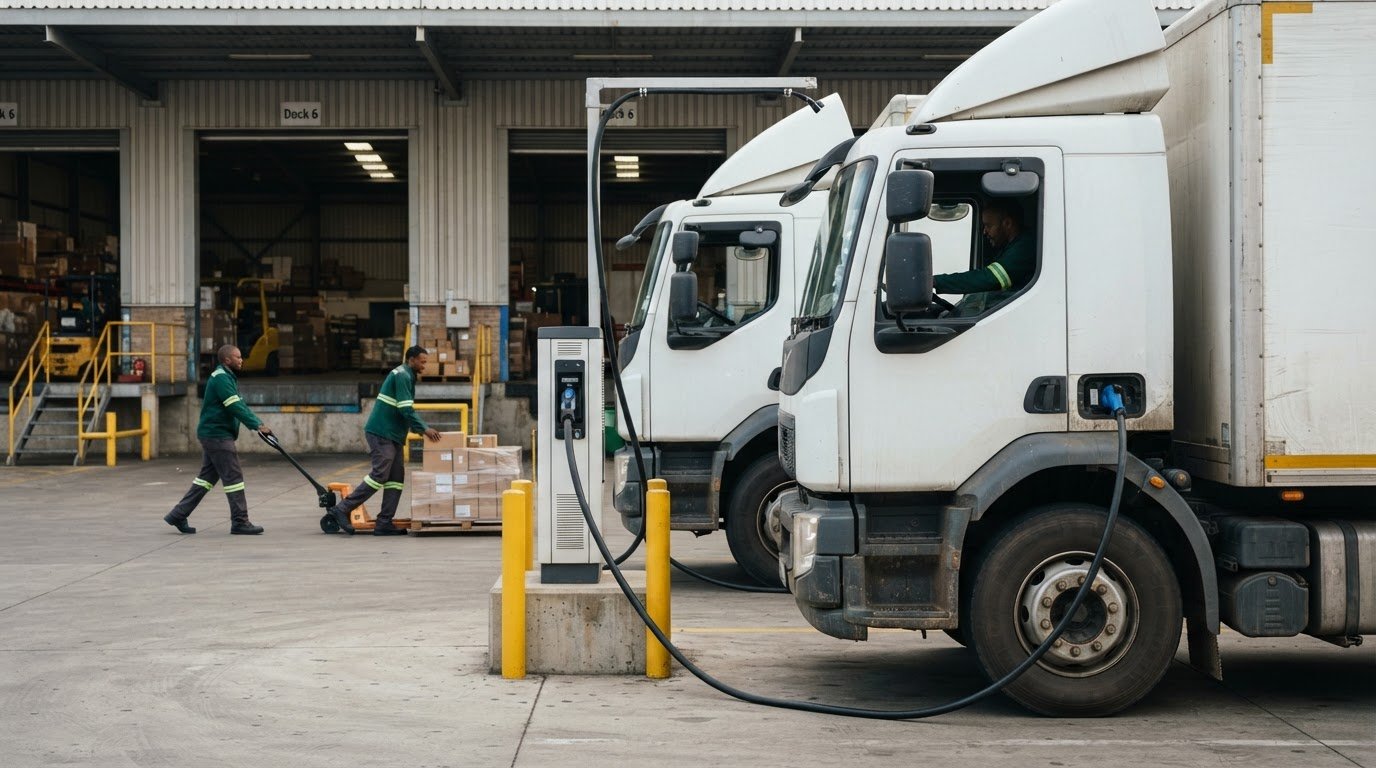
For South African organisations assessing vehicle materials alongside electrification, an Electric Vehicle Ecosystem provides a related infrastructure context.
Environmental benefits and fossil-resource substitution
Biocomposites can replace some fossil-derived material inputs with biological feedstocks. In packaging, they offer alternatives to conventional plastics; wood, corn starch, sugar cane and vegetable waste from fat or paper production can supply biopolymer inputs. The commercial case is material substitution, not an automatic environmental benefit. Performance, manufacturing requirements and end-of-life treatment determine whether the alternative suits a product system.
Replacing fossil-derived inputs
Start substitution by identifying which part of a product relies on fossil-derived plastic or reinforcement. A packaging component, for example, can be assessed for a biopolymer matrix made from corn starch or sugar cane. Wood and vegetable waste from fat or paper production are other potential feedstocks. The selected input must still meet the product’s processing and performance requirements. Biological origin alone does not establish that a material is a suitable industrial replacement.
Packaging and material performance
Packaging shows the practical balance between replacing conventional plastic and retaining product function. A biocomposite formulation may offer biodegradability and can have improved mechanical properties compared with traditional plastics. Biocomposites are also associated with strength, rigidity, insulation and low density. These characteristics do not apply equally to every formulation. Manufacturers need to match material properties to the packaging’s purpose, including its required protection, handling and production process.
Feedstock selection also shapes substitution decisions. Wood, corn starch and sugar cane are biological sources for biopolymers, while vegetable waste from fat or paper production can provide another input route. Each option has a different supply and processing chain. Compare the finished material, not just the origin of one ingredient. This helps manufacturers assess whether a feedstock can meet product specifications and production needs.
End-of-life and environmental assessment
Biodegradability is a material property, not proof that every product will break down in every disposal setting. The matrix, reinforcement, additives and product form influence end-of-life handling. A packaging item made with a biopolymer therefore needs assessment as a complete product. Manufacturers should consider how the material is collected, processed and treated after use, alongside its function during service. Without that system-wide view, feedstock substitution alone gives an incomplete picture of environmental performance.
Industrial assessment should connect material choice to the product lifecycle. For packaging, define the function first, select a candidate feedstock such as sugar cane or wood, then assess processing, durability and end-of-life routes. Compare the finished biocomposite with the conventional plastic it could replace. This distinguishes measurable material performance from broad environmental claims. It also shows where a biological input offers a workable substitution and where formulation or disposal requirements remain decisive.
For South African manufacturers, assess feedstock availability, manufacturing compatibility and end-of-life pathways together. A biocomposite’s low density or insulation properties may support a particular design, while its matrix and reinforcement determine how it performs after manufacture. The aim is not to label a material sustainable because of its origin. It is to establish whether a defined product can use biological inputs without compromising its required function or creating an unsuitable end-of-life outcome.
Natural-fibre reinforcement and resin matrices
Natural-fibre composites rely on two components working together: reinforcing fibres and a resin matrix. Flax fibres, for example, carry loads within a shaped part, while resin binds the fibres and transfers stress between them. The matrix also influences the finished component’s surface and resistance to its operating environment. Engineers select the combination for the part’s function, not simply for the fibre’s biological origin.
Fibre geometry determines how reinforcement contributes to a component. Length, orientation and distribution affect how forces pass through flax or hemp fibres. Fibres aligned with a principal load can reinforce that direction, while other orientations may suit a part exposed to varied stresses. Short fibres and woven fabrics offer different design options. For a vehicle panel or furniture component, engineers match fibre architecture to shape, loading and manufacturing requirements.
The resin matrix sets another boundary. Thermoplastic matrices soften when heated and can be reshaped during processing; thermosetting resins cure into a network that does not remelt in the same way. These matrix types affect forming, repair and end-of-life considerations. A flax-reinforced thermoplastic part and a flax-reinforced thermoset part are different formulations. Their matrix chemistry influences both processing conditions and the finished composite’s behaviour.
Moisture management is a core design variable for natural fibres. Flax and hemp can absorb moisture, causing fibre swelling and potentially weakening the interface between reinforcement and resin. A poorly bonded interface can reduce effective load transfer. Manufacturers can address this through fibre drying, compatible surface treatments and controlled resin wetting. These process controls matter especially for components exposed to damp conditions, such as exterior trim.
Fibre selection must also reflect mechanical demands. Jute has lower mechanical strength than hemp or flax and may be more sensitive to moisture. Fibre choice therefore matters: a light-duty interior panel has different requirements from a component carrying sustained loads. Resin compatibility, fibre quality and orientation then affect how effectively the reinforcement performs. Testing the complete composite provides a more useful basis for selection than evaluating loose fibres alone.
For South African manufacturers, material qualification should link the formulation to the intended component and production route. First define the part’s loads, moisture exposure, shape and surface requirements. Then specify the fibre, matrix and interface treatment, and assess the resulting composite against those conditions. Changing from flax to hemp, or from thermoplastic to thermoset resin, can alter processing and performance. Consistent input quality and documented production controls help maintain repeatable component behaviour.
Applications in transport, aircraft, construction and infrastructure
Application fit depends on a component’s function, not simply the sector using it. A transport panel, aircraft interior part, building product and public seating unit each face different loads, exposure and maintenance demands. For South African projects, assess whether the material can meet those requirements within the existing manufacturing and asset-management system. Evaluate biocomposite materials for industrial use against a defined component specification, rather than selecting by category alone.
In transport, engineers can assess biocomposites for non-primary components, where density, stiffness and geometry shape material selection. Vehicle interiors provide a practical example: door panels, dashboards and seats have distinct forms and operating conditions. Aircraft applications require equally careful assessment. Interior panels and fittings can be evaluated according to their structural role, exposure and fire-performance requirements. Natural-fibre composites are not universal replacements for every metal or conventional composite part.
Construction offers another area for evaluation. Wood-fibre-reinforced plastics have long been used in decking boards and fences, where manufactured profiles become building products. Assessment should consider moisture exposure, loading, surface finish and maintenance throughout the asset’s use. A decking profile and a structural building component are not equivalent applications. Engineers must match formulation and production method to each product’s function and expected service conditions.
Infrastructure projects extend the decision beyond material properties. Seating, fittings and other repeated components can be assessed within a larger public-asset system. Sustainable seating infrastructure, for example, depends on performance and service requirements, not composition alone. Procurement teams can define use conditions, maintenance expectations and replacement planning before comparing candidate materials. This creates a clearer basis for deciding whether a biocomposite suits the infrastructure application and its operational demands.
Across aircraft, buildings and transport, the selection process follows the same logic. Define the component’s function and operating environment, then identify its load, moisture, thermal and fire-performance demands. Assess fibre, resin, manufacturing route and maintenance together. A fencing profile may need a different formulation from an aircraft fitting, even if both contain natural fibres. Component-level testing and production controls support repeatable performance. Biocomposite materials for industrial use are most compelling when they meet a clear specification and fit the production process.
The practical takeaway is to specify the application before selecting the material. South African asset owners and manufacturers can begin with one component, define its functional requirements, and assess whether a biocomposite meets them. For public seating projects, discuss sustainable seating infrastructure as part of the wider asset requirement, rather than treating material choice as an isolated procurement decision.
Greenovations Venture Studio: Drone-Powered Industrial Intelligence (GII)
Greenovations offers Drone-Powered Industrial Intelligence (GII) for organisations assessing industrial operations and infrastructure decisions. Where biocomposite adoption forms part of a wider industrial project, GII brings operational intelligence into material and asset planning. Greenovations also develops and commercialises Biocomposite Materials, connecting this topic to an industrial solution rather than treating fibre selection as an isolated decision. Its No-CAPEX model deploys solutions without requiring upfront capital from partners. Contact Greenovations to discuss your industrial priorities and align material choices with your project’s operational requirements.
Move from material assessment to project definition
Turn material interest into a defined project decision. Identify the component, its operating conditions and the performance evidence required for adoption. Then assess production fit, asset requirements and end-of-life handling together. This gives procurement and engineering teams a shared basis for deciding whether biocomposite materials for industrial use belong in a specification, a trial or a later investment phase.
Greenovations connects this material focus with wider infrastructure and industrial requirements through Drone-Powered Industrial Intelligence (GII), an Electric Vehicle Ecosystem and Sustainable Seating Infrastructure-as-a-Service. These offerings serve distinct operational contexts, giving organisations a way to consider materials alongside assets and deployment needs.
Set out the project requirement and its decision criteria, then contact Greenovations Venture Studio to discuss the relevant next step. A disciplined project definition creates a stronger foundation for implementation.
Frequently Asked Questions
What are the advantages of this?
Biocomposites can combine low density, strength, rigidity and insulation, and some formulations are biodegradable. Their advantages depend on the component and its operating demands, not the material label alone. The AZL Institute study found that biocomposites can replace standard fibres in many technical products. For manufacturers, this makes them worth assessing where the product specification allows substitution without compromising required function.
What areas of application are there for these composites?
Applications span automotive production, packaging, construction, technical textiles and biomedical engineering. Jute, for example, is used in packaging and technical textiles, while wood-fibre-reinforced plastics feature in decking and fencing. Biocomposites also appear in tissue-engineering scaffolds and drug-delivery systems. Emerging uses include advanced wound-healing materials and biodegradable electronics. Each field has different requirements for mechanical performance, exposure and end-of-life handling, so the application determines the relevant formulation.
Which natural fibres and bio-based resins are used in industrial biocomposites?
Common natural reinforcements include flax, hemp, jute and wood fibres. Biopolymers can be made from wood, corn starch, sugar cane or vegetable waste from fat or paper production. These feedstocks can inform bio-based matrix choices, but they do not identify a single resin suitable for every fibre or product. Manufacturers select reinforcement and matrix together, considering compatibility, moisture exposure, processing method and the finished component’s performance requirements.
What are the main industrial applications of biocomposites in automotive, construction, packaging and consumer goods?
Automotive manufacturers use biocomposites in interior parts, while construction products include decking boards and fences made from wood-fibre-reinforced plastics. Packaging applications include alternatives to conventional plastics. Consumer goods can also use natural-fibre composites where product design and performance requirements suit them. The same material isn’t automatically suitable across all four sectors: a packaging format and a durable building profile face different demands for strength, exposure and product life.
What equipment and manufacturing processes are needed to make industrial biocomposites?
Equipment depends on the formulation and product shape. Extrusion is the most widely used processing technique for biocomposites, principally for green biocomposites. An industrial line typically feeds and mixes material before forcing it through a shaped die; the resulting profile can then be cooled and cut to specification. Other forms may require different equipment. Fibre preparation, resin compatibility and process control influence whether production delivers consistent material distribution and component quality.
What are the environmental impacts and life-cycle benefits of biocomposites compared with conventional materials?
Biocomposites can substitute biological feedstocks for some fossil-derived inputs, and some formulations are biodegradable. Neither property alone establishes a lower total environmental impact than a conventional material. A life-cycle comparison should account for feedstock sourcing, processing, transport, product durability, maintenance and end-of-life treatment. Packaging made with a biopolymer, for example, needs assessment as a complete product and within its disposal pathway, not solely by its material origin.
Visual summary
Planning a project like this?
Talk to the Greenovations venture desk about a No-CAPEX structure.