A natural fibre alone does not make a biocomposite. Biocomposite materials in South Africa combine reinforcing fibres with a polymer matrix, which may be conventional or bio-based; the choice of materials and how they bond shape the finished product’s performance. The value chain runs from fibre and polymer feedstocks through processing into applications such as components, panels and consumer goods.
The distinction matters: bio-based inputs don’t automatically make a material biodegradable, moisture-resistant or suitable for every use. South African research is testing how locally relevant materials and formulations perform, while the Biorefinery Industry Development Facility was established in 2017.
This article explains how biocomposite materials in South Africa are structured, how fibres and polymers move through the value chain, and where these materials are used. It also examines South African research and facilities, helping you connect technical choices with production and end-use requirements.
Key Takeaways
- Assess biocomposites by their intended function: non-functional vehicle components can offer a practical application route where structural performance is not the primary requirement.
- Compare fibre type, polymer matrix and fibre-matrix bonding, since these design choices influence strength, processing and moisture response.
- Trace how agricultural residues move from feedstock into processed fibres and finished materials, while accounting for consistency and end-of-life requirements.
- Identify where automotive, construction and consumer-goods applications place different demands on material performance and production.
- Explore how South African biomaterials research and facilities are addressing the gap between laboratory formulations and industrial use.
What is the Biocomposites Market Size?
A biocomposite combines reinforcing material with a surrounding matrix to form an engineered composite. The reinforcement may be a natural fibre, such as wood or flax, while the matrix may be synthetic polypropylene or a bio-based polymer. Global market growth does not establish a South African market value, but it does highlight why manufacturers assess feedstock, processing and end-use performance together.
Market indicators show expanding applications rather than one uniform material category. Transportation accounted for about 29% of global biocomposites market revenue in 2024, whilst green biocomposites accounted for 61%. Transportation was also the dominant application segment in 2025. These figures describe the global market, not South African sales, and demonstrate the importance of vehicle components as an application area.
Wood-fibre composites use material such as wood flour or wood fibre within a polymer matrix. Non-wood alternatives include agricultural fibres, which can be selected for a specific component or production process. Wood fibre held the largest share over the 2023-2033 forecast period. The distinction matters: fibre dimensions, consistency and matrix compatibility affect manufacture and the component’s mechanical behaviour.
Green and hybrid composites differ in their feedstocks. A green composite uses bio-based reinforcement, a bio-based matrix, or both; a hybrid combines bio-based and conventional inputs. For example, natural fibre in polypropylene makes a hybrid, not a fully bio-based composite. PLA reinforced with bamboo fibre is described as compostable under industrial conditions, illustrating why composition alone does not determine disposal performance.
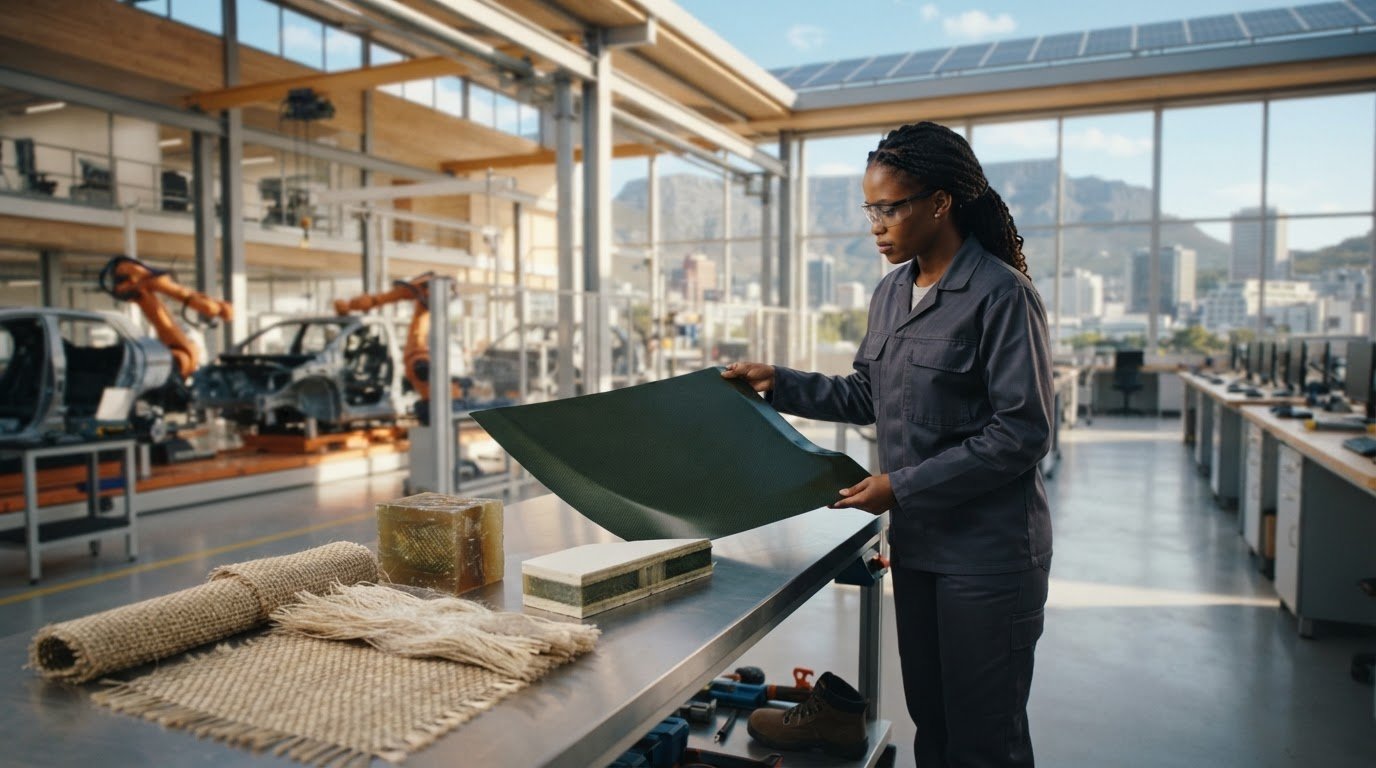
In South African vehicle manufacturing, biocomposites could suit non-functional interior components such as door trim, parcel shelves and headliner panels. Because these parts do not carry primary structural loads, material selection can prioritise weight, fit, surface finish and durability. Fibre composites can also provide acoustic or thermal insulation. Moisture sensitivity and variation in natural-fibre quality remain important considerations for consistent production.
Biocomposites have no universal cost or performance advantage over conventional plastics and fibre-reinforced composites. Cost and performance depend on fibre supply, polymer choice, processing, fibre-to-matrix bonding and component specifications. Conventional materials may remain better suited to demanding loads or environments.
No single standard or regulation applies to every biocomposite product in South Africa. Requirements depend on the product’s intended use and claims, so vehicle trim and material marketed as biodegradable raise different compliance considerations.
Biocomposite material prices in South Africa depend on the fibre, polymer, formulation, processing and order specification. A market-wide figure would not capture the difference between a wood-fibre polypropylene compound and a specialised bio-based formulation.
Fibre reinforcement and polymer matrices
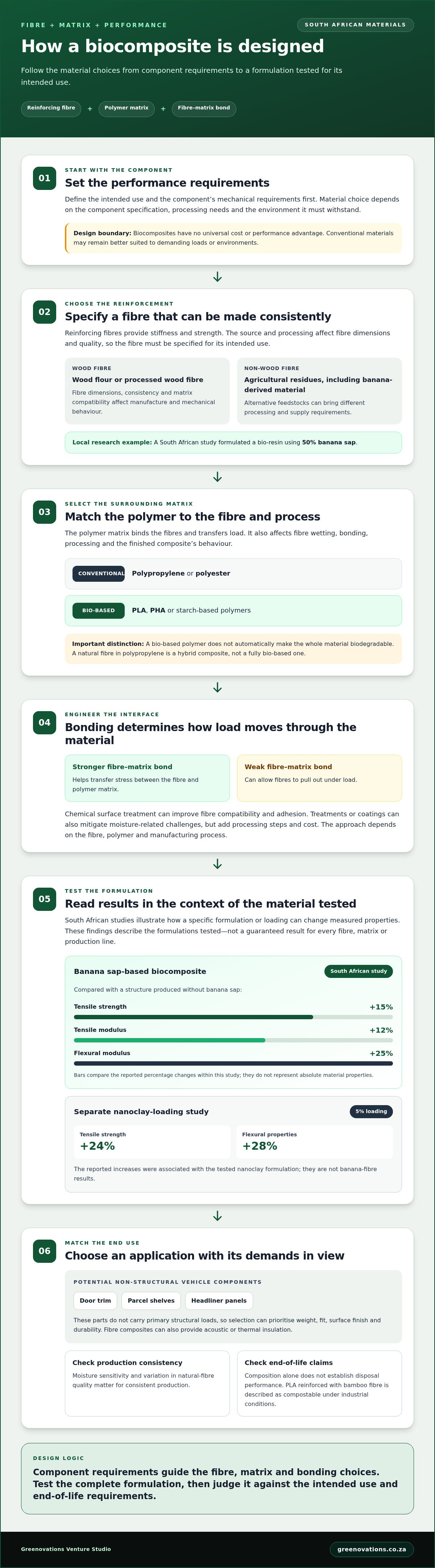
Fibre reinforcement provides stiffness and strength, while the polymer matrix binds the fibres and transfers load. Their interface, composition and processing determine the material’s mechanical performance.
Fibre treatment and adhesion
Chemical treatment modifies a fibre’s surface to improve compatibility and adhesion with a polymer matrix. Stronger fibre-to-matrix bonding helps transfer stress; weak bonding can allow fibres to pull out under load. Treatment depends on the fibre, polymer and manufacturing process. Surface treatments and coatings can also mitigate moisture-related challenges, but they add processing steps and cost. These trade-offs affect production control and the finished component’s environmental profile.
Wood, non-wood and banana fibres
Wood fibres include wood flour and processed wood fibre, whilst non-wood reinforcement can use agricultural residues, including banana-derived material. Fibre dimensions and quality vary with source and processing, so the material must be specified for its intended use. A South African study formulated bio-resin using 50% banana sap, an example of locally relevant feedstock entering composite development. Compared with wood fibre, non-wood options can create different processing and supply requirements.
Polymer matrices include conventional polymers such as polypropylene and polyester, as well as bio-based options such as PLA, PHA and starch-based polymers. The matrix affects fibre wetting, bonding, processing and the finished composite’s behaviour. A bio-based polymer does not automatically make the whole material biodegradable. Performance depends on the complete formulation and how it is processed.
Measured results show how formulation changes performance. In a South African study, a banana sap-based biocomposite had 15% higher tensile strength and 12% higher tensile modulus than a structure produced without banana sap. Its flexural modulus was 25% higher. These results demonstrate the potential of the formulation tested, not a universal outcome for every fibre, matrix or manufacturing line.
Reinforcement loading also matters. In a South African study, 5% nanoclay loading was associated with a 24% increase in tensile strength and a 28% increase in flexural properties. Those figures concern the tested formulation, not banana fibre specifically. For material selection, compare fibre type, matrix, loading and adhesion against the component’s mechanical requirements.
For project teams translating these variables into production choices, industrial biocomposite applications provide a relevant area to explore. The decisive step is matching fibre and polymer design to processing capability and end-use requirements.
Natural-fibre and biodegradable-polymer value chain
A viable biocomposite value chain connects agricultural or forestry feedstock to a specified material and end use. Each stage affects consistency, strength, manufacturing requirements and end-of-life handling.
Biomaterials and biocomposites value chains
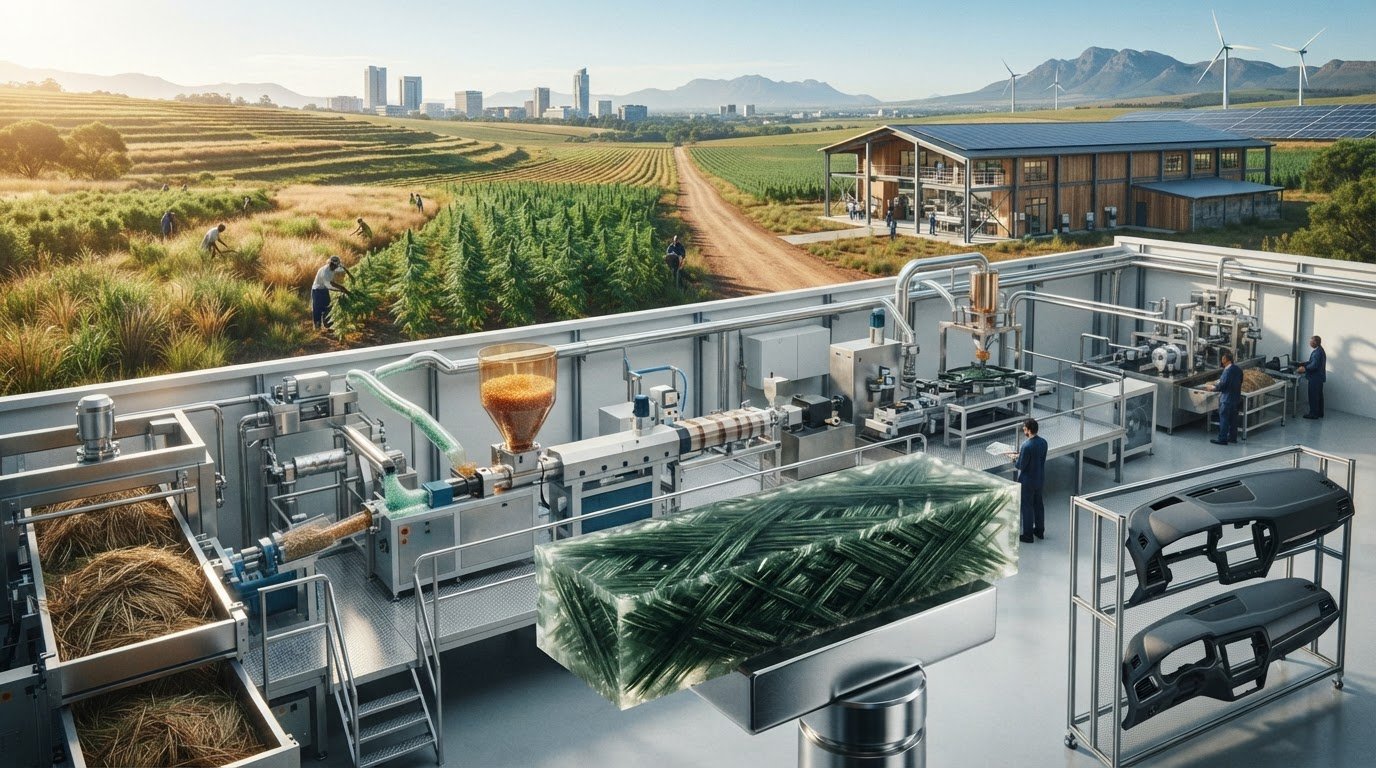
The biomaterials chain converts biological feedstocks into usable materials. The biocomposites chain combines reinforcement and a matrix, then fabricates components. For a natural-fibre composite, this could mean collecting residues, grading and processing fibres, compounding them with a polymer, and forming a product such as a vehicle interior panel.
Each hand-off creates a quality-control requirement. Growing conditions, harvest timing and processing influence fibre properties, while binder type, fibre dimensions, fibre-to-binder ratio and adhesion affect the final material. A sustainable commercial model therefore needs defined feedstock specifications, repeatable processing and an application that can consistently use the resulting material.
South Africa’s action plan assigns 44 months to the NCPC-led feedstock-matching intervention and 51 months to the TIA-led bridge-funding intervention for biomaterials research. It also allocates 21 months to identifying priority clusters of platform biochemicals. These interventions address separate points in the chain: connecting supply with demand, bridging research funding, and identifying chemical building blocks for further development.
A biodegradable polymer does not mean a finished composite will break down in every environment. Fibre, matrix, additives, product thickness and disposal conditions all affect degradation. Many biocomposites require industrial composting facilities to break down effectively, and landfill conditions may not produce that outcome. End-of-life planning must match the actual formulation and available waste route.
Sourcing and testing materials
To source materials, first define the intended application and specify fibre and polymer requirements. Then match those requirements to feedstock and processing capacity in South Africa. Before making production decisions, test samples against the component’s mechanical, moisture and manufacturing demands.
For a vehicle component, for example, assess fibre consistency, matrix compatibility, strength retention and behaviour during forming. Record the material formulation and processing conditions alongside each result. Otherwise, a comparison may reflect different manufacturing inputs rather than a meaningful difference between materials.
Processing connects the supply chain to repeatable production. Fibre preparation controls dimensions and moisture; compounding distributes reinforcement through the polymer; fabrication shapes the compound into a part. Each stage can affect adhesion and mechanical performance, so specifications should follow the material through production, not stop at feedstock acceptance.
South Africa’s action plan assigns 42 months to the CSIR-led biomaterials centre-of-excellence intervention and 60 months to CSIR-led support for pilot biorefineries. It schedules six months for establishing the Biorefinery Development Facility as a virtual Centre of Excellence. These measures connect research, pilot processing and scale-up, while businesses still need application-specific material specifications and test evidence.
Automotive, construction and consumer-goods applications
Biocomposites enter applications where their properties match the component, not simply because fibres are natural. Transportation accounted for about 29% of global market revenue in 2024, and was the dominant application segment in 2025. For South African manufacturers, the relevant opportunity is assessing components against weight, strength, finish, moisture exposure and existing production processes.
In automotive manufacturing, natural-fibre composites can be considered for non-structural interior parts such as trim panels, parcel shelves and headliners. Since these components are not primary load-bearing structures, designers can prioritise low weight, acoustic performance and a consistent surface. The material must still meet the part’s fit, durability and processing requirements. It is an option for selected components, not a universal substitute for synthetic plastics or structural composites.
Construction applications have different performance criteria. Natural-fibre composites can provide thermal or acoustic insulation in panels and interior finishes. Mycelium composites, grown in moulds, are used in acoustic panels and experimental building materials. An interior acoustic panel has different demands from an element exposed to moisture or repeated mechanical loads. Agricultural fibres can provide reinforcement, but manufacturers need to manage feedstock variation.
Consumer applications include packaging, furniture components and moulded goods. Mycelium can grow into a mould, making it relevant to packaging forms and experimental products. Fibre-reinforced polymer components may also suit seating parts, housings or reusable product casings, where designers can specify the required finish and strength. The end-of-life route must match the product’s complete composition: bio-based content alone does not establish that it will biodegrade in its disposal environment.
Start application selection with the part’s function. A practical assessment compares the incumbent material with the proposed composite across:
- Load and weight: define whether the part carries force or mainly provides a finish, enclosure or support.
- Exposure: assess moisture, temperature and wear, particularly for vehicle interiors and building panels.
- Manufacturing: establish whether the compound can be formed using the available process and achieve the required dimensions.
- End of life: align fibre, polymer and disposal route before describing a product as biodegradable.
These criteria help distinguish technically suitable uses from speculative substitution. A vehicle trim panel, an acoustic construction panel and a consumer package may all contain natural fibres, but each needs its own material specification and performance evidence. In South Africa, match local feedstock and manufacturing capability to a defined part, then evaluate the finished product against its operating conditions.
South African biomaterials research and facilities
South African biomaterials research connects laboratory formulations with feedstock development, pilot processing and industrial applications. Its value lies in testing material properties against the requirements of manufacturing, packaging and building materials.
Research and facilities
The Biorefinery Industry Development Facility was established in Durban in 2017 to support biomaterials research and development. South Africa’s action plan also assigns 42 months to the CSIR-led biomaterials centre-of-excellence intervention and 60 months to CSIR-led support for pilot biorefineries. Together, these initiatives address research capability and the transition from laboratory work towards production processes.
The plan also targets supply coordination and commercial development. It assigns 44 months to the NCPC-led feedstock-matching intervention, 51 months to TIA-led bridge-funding for biomaterials research, and 55 months to the dti-led industry-partnership intervention. These measures address distinct value-chain constraints: matching a feedstock to users, supporting research between stages, and connecting industry with biomaterials development.
Standards and skills form another part of this infrastructure. The action plan assigns 55 months to the DAFF-led development of new biomaterials and feedstock standards, alongside 12 months for the SABS-led adaptation of existing biomaterials standards. It also schedules 27 months for university and college training programmes. For manufacturers, clear specifications and technical skills help translate material properties into repeatable production requirements.
Environmental benefits and life-cycle impacts
Biocomposites made with renewable fibres can use agricultural by-products, reduce reliance on fossil resources and help mitigate lignocellulosic waste. Their full life-cycle impact also depends on processing, product life and disposal conditions, not just bio-based content.
A South African study recorded 17.6% biodegradation for a banana sap-based biocomposite over 55 days, compared with 8% for the control composite. These results describe the materials and test period studied; they do not establish breakdown in every setting. Many biocomposites need industrial composting facilities to degrade effectively, and landfill conditions may not provide that route.
Production and adoption challenges
Production risks include inconsistent natural-fibre quality, moisture absorption, swelling and reduced mechanical properties. Growing conditions, harvest timing and processing affect fibre consistency, while surface treatments can add manufacturing steps and cost. These variables make feedstock specifications, process control and application-specific testing essential for reliable scale-up.
Adoption also depends on matching a material to an actual use and an end-of-life route. A renewable fibre does not by itself establish biodegradability, and a biodegradable formulation does not remove the need for suitable processing or disposal infrastructure. South African research and facilities matter because they can connect material properties, feedstock standards and pilot production. Explore biocomposite materials for industrial applications when assessing how these materials could fit a defined production requirement.
Greenovations Venture Studio: Drone-Powered Industrial Intelligence (GII)
Greenovations Venture Studio offers Drone-Powered Industrial Intelligence (GII) to help organisations assess industrial operations. Biocomposite adoption depends on more than material selection: project teams also need a clear view of operating requirements and implementation context. When industrial intelligence is relevant to that assessment, GII can support the next step alongside consideration of biocomposite applications.
Turn to GII when your organisation needs drone-powered intelligence to inform industrial decision-making. It provides industrial intelligence, not a biocomposite material specification or a substitute for application-specific material testing.
To discuss your industrial requirements, visit greenovations.co.za.
Turn material potential into an industrial decision
Frame biocomposite materials in South Africa around a defined operational requirement, not a broad sustainability target. First identify the component, performance criteria, feedstock pathway and production constraints. This gives technical teams and decision-makers a shared basis for deciding whether development should advance, pause or move into a controlled pilot.
Greenovations Venture Studio’s offerings address distinct industrial needs: Drone-Powered Industrial Intelligence (GII), an Electric Vehicle Ecosystem and Sustainable Seating Infrastructure-as-a-Service. Each serves a different operational context, so begin the discussion with the problem your organisation is solving rather than assuming the services are connected.
For organisations evaluating materials alongside wider industrial transformation, the useful next move is a focused conversation about scope, interfaces and implementation priorities. Contact Greenovations Venture Studio to discuss the opportunity. A disciplined brief gives the conversation a practical starting point and helps keep the next decision grounded in your operational requirements.
Frequently Asked Questions
Bio-composite Materials - What Are They?
A biocomposite is an engineered material that combines reinforcement, such as plant fibre, with a matrix that binds it into a usable form. For example, a manufacturer could combine natural fibres with polypropylene to produce a composite part. The term describes the material’s composition, not a guaranteed environmental outcome. To assess a product, identify its fibre, matrix, additives and intended disposal route.
What are biocomposite materials and their main types?
Biocomposites are commonly grouped by their reinforcement and matrix. Wood-fibre composites use wood particles or fibres; non-wood versions use plant fibres or agricultural residues. A hybrid pairs bio-based reinforcement with a conventional polymer, while a composite using bio-based inputs for both is sometimes called fully green. These categories clarify material composition, but processing and end-use requirements still determine suitability.
Which biocomposite materials are manufactured or researched in South Africa?
Research into biocomposite materials in South Africa includes banana sap-based bio-resin formulations and nanoclay-enhanced composites. One South African study used banana sap in its resin formulation, while another reported changes in mechanical properties associated with nanoclay loading. These are research formulations, not evidence that every material is manufactured at commercial scale. This distinction matters when assessing a material for a production specification or procurement plan.
What natural fibres and agricultural waste are used in South African biocomposites?
South African biomaterials research considers agricultural residues and banana-derived inputs, including banana sap used in a bio-resin formulation. Agricultural residues can provide lignocellulosic material for processing into reinforcement, but the specific feedstock determines fibre characteristics and manufacturing requirements. Growing conditions, harvesting and preparation affect consistency. For procurement, distinguish a studied feedstock from a material already available as a standard commercial input.
Who are the South African biocomposite manufacturers, suppliers, and research institutions?
Named South African biomaterials initiatives include the CSIR-led centre-of-excellence and pilot-biorefineries interventions, alongside TIA-led bridge funding for research. The action plan also identifies NCPC-led feedstock matching and SABS-led standards adaptation. The Biorefinery Industry Development Facility is another relevant research facility. These organisations and initiatives support research, coordination or standards work; they should not automatically be treated as commercial manufacturers or suppliers.
What are the applications of biocomposites in South Africa, including construction, automotive, and packaging?
Biocomposites can be considered for non-structural automotive interior parts, acoustic or thermal construction panels, and packaging. Mycelium composites, for example, are used in packaging and acoustic panels, as well as experimental building materials. Application selection depends on required strength, moisture exposure, finish and manufacturing process. A packaging insert and a vehicle trim panel have different operating demands, so each needs its own material and performance specification.
Visual summary
Planning a project like this?
Talk to the Greenovations venture desk about a No-CAPEX structure.