
A biocomposite isn’t automatically biodegradable or plastic-free. The biocomposite vs plastic choice depends on composition: a biocomposite combines materials, often a plastic matrix with renewable fibres, while conventional plastic is typically made from fossil-based feedstocks. Whether it biodegrades depends on its formulation and end-of-life conditions.
A renewable filler alone doesn’t determine how a product performs or breaks down. A bio-based label also doesn’t guarantee lower cost or longer service life. Material choice, processing needs, operating conditions and end-of-life options all shape the commercial case.
This biocomposite vs plastic comparison explains how the materials differ in feedstocks, biodegradability, durability and resistance. It also covers practical considerations behind cost and suitability, helping you assess which material fits an application rather than relying on labels alone.
Key Takeaways
- Assess biodegradability by the material’s full composition and the conditions available at end of life, not by its bio-based label alone.
- Match the composite’s matrix and natural reinforcement to the application, since a renewable filler does not guarantee plastic-free content or suitable performance.
- Compare feedstocks and manufacturing requirements to understand where material choice may affect cost and supply decisions.
- Weigh moisture, heat, UV exposure and expected service life when evaluating durability, as resistance varies with the material design and operating environment.
- Consider repair, reuse and recycling alongside disposal when deciding whether a material fits the product’s full lifecycle.
Bio-based biocomposite that biodegrades - complex or not?
Biodegradability depends on formulation and disposal conditions, not simply on whether a material is a biocomposite. A biocomposite vs plastic assessment should compare the application, material composition, manufacturing process and realistic end-of-life route.
Matching materials to applications and disposal
Choose a material by matching its performance to the product’s composition and practical disposal route. A renewable filler doesn’t make a plastic matrix biodegradable. A durable outdoor component and compostable packaging have different performance and end-of-life needs. Start with the intended use, then consider whether repair, reuse, recycling or suitable composting is feasible where the product will be discarded.
Biodegradable materials and manufacture
Biodegradable plastics are formulated to break down under particular environmental conditions. They may be made with plant-derived polymers, such as corn-starch-based plastic, and natural fibres or cellulose can reinforce a bioplastic matrix. Reinforcement can broaden potential applications, but it doesn’t show how quickly the finished product will break down. Processing and disposal conditions both matter.
Used coffee grounds illustrate how feedstock choices shape a formulation. A patent describes bioplastic cup mixtures containing 10 to 60% used coffee grounds by weight, alongside mixtures containing 10 to 60% bioadhesive by weight. These are formulation ranges, not a universal recipe. Manufacturers must assess how the grounds affect moulding, strength and the product’s intended disposal route.
For compostable packaging, EN 13432 defines requirements for industrial compostability and specifies how testing must be carried out. That standard concerns packaging; it doesn’t establish that every biocomposite will biodegrade. In South Africa, distinguish material composition from evidence about compostability and the conditions required for breakdown.
There is no single fixed cost comparison for biocomposite materials and plastic in South Africa. Price depends on the specific case and is provided after a quote request. Key cost factors include feedstock, formulation, processing requirements, production scale and end-of-life handling. These variables shape the commercial case for choosing biocomposite or plastic.
Biocomposite plastics don’t readily degrade, so disposal shouldn’t be based on a bio-based label. In South Africa, consider the actual material and available end-of-life route. Repair and reuse can extend a product’s life; recycling depends on whether the material is compatible with the relevant recovery stream.
Biocomposite plastics can be processed through injection moulding, blow moulding and extrusion. Production requires control of pre-drying, melt temperature and shrink behaviour, because natural fillers can affect how a material flows and sets. These properties influence product quality and manufacturing efficiency, so a formulation suited to one process may not transfer directly to another.
What is Biocomposite Plastic?
A biocomposite combines distinct materials, including a matrix and a reinforcing component. Unlike conventional plastic, it contains at least one naturally derived phase, but that doesn’t necessarily make the finished material biodegradable.
Differences from conventional plastic
The main difference is composition: conventional plastic commonly uses a polymer matrix, while a biocomposite adds reinforcement such as wood fibre, bamboo or rice husk. The matrix binds and supports the reinforcement, which carries much of the load. Some biocomposites still use polyethylene, polypropylene, nylon or polystyrene, so “bio-based” doesn’t mean entirely free of fossil-derived plastic.
This distinction matters for specification and end-of-life planning. A fibre-filled polypropylene component remains a plastic composite, not automatically a compostable product. Definitions also vary: some include synthetic fibres or polymers, while narrower definitions require natural fibres and biopolymers. Compare the actual formulation and intended function, not just the material label.
Applications across industries
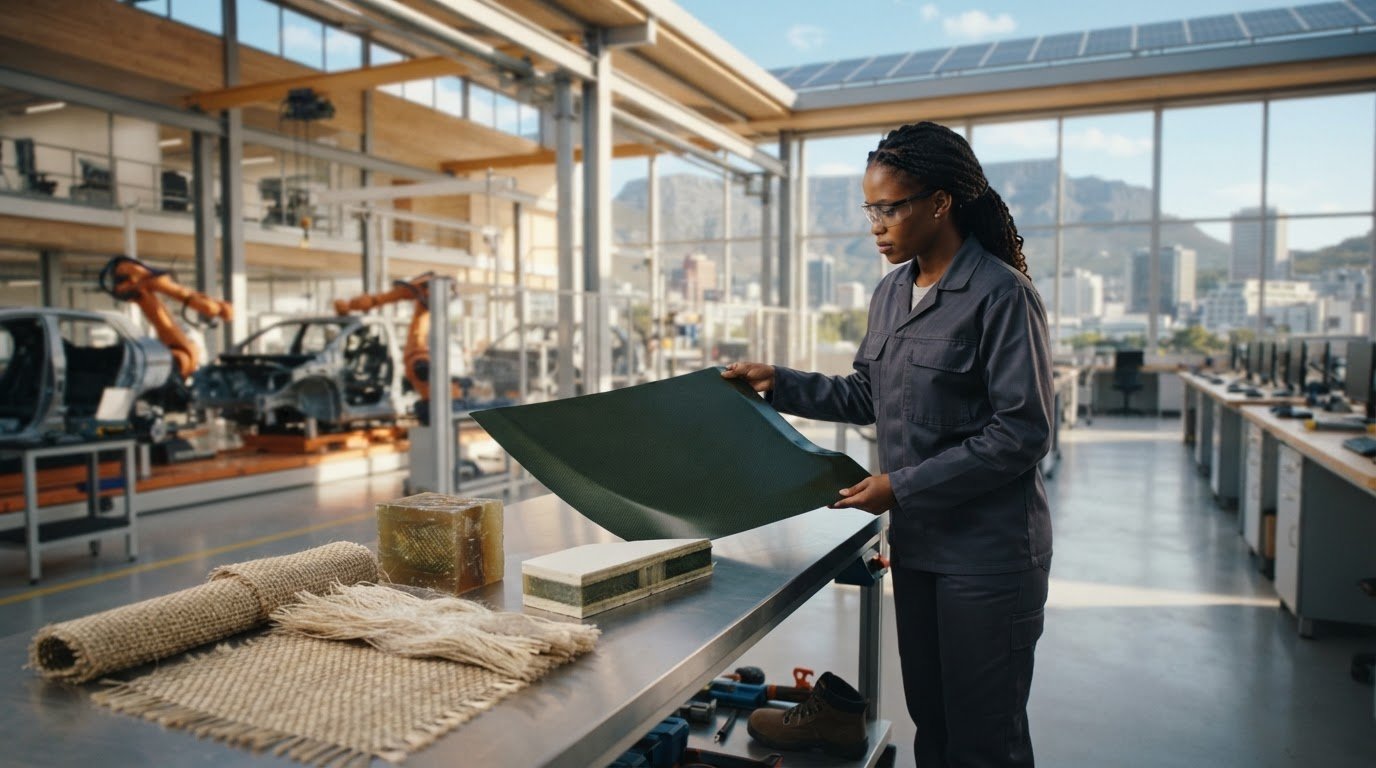
Automotive manufacturers use biocomposites in parts where low weight and strength are useful. Natural-fibre reinforcement can be used in interior or structural components, depending on the required mechanical performance. Key factors include load, heat exposure, moisture and manufacturing process. A formulation suitable for a vehicle component may not suit a load-bearing construction element.
In construction, biocomposites are used for decking, cladding and outdoor furniture. Each application places different demands on the material: decking faces repeated contact and weather exposure, while cladding must retain its shape on a building exterior. Fibre type and polymer matrix influence stiffness, surface behaviour and resistance. Product design should match the composite to its operating conditions.
Biocomposites are also used in electrical and electronic equipment, agricultural machinery and structural components. In biomedical applications, biological origin alone doesn’t establish suitability. The intended function, contact conditions and required mechanical performance determine whether a particular composite fits the use. These are application-specific design decisions, not properties shared by every biocomposite.
Biodegradable and potential packaging uses
Biodegradable plastics are used in single-use packaging, shopping bags, disposable utensils and cups. Plant-sugar-derived PLA is another example used in packaging and disposable items. Corn-starch-based plastics are also among biodegradable plastic types, but breakdown depends on the product’s formulation and the conditions available after use.
When selecting packaging, distinguish compostable materials from fibre-reinforced plastics designed for reuse or recycling. A biocomposite can contain natural reinforcement yet remain durable and non-biodegradable. This affects collection, sorting and disposal. For South African businesses, both material composition and the practical end-of-life route matter when specifying packaging.
Injection moulding allows manufacturers to form complex packaging and component shapes, while extrusion can produce continuous profiles. Biocomposites can use these manufacturing methods, but processing settings must suit the formulation. For application-specific material selection, biocomposite materials provide a relevant starting point for assessing composite options.
Renewable feedstocks and fossil-fuel alternatives
Biocomposites can reduce reliance on fossil-derived inputs, but renewable content alone doesn’t establish environmental performance. Feedstock selection, processing and end-of-life design all influence a material’s footprint.
Plastic recycling rates and alternatives
Material alternatives matter because only about 9% of plastic is recycled globally. That figure makes recycling design relevant, but it does not make renewable feedstock an automatic replacement. A biocomposite can combine bio-based fillers with a plastic matrix, so its recovery route depends on the complete formulation.
Designing for repair, reuse and recycling can support more circular use. Suitable recovery technologies and compatible material streams matter too. A product made from multiple components may need to be separated before recycling; a single-material design can simplify recovery. Assess expected service life and available recovery routes alongside feedstock.
Materials used in biocomposites
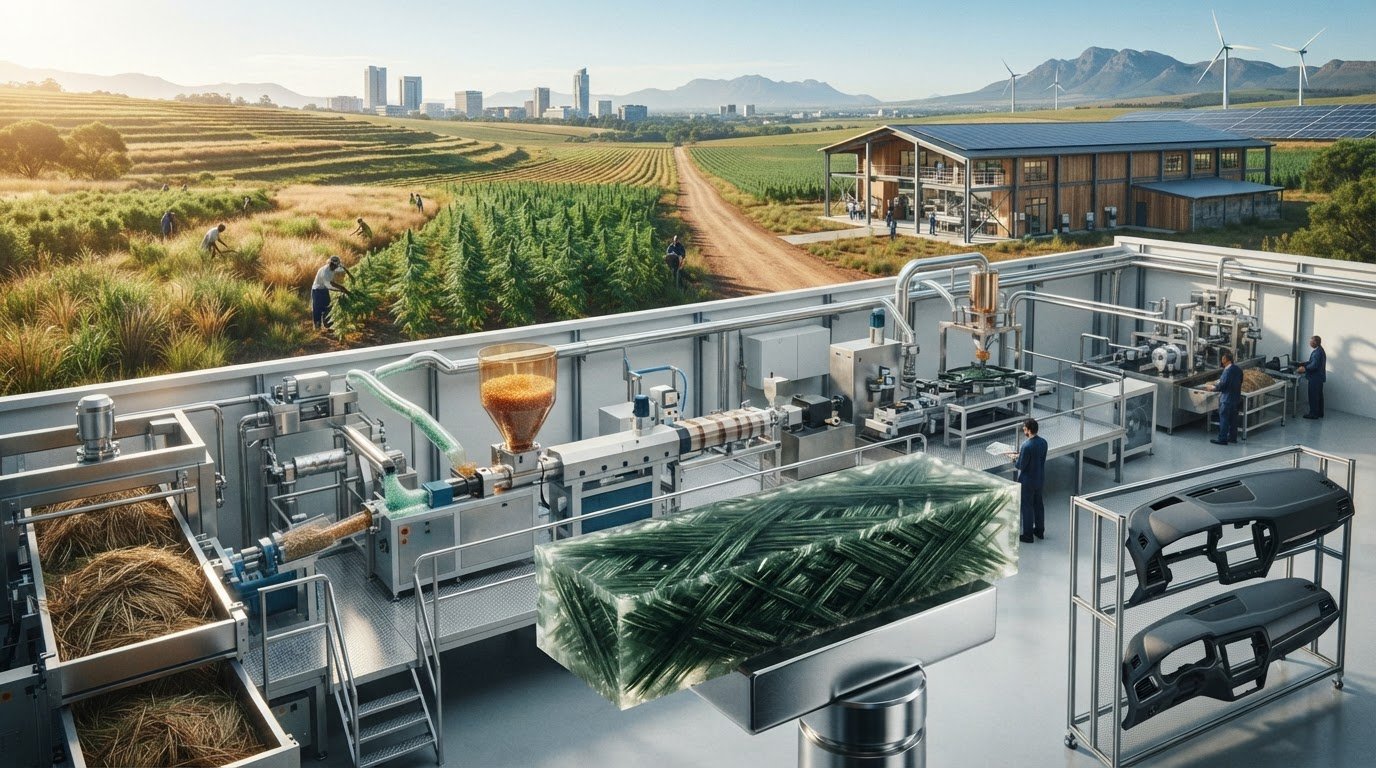
Biocomposites combine a matrix and reinforcing materials, with at least one constituent of biological origin. Reinforcements may include wood, bamboo, rice husk, cellulose, agricultural residues or non-wood fibrous biomass. The matrix binds the fibres and supports the finished component, while the combination determines performance and processing needs.
Non-wood feedstocks can include by-products rather than purpose-grown fibres. One patented panel formulation specifies protein-containing non-wood fibrous biomass at 20 to 100%, preferably 20 to 60%. These ranges describe that formulation, not every biocomposite. They show how manufacturers can specify alternative inputs within a defined material design.
Panel examples demonstrate the range of possible sources. One combines 800 g of wood particles with 500 g of distillers dried grains with solubles (DDGS). Another uses 800 g of used fruit-drink carton fibre and 200 g of DDGS. Such formulations use different feedstocks, so their mechanical properties and manufacturing requirements also differ.
Starch is another renewable input. Millions of tons of pure potato and corn starch are produced every year for food and other applications. Plant-derived polymers can also provide an alternative to fossil-based polymers, while natural fibres or cellulose extracts can reinforce a bioplastic matrix. The specific blend determines whether the material fits its intended application.
Renewable raw materials are often described as readily available and abundant, but sourcing still affects environmental impact. The result depends on the materials selected and the processes used to manufacture products. A robust comparison traces feedstock, production method and end-of-life route instead of treating renewable content as a complete measure of footprint.
Bio-based versus fossil-based plastics
Bio-based describes a plastic’s resource origin, not how it behaves after use. Fossil-based plastics use fossil feedstocks, while bio-based plastics use renewable biological resources. This distinction matters, but it doesn’t establish whether a product is biodegradable, recyclable or preferable across its full lifecycle.
Plant-sugar-derived PLA illustrates the difference. It is a bio-based polymer used in packaging and disposable items, yet plain PLA can take several decades to biodegrade in nature. Its origin is renewable, but its breakdown depends on environmental conditions. A bio-based label is no substitute for evidence about disposal performance.
Conventional plastics can take hundreds of years to degrade. That doesn’t mean every bio-based plastic breaks down quickly or every fossil-based plastic performs identically. Polymer chemistry and product design determine function. Assess feedstock, service life and end-of-life behaviour separately rather than treating them as one property.
Biocomposites add another distinction: their matrix may be fossil-derived even when their reinforcement is renewable. Polyethylene or polypropylene can bind natural fibres, creating a composite with bio-based content but a persistent plastic matrix. In other formulations, bio-based polymers and renewable fillers can replace oil-based, non-renewable plastics.
For procurement, compare the complete formulation with the application. A rigid component designed for long service has different requirements from single-use packaging. Mechanical performance, processing compatibility and disposal routes all affect operational suitability. A renewable input may reduce reliance on fossil resources, but it doesn’t guarantee a lower environmental footprint.
Special attention is required for claims about biodegradability. Breakdown depends on environmental factors and specific conditions; a product intended for industrial composting should not be assumed to decompose in ordinary surroundings. EN 13432 sets requirements and testing procedures for industrially compostable packaging, but the standard does not establish that every bio-based plastic is compostable.
Bio-based and fossil-based polymers can also differ in sourcing exposure. Plant-derived feedstocks link production to renewable raw materials, while fossil-based inputs rely on non-renewable resources. Manufacturing processes affect environmental impact in either case. A sound comparison considers the polymer, reinforcing material, production method and end-of-life route together.
The practical conclusion is that origin, composition and disposal are separate decision factors. PLA shows that a renewable source doesn’t ensure rapid breakdown; a fibre-reinforced fossil-based matrix shows that renewable content doesn’t make a composite fully bio-based. Evaluate each property against the required function before choosing a material.
Biocomposite durability and resistance
Biocomposites can offer useful resistance, but performance depends on formulation and service conditions. Potential risks include moisture-related swelling, biological attack and insufficient strength for heavy load-bearing applications.
Durability varies with the matrix, reinforcement and exposure. A biocomposite containing hydrophilic biofibres may swell when exposed to moisture, changing its dimensions or fit. This matters for outdoor decking and cladding, where repeated wetting can affect component tolerances. The material’s behaviour must suit the exposure expected in its application.
Resistance isn’t uniformly poor, either. Biocomposites are described as resistant to moisture, UV light and temperature fluctuations. However, that broad characteristic doesn’t remove formulation-specific vulnerabilities. Biofibres can remain susceptible to bacterial, fungal and insect attack, and may perform poorly in alkaline environments. Consider the reinforcement and surrounding conditions alongside the polymer matrix.
Strength sets another limit. Some biocomposites may not have the strength required for heavy load-bearing applications, so replacing conventional plastic or another material without assessing mechanical demands can create a performance mismatch. A non-load-bearing panel and a structural component have different requirements. Tailoring the biocomposite to its application helps match performance to the actual duty.
Reinforcement can also affect performance. Layered silicate clay in PLA bioplastics has been associated with improved tensile and flexural properties, heat-distortion temperature and barrier properties. These effects are specific to particular formulations, not universal to every PLA composite. Select materials based on the properties the application needs, such as stiffness, heat resistance or barrier performance.
For a practical durability assessment, match expected exposure to material behaviour: moisture, UV light, temperature fluctuations, biological attack and alkaline conditions. Then compare those risks with the component’s mechanical demands and intended service life. This helps distinguish a suitable sustainable material from one that merely meets a bio-based specification.
Durability also affects circular use. A component that retains its function can be repaired and reused before recycling; one that degrades prematurely may have a shorter useful life. Environmental impacts depend on the materials and manufacturing processes used, so bio-based content alone can’t establish a lower footprint. Evaluate service performance and end-of-life recovery together.
To assess application-specific material options against durability and resistance requirements, discuss material options.
Greenovations Venture Studio: Drone-Powered Industrial Intelligence (GII)
Greenovations Venture Studio is relevant when a material decision forms part of a wider industrial project. Its Drone-Powered Industrial Intelligence (GII) offering supports industrial operations, where priorities extend beyond selecting a polymer or fibre. This comparison helps clarify material trade-offs; broader project decisions also involve infrastructure and operational requirements.
Consider GII when assessing industrial priorities alongside material choices. Greenovations Venture Studio also offers an Electric Vehicle Ecosystem, Sustainable Seating Infrastructure-as-a-Service and Solar PV Recycling. These are distinct offerings, not substitutes for evaluating material composition, performance and end-of-life routes.
To discuss how your industrial priorities align with Greenovations Venture Studio’s offerings, contact Greenovations Venture Studio.
Turn material selection into a project decision
Bring material choices into the project specification before procurement locks in tooling, production methods or disposal assumptions. For a biocomposite-versus-plastic decision, define the required function, acceptable performance limits and end-of-life route together. This gives engineering, procurement and operations teams a shared basis for evaluation, rather than making material origin the sole selection criterion.
Apply those criteria to the actual operating context. The same formulation may suit one component and fail another because exposure, load and manufacturing needs differ. Recording the rationale also supports consistent review when specifications, suppliers or recovery routes change. The aim isn’t to choose the newest material, but to match technical performance to project requirements.
Where material strategy connects to wider industrial planning, Greenovations Venture Studio can be part of the next conversation. Contact Greenovations Venture Studio to discuss your project priorities. A disciplined specification creates a stronger basis for practical decisions and confident execution.
Frequently Asked Questions
Which is Better For the Environment?
Neither option is universally better for the environment; the stronger choice depends on the product’s full life cycle. Compare alternatives that perform the same function, then consider feedstock sourcing, manufacturing energy, transport, service life and disposal. For a reusable component, a longer service life and repair may outweigh a renewable input; for short-lived packaging, collection and recovery routes matter more. Assess both materials against the same performance brief.
Why bio-based?
Bio-based materials can reduce dependence on fossil resources and broaden feedstock options, but biological origin doesn’t guarantee better performance. In procurement, specify the required function first, then assess whether a biological feedstock meets processing, quality and supply needs. Residues such as wood fibre or rice husk can reinforce some composites, linking material design to available biomass streams. The case depends on both feedstock and application.
How do biocomposites compare with plastic in strength, weight and durability?
Biocomposites can be lightweight and strong, but performance depends on fibre type, matrix, design and operating conditions. An automotive interior panel, for example, has different load and impact demands from a structural bracket. Compare finished parts, not raw material labels: assess weight, stiffness, impact behaviour, moisture exposure and heat in the intended assembly. Testing prototypes under representative conditions shows whether a particular grade meets the specification.
Are biocomposites biodegradable or compostable, and under what conditions?
Some biocomposites biodegrade, but many contain durable polymer matrices and aren’t compostable. Biodegradation requires suitable temperature, moisture, microorganisms and time; ordinary outdoor conditions may not reproduce industrial composting conditions. Compostable packaging must suit the disposal system it will enter, including separate collection and appropriate treatment. EN 13432 sets testing requirements for industrially compostable packaging, and the claim should apply to the finished packaging article, not merely one ingredient.
What is the environmental impact of biocomposites versus plastic over their life cycle?
A life-cycle comparison should assess equivalent products performing the same function over the same service period. Include feedstock sourcing, processing energy, manufacturing losses, transport, maintenance, replacement and end-of-life recovery. Biocomposite impacts vary with fibre, polymer and manufacturing route; plastic impacts also vary by resin and recovery method. For South African procurement, document transport and the actual waste route rather than assuming recycling or composting will happen.
What are common uses of biocomposites and conventional plastics?
Biocomposites are used in vehicle components, decking, cladding and outdoor furniture, where fibre reinforcement can contribute stiffness and reduce weight. Suitability depends on load, exposure and manufacturing process. Conventional plastics are used in packaging, household, construction and industrial applications; biodegradable plastic formulations are also used in bags, cups and disposable utensils. Composites also feature in biomedical, electronics and agricultural equipment applications, with specifications determined by each product’s function.
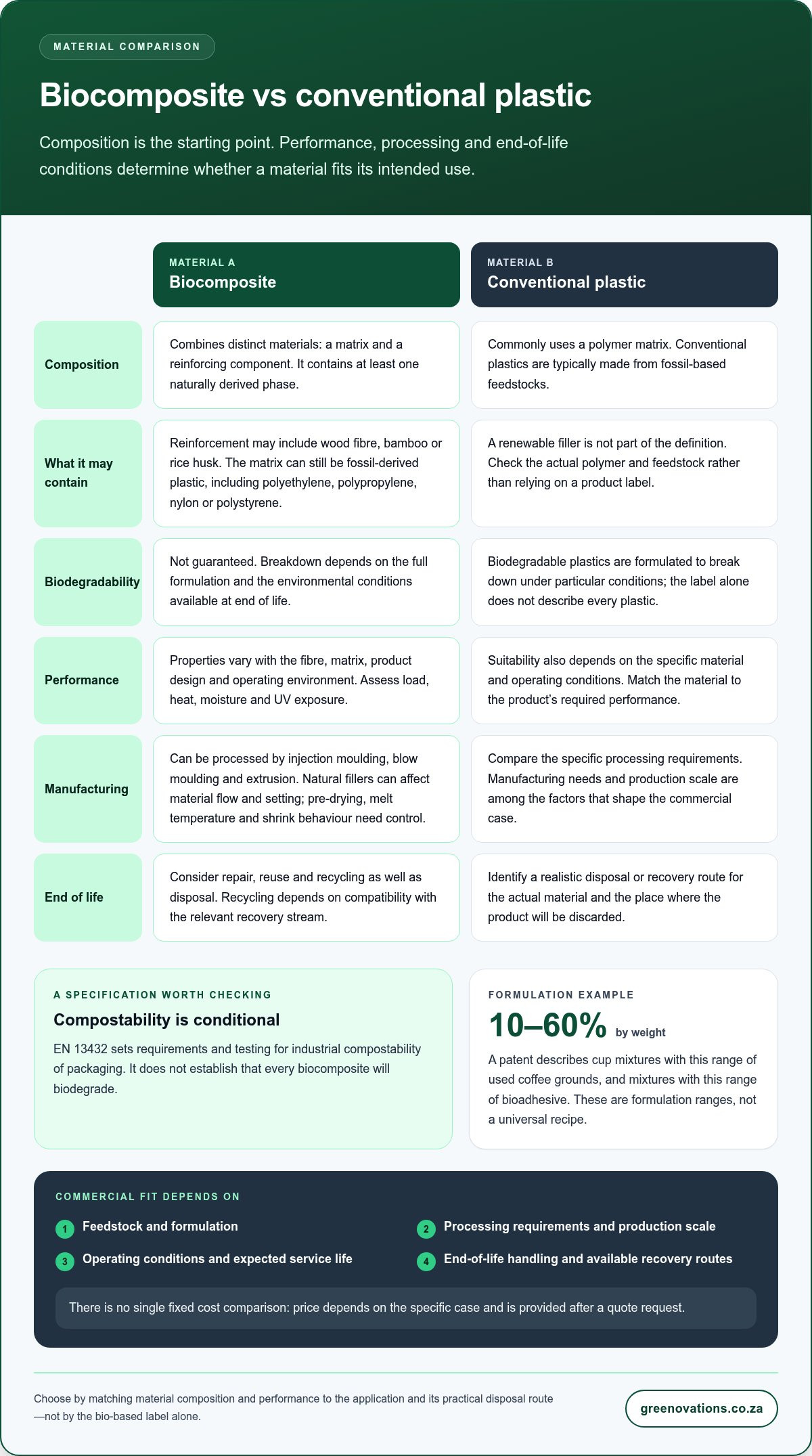
Visual summary
Planning a project like this?
Talk to the Greenovations venture desk about a No-CAPEX structure.