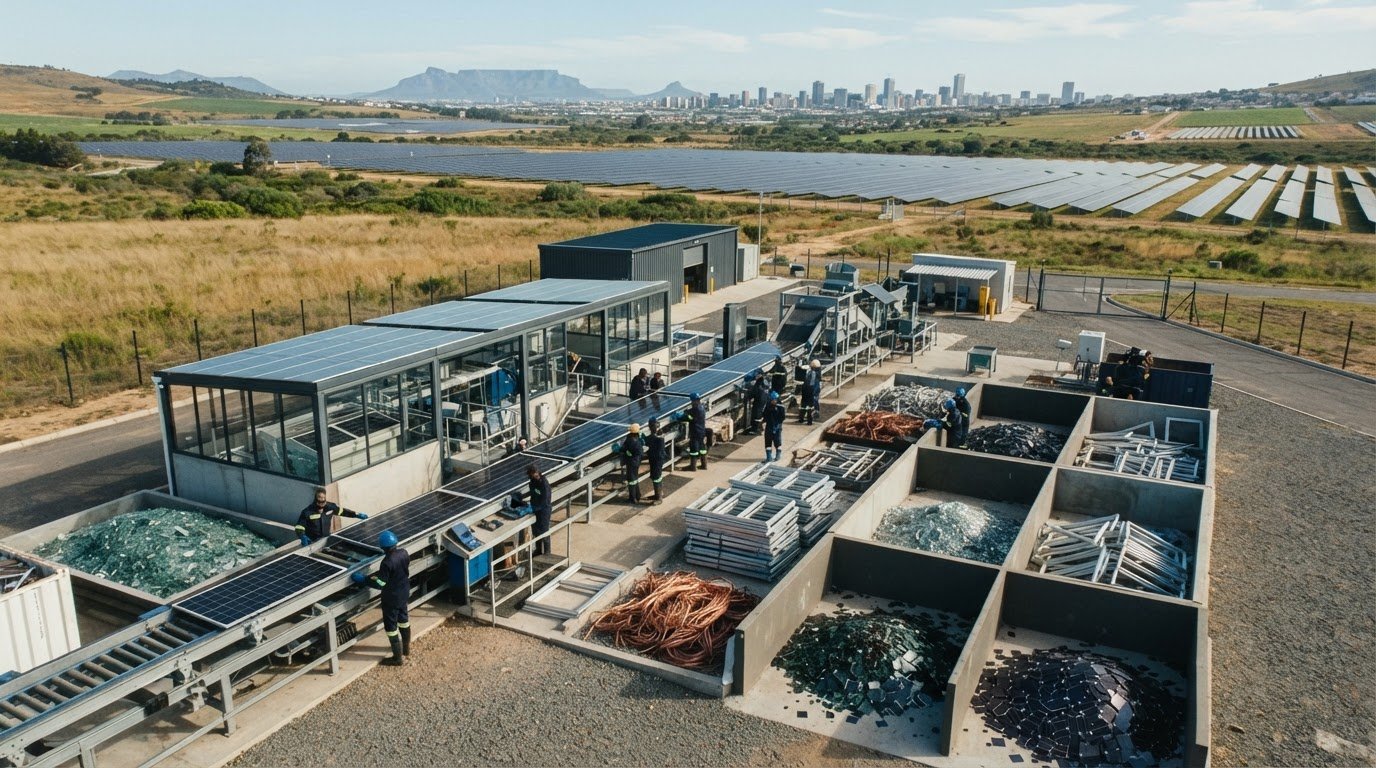

A certificate is not an evidence chain. For commercial asset owners, the phrase “solar panel recycling certified auditable” should mean more than a logo or programme membership. It should be supported by records tracing panels from collection through processing to documented material outcomes. Without that chain, recycling claims can fail procurement review, investor scrutiny and ESG reporting.
That distinction matters. Certification, membership of a certification programme and auditable operating records are separate forms of evidence, and none substitutes for the others. Greenovations Venture Studio provides commercial solar PV decommissioning and recycling as an industrial asset-management service, with recovery streams including aluminium, copper, glass and silver concentrates.
This guide sets out a practical evidence standard for assessing commercial recycling, including the records that support traceability and audit review. It also explains how documented recovery can strengthen asset close-out and ESG reporting. The aim is to establish whether the controls and material outcomes support the claim, rather than accept a recycling statement at face value.
Key Takeaways
- Distinguish certification, facility audits and project-level records before treating a recycling claim as procurement-ready.
- Assess a solar panel recycling certified auditable claim by tracing evidence across each stage, from panel inventory to final reporting.
- Use an audit-trail framework to identify the custody, processing and recovery evidence needed for review.
- Align recycling documentation with internal audit controls and ESG reporting requirements to support defensible asset close-out.
- Greenovations provides commercial solar PV decommissioning and recycling, with recovered material streams including aluminium, copper, glass and silver concentrates.
What makes solar panel recycling certified and auditable?
“Certified”, “auditable” and “recovered” describe different controls. Certification is an attestation against a defined scheme and scope. Auditability is the ability to inspect evidence across the work. Material recovery concerns what processing produces and where those outputs go. A certificate may support a claim, but it does not prove that a particular project’s panels were received, processed or converted into specified material streams.
Auditable recycling links documented custody to verifiable processing outcomes. The test is not simply whether a document exists, but whether the records connect the asset owner’s panels with the reported results. A general Solar Panel Recycling Overview provides context on panel materials and end-of-life considerations. Project assurance, however, depends on evidence tied to the recycling work itself.
Certification, programme membership and auditability are different
Certification attests only to the activities, site, period and controls covered by the applicable scheme. Programme membership indicates participation. On its own, it does not establish ongoing independent assessment or certify every operation. Auditability is operational: records must be accessible, hand-offs traceable and reported outcomes reviewable. Treat these as separate evidence categories, not interchangeable labels.
Why commercial solar asset owners need evidence
For procurement and asset decommissioning, project-level records help reconcile what was removed with what was received and processed. They give internal reviewers a basis for testing recycling claims before those claims enter ESG disclosures or investor materials. Without supporting evidence, reported recovery can create assurance and reputational exposure, even when a facility holds a credential.
Separate facility-level credentials from records for the specific project or batch. A facility audit may assess systems and controls across an operation, but it does not by itself identify an asset owner’s panels or establish their final outcomes. Project evidence should connect the relevant stages, for example:
- Identification: An inventory or batch reference links the panels to the decommissioning project.
- Custody: Collection and transfer records show the movement of that batch between responsible parties.
- Processing and outcomes: Records describe the processing performed and substantiate reported material streams or destinations.
Each record should reconcile with the next, with any differences in quantities or categorisation clearly explained. That is the difference between a certificate signalling a defined form of assurance and an evidence chain supporting a project-specific claim. Greenovations provides commercial solar PV decommissioning and recycling, with material recovery activity including aluminium, copper, glass and silver concentrates.
Build the solar panel recycling audit trail from collection to recovery
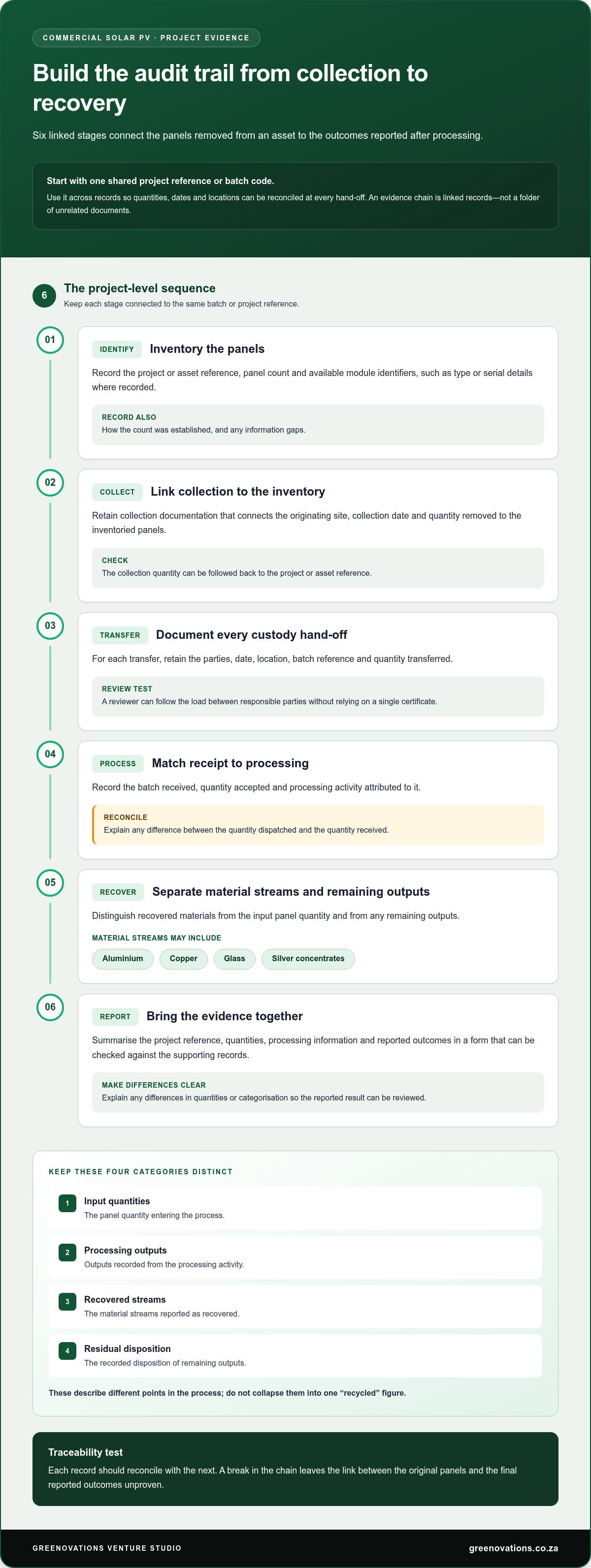
A project-level audit trail connects the panels removed from an asset to the outcomes reported after processing. Build it as a linked sequence, not a folder of unrelated documents. Give records shared identifiers, such as a project reference or batch code, so quantities, dates and locations can be reconciled across hand-offs.
Record the panels and every custody transfer
Start with an inventory of the modules and the identifying information available, such as counts, type or serial details where recorded. Collection evidence should connect the originating site, collection date and quantity to the receiving facility. The SEIA Solar Recycling Program provides industry context, but a project’s own chain still needs evidence specific to its panels and movements.
- Inventory: Record the project or asset reference, panel count and available module identifiers. Note how the count was established and any information gaps.
- Collection: Link the inventory to collection documentation showing the originating site, collection date and quantity removed.
- Custody transfer: At each hand-off, retain records identifying the parties, date, location, batch reference and quantity transferred. These details let a reviewer follow the load without relying on a single certificate.
- Processing: Record the batch received, the quantity accepted and the processing activity attributed to it. Reconcile any difference between dispatched and received quantities.
- Recovery: Distinguish recovered material streams from the input panel quantity and any remaining outputs. Relevant streams may include aluminium, copper, glass and silver concentrates.
- Final reporting: Bring the project reference, quantities, processing information and reported outcomes together in a summary that can be checked against the supporting records.
Traceability relies on linked records at every custody transfer. A break in the chain leaves the connection between the original panels and the final reported outcomes unproven.
Reconcile processing with recovered material outcomes
Keep four categories distinct: input quantities, processing outputs, recovered streams and residual disposition. They describe different points in the process and should not be collapsed into one “recycled” figure. If reported outcomes use estimates, allocations or mass-balance methods, the supporting report should explain the method, assumptions, units and exclusions. This helps a reviewer understand what the figures represent instead of assuming a total is precise.
For example, if collection records show one quantity and facility records show another, make the difference visible and explain it in the final summary. Record damaged modules, rejected loads and adjustments against the relevant batch reference, together with their disposition. This provides a consistent basis for procurement review and ESG reporting, while keeping project facts separate from facility-wide performance claims.
Greenovations’ commercial solar PV recycling connects end-of-life panels with documented material recovery, including aluminium, copper, glass and silver concentrates.
Compare certificates, audits and recovery records before procurement
Procurement decisions need to distinguish the assurance mechanism from the project evidence. A facility credential may indicate that specified operations were assessed, but it does not by itself show what happened to a particular batch of panels. Compare each item by scope, timing, independent oversight, traceability and the evidence available to the asset owner. A solar panel recycling certified auditable claim is defensible only when the supporting evidence matches the claim being made.
Certificate: The document and its issuer define the scope. It may relate to a batch or a broader activity, and may not identify all downstream destinations or recovered quantities. Review the issuing party, covered material or service, date and batch reference.
Facility audit: The scope concerns the operations and controls examined at a facility. Review which activities and sites were included, who conducted the review and when. An audit report can describe findings, but it does not automatically trace a specific project’s panels through each stage.
Third-party certification: Scope and review frequency depend on the named scheme. Independent assessment can provide structured assurance within that scope, but the label alone does not establish project-level custody or material outcomes. Check the scheme’s current requirements, certification status and applicability to the claimed activity.
Project-level records: The scope is the defined project, load or batch. These records can connect collection, hand-offs, processing and reported outputs through shared identifiers. Their value depends on completeness and reconciliation. They are not automatically independent certification.
What a certificate can and cannot demonstrate
A certificate is more useful when it identifies a batch and links to processing evidence. It can help document a defined transaction or claim, but may not establish the quantities recovered or where each material stream went. A receipt or completion statement records an event; it is not equivalent to independently audited certification. Assess each document according to what it actually substantiates.
How to assess audit scope and independence
Before relying on an audit or certification claim, establish who assessed the operation, which processes and sites fell within scope, and when the assessment took place. Determine whether the framework includes continuing surveillance or reflects a review at a single point in time. Verify the scheme’s scope and status against its published material. Do not infer coverage from a logo or membership reference.
Keep regulatory compliance separate from voluntary assurance. South African legal obligations must be assessed against current, authoritative South African sources and the circumstances of the activity. A foreign certification framework may inform a procurement control, but it does not automatically demonstrate compliance with South African requirements. Nor does compliance alone prove a project’s recovery outcomes. Set the evidence threshold against the relevant internal controls, then require records substantiating the specific claim.
Use this procurement checklist to test recycling evidence
Set the evidence standard before decommissioning begins. A clear procurement scope defines what must be recorded, how exceptions will be handled and what the asset owner needs for review. This turns “solar panel recycling certified auditable” from a broad claim into project-specific requirements that procurement, asset management and ESG teams can assess consistently.
Set evidence requirements in the procurement scope
Specify the assets and expected quantities, the custody stages to be documented, and the reporting outputs required at completion. Align access to supporting evidence and retention expectations with internal audit and ESG controls. Define in advance how partial loads, damaged or rejected modules, quantity variances and residual materials must appear in project records.
- Scope: Does the project record identify the relevant assets, inventory basis, expected quantities and processing activity?
- Custody records: Can each collection and hand-off be linked through dates, locations, parties, quantities and a consistent project or batch identifier?
- Processing evidence: Do records identify the material received and the processing attributed to the project, rather than relying only on a general facility statement?
- Material outcomes: Are recovered streams and residuals reported separately, with units, calculation methods and assumptions stated where relevant?
- Reporting: Does the final project summary reconcile with supporting records and provide information in a form usable by procurement, internal audit and ESG teams?
- Assurance: Are certification or audit claims clearly scoped, dated and attributable to an identifiable issuer or assessor?
- Retention: Are evidence access and retention arrangements aligned with the organisation’s decommissioning, asset-disposal and records-management controls?
Review the evidence package for gaps
Test the records as a connected sequence, not as a collection of documents. Reconcile the inventory against collection, processing and reported output quantities. Check that dates, identifiers, hand-offs and named facilities remain consistent. Make any discrepancy visible, explain it and associate it with the relevant project or batch rather than absorbing it into an unexplained total.
Keep claims about South African legal duties, waste classifications or statutory reporting separate from voluntary certification and assurance. Verify legal references against current authoritative South African sources and the facts of the specific activity. A foreign certification framework may inform procurement controls, but should not be presented as proof of local legal compliance without support. Record the source and date of any legal or scheme verification in the organisation’s review file.
Retain the completed evidence package alongside the project’s decommissioning and asset-disposal records. This preserves the link between the physical asset, its treatment and the outcomes reported to internal or external stakeholders. Greenovations provides commercial solar PV recycling for solar asset owners seeking documented decommissioning and material recovery.
Greenovations delivers commercial solar PV recycling with auditable recovery
End-of-life modules are industrial assets moving through a defined decommissioning decision, not an undocumented disposal event. Greenovations Venture Studio provides commercial solar PV decommissioning and recycling for solar asset owners, with certified, auditable service and material recovery that includes aluminium, copper, glass and silver concentrates.
The phrase “solar panel recycling certified auditable” should describe a control system, not function as a marketing label. For procurement teams, the commercial value lies in linking asset retirement to documented recycling activity and reportable material outcomes. That connection supports project close-out, asset-disposal governance and ESG measurement without relying on unsupported recovery rates or broad claims.
Treat decommissioning as an auditable industrial workflow
A controlled transition gives asset owners a clearer basis for managing decommissioning across procurement, operations and reporting. Greenovations’ commercial recycling service is structured around certified, auditable decommissioning and recycling, allowing the activity to be considered within the project’s asset-management controls. Relevant records should support the organisation’s review of what was retired and how the recycling claim is represented.
This is distinct from residential rooftop installation. The focus is commercial solar infrastructure and the materials associated with its end of life. An evidence-led approach helps internal teams apply consistent governance, maintain a coherent asset-disposal record and assess whether reported recovery information is suitable for institutional ESG measurement. It does not require treating every material stream as a guaranteed revenue outcome.
Translate recovered materials into commercial outcomes
Material recovery has an industrial dimension as well as an environmental one. Aluminium, copper, glass and silver concentrates are relevant outputs from Greenovations’ recovery activity. These materials can enter secondary industrial sales channels, connecting end-of-life infrastructure with potential materials value. The commercial significance depends on documented outcomes, not an assumed recovery rate or unsubstantiated valuation.
For asset owners, that distinction matters. Recovery records help separate the materials reported from the broader quantity of panels decommissioned, giving procurement and ESG teams a more disciplined basis for evaluating performance. They also support governance by making material outcomes part of the asset-disposal record, rather than leaving recycling claims detached from operational evidence.
Greenovations operates nationally across South Africa, supporting commercial solar PV recycling as an industrial asset-management workflow. For project teams, the practical next step is to define the asset scope, reporting needs and evidence expectations that will govern the decommissioning work. This frames recycling as an accountable project requirement and connects material recovery with procurement and institutional reporting.
Discuss commercial solar PV recycling requirements with Greenovations to align your project’s decommissioning and recovery needs with its asset-management and reporting objectives.
Make evidence part of the next asset decision
Embed evidence requirements in project governance before panels are retired. Define who owns the records, how they will be reviewed and how recycling outcomes will be carried into asset-disposal and ESG reporting. This turns solar panel recycling certified auditable from a procurement phrase into a repeatable control for future decommissioning decisions.
Greenovations supports commercial solar asset owners with certified, auditable decommissioning and recycling. Its recovery activity includes aluminium, copper, glass and silver concentrates, giving project teams material outcomes to account for in their reporting. The value is not a claim without context, but a documented basis for connecting end-of-life assets with recovery and organisational oversight.
Build the evidence standard into your next project brief, then align the recycling workflow with your internal controls. Discuss auditable commercial solar PV recycling with Greenovations and take a more structured approach to decommissioning. Clear requirements can support stronger, more consistent decisions as your solar assets reach end of life.
Frequently Asked Questions
What does certified solar panel recycling mean?
It means a recycling activity is associated with a stated certification or assurance framework, but the framework’s scope determines what the claim covers. A facility credential, for example, may not identify the handling of a specific project’s panels. For solar panel recycling certified auditable assurance, link the stated scheme to project evidence and check its current requirements and relevance in South Africa before treating it as proof of legal compliance.
Can a Certificate of Recycling prove that every solar panel was recycled?
No. A Certificate of Recycling may document receipt or completion, but its evidential value depends on its contents and supporting records. Check whether it identifies the project, quantities and relevant batch, and whether those details match the processing information. If a certificate states only that material was received, it does not establish every downstream destination or recovered quantity. Assess it alongside the records supporting the specific claim being made.
How can solar panel recycling be made auditable?
Set up the record structure before collection, using a project reference that follows the panels through handling and reporting. For example, procurement can require the same batch identifier on collection paperwork and the final processing summary. Record any exception against that identifier, rather than relying on an email explanation detached from the project file. Auditability comes from evidence that can be reviewed and reconciled, not simply from a general sustainability statement.
What records should commercial solar owners retain after panel recycling?
Retain the records needed to substantiate the organisation’s asset-disposal and reporting decisions. A project file may include the decommissioning inventory, collection and transfer documents, processing information, recovery reporting and any certificate issued for the work. Keep calculation notes or assumptions alongside reported quantities, so a later reviewer can understand how figures were derived. The retention period and access controls should follow the organisation’s own records-management and audit policies.
Are US solar recycling certifications proof of compliance in South Africa?
No, not by themselves. A US certification can describe practices assessed under that framework, but it does not automatically establish compliance with South African legal requirements. Separate voluntary assurance from local legal analysis. Before relying on a compliance claim, verify the relevant South African requirement and the certification’s scope using current authoritative sources. This distinction helps procurement teams avoid presenting an overseas credential as a substitute for jurisdiction-specific review.
What happens if recycling records do not reconcile with the project inventory?
Treat the difference as an open evidence issue and document how it was investigated. Check whether the discrepancy relates to a rejected load, damaged modules, a counting basis or a measurement assumption. Record the explanation and retain supporting material with the project file. Do not adjust reported figures without a clear basis. If the variance changes a reported outcome or compliance assertion, route it through the organisation’s established audit and governance process.
Which materials can be recovered from end-of-life solar panels?
Commercial solar PV recycling can recover material streams including aluminium, copper, glass and silver concentrates. Establish the specific outputs and quantities from the project’s processing records rather than assuming them from a general description of panel composition. For reporting, distinguish materials recorded as recovered from inputs or residuals, and retain the basis for any quantities stated. This gives asset owners a more precise account of material outcomes without implying a fixed recovery rate.
Visual summary
Planning a project like this?
Talk to the Greenovations venture desk about a No-CAPEX structure.