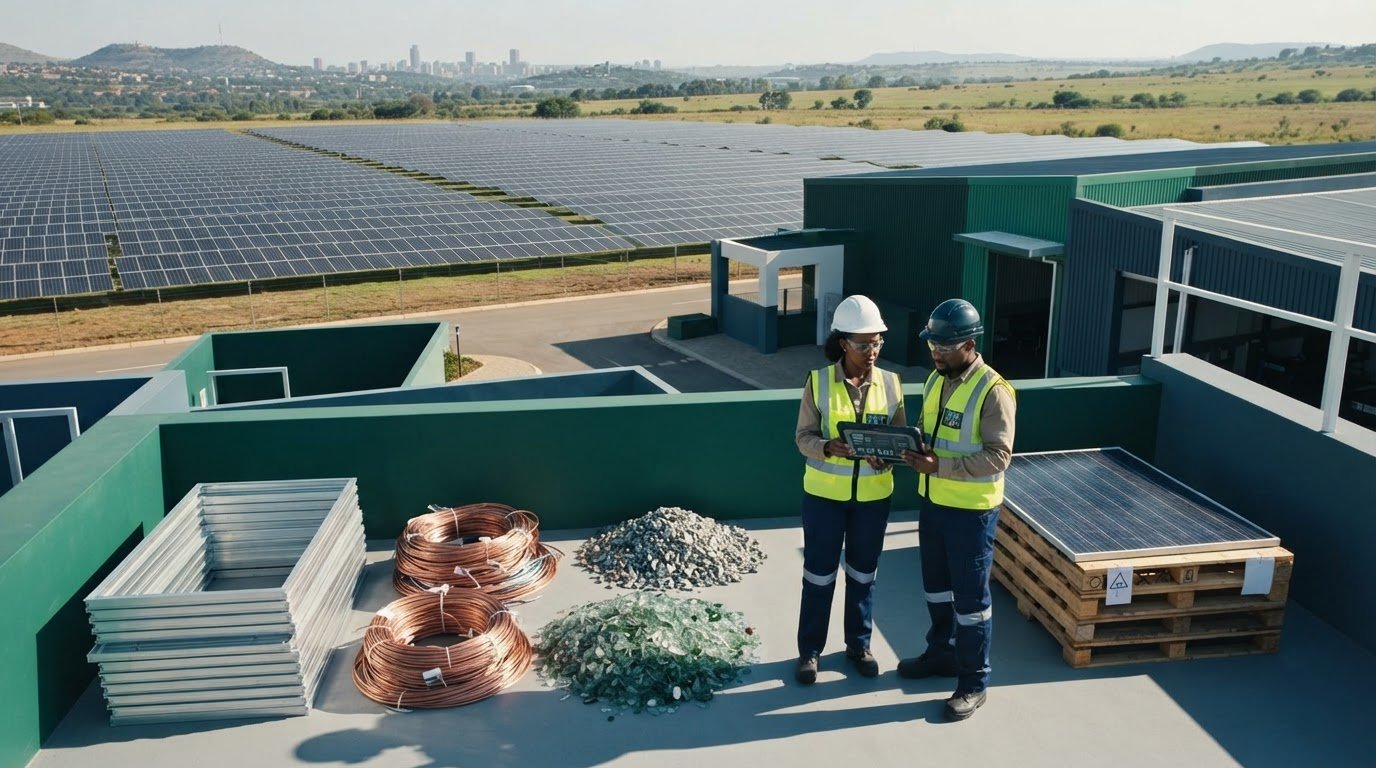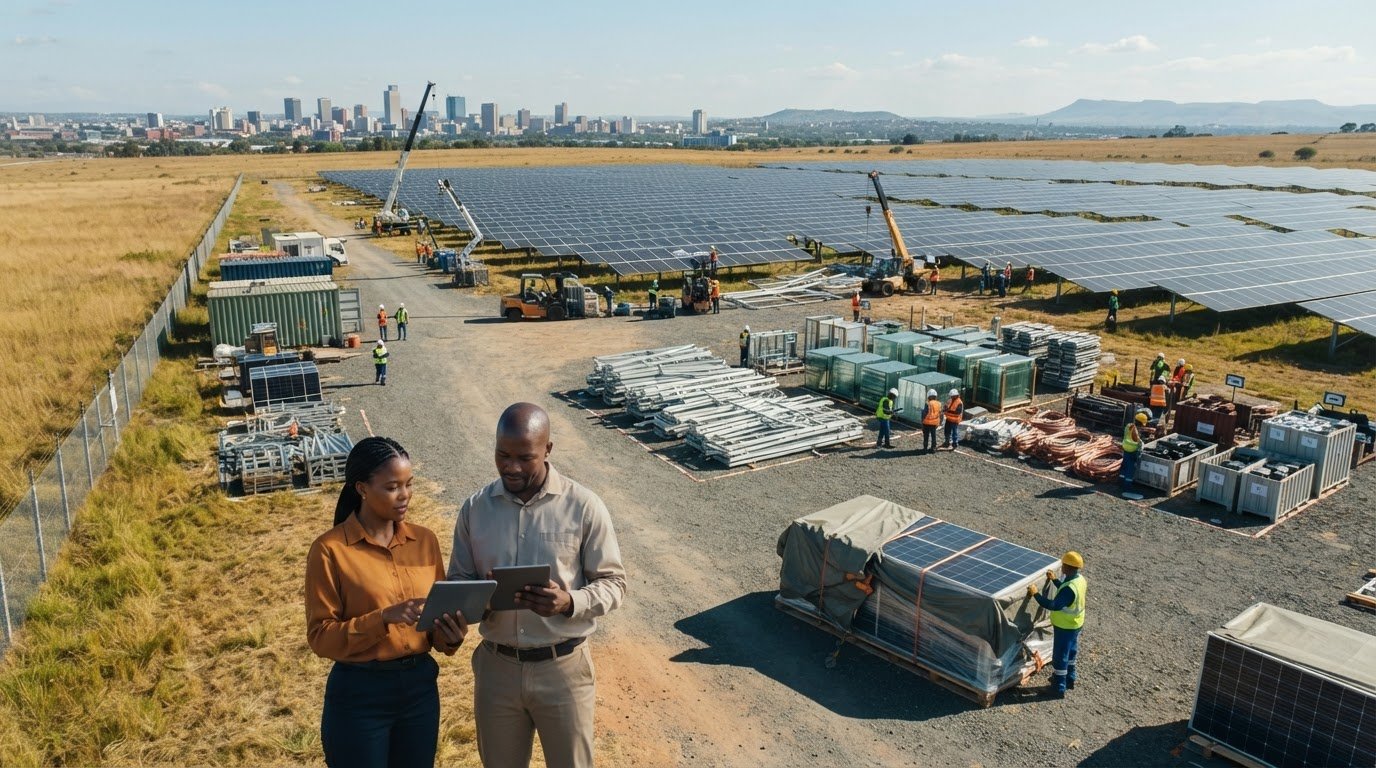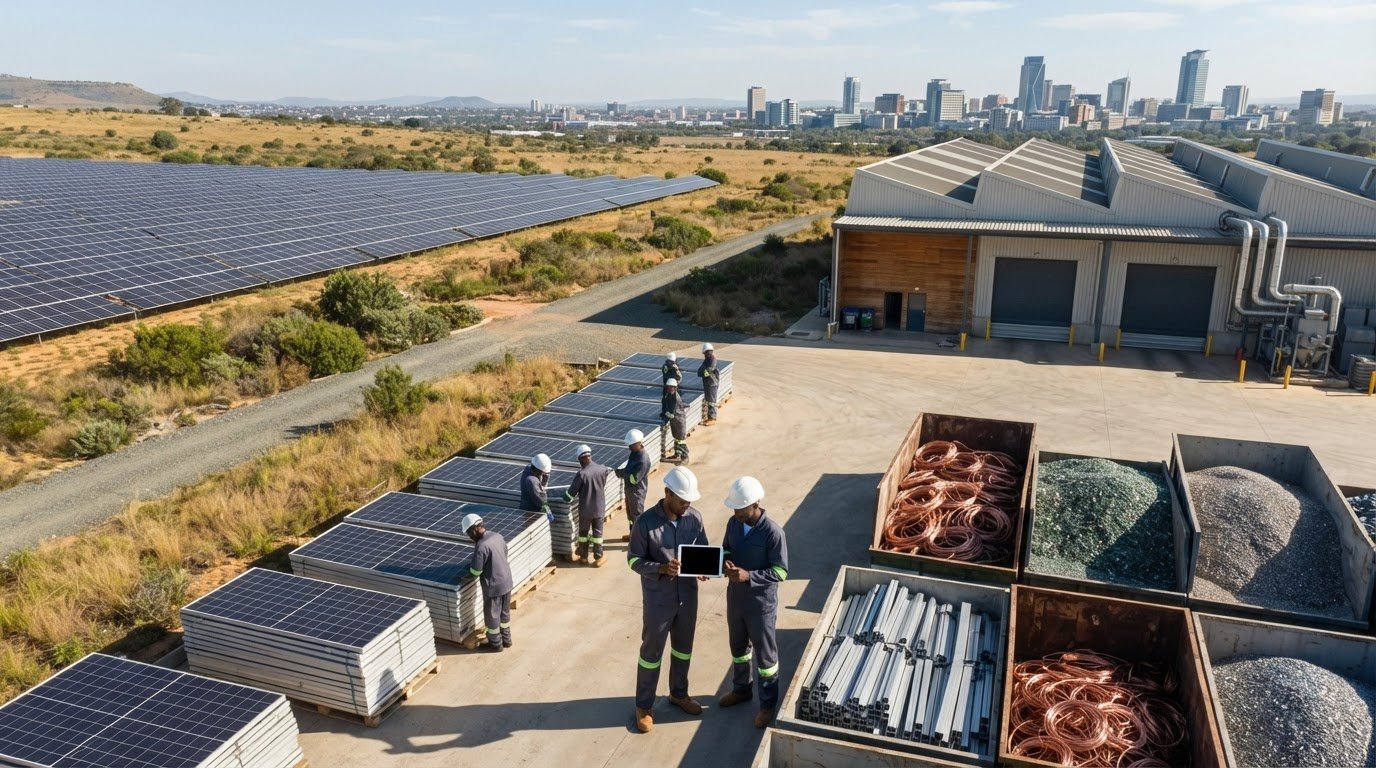
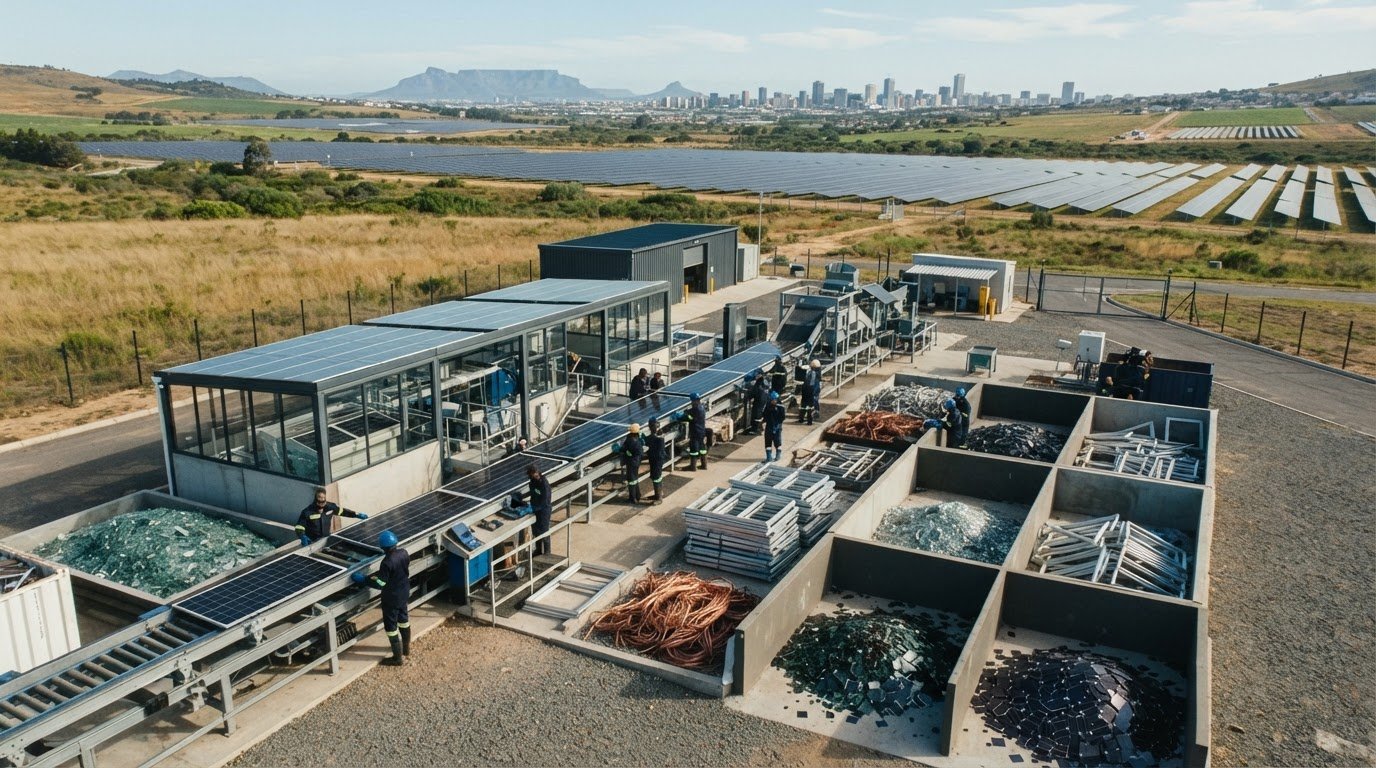
Old solar panels are dismantled so their glass, aluminium and other recoverable materials can be separated for recycling or reuse. What happens to old solar panels depends partly on their technology: some contain hazardous materials, such as lead or cadmium, that require special handling rather than disposal with ordinary waste.
Whether a panel can be recycled is only part of the question. Its end-of-life route determines which materials are recovered and which are lost. This article explains how decommissioned panels are managed in South Africa, why they need a separate recycling route from general electronic waste, and how poor disposal can waste resources or mishandle hazardous components. It also covers how panel condition and lifespan shape the decisions that follow.
Key Takeaways
- Retired panels contain recoverable materials, so the recycling route affects how much can re-enter the supply chain.
- Separate recycling helps recover more than the aluminium frame and supports material recovery from the panel itself.
- Assess a panel’s performance and condition, not age alone, when planning replacement and end-of-life management.
- Improper disposal can waste useful materials, while some panel technologies require special handling because they contain hazardous substances.
- Solar PV recycling provides a dedicated route for managing decommissioned panels as part of a broader end-of-life plan.
Solar Panel End of Life: What Happens To Old Panels?
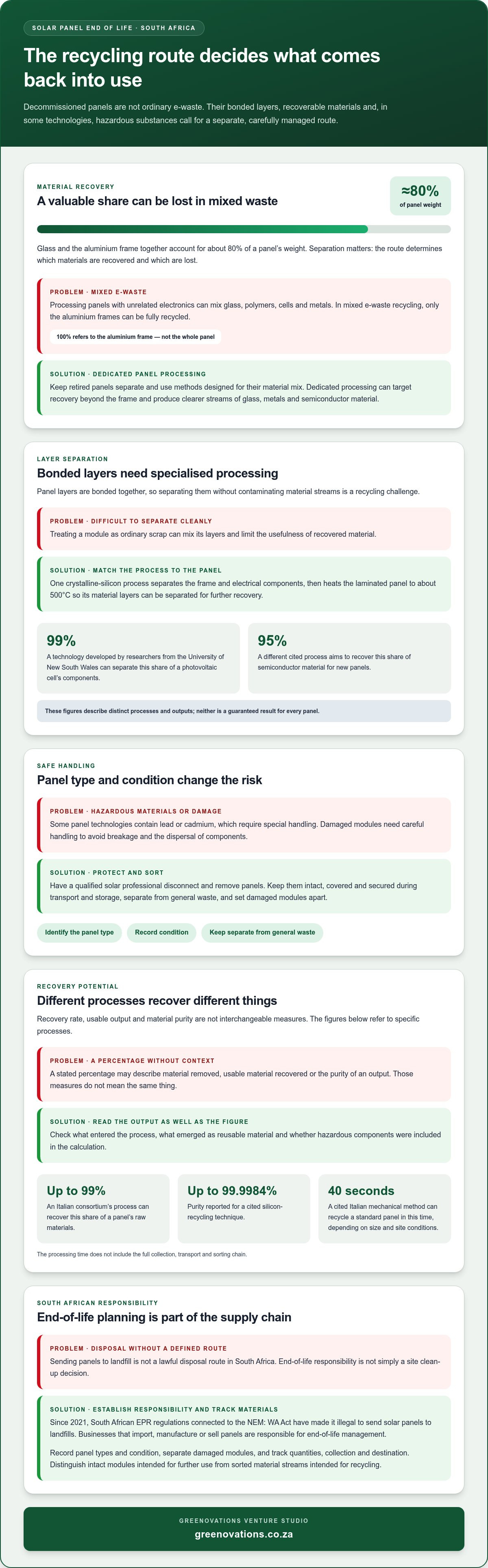
Decommissioning separates panels from their installation, then directs intact modules or recovered materials towards reuse or recycling. Glass and aluminium together make up about 80% of panel weight.
Homeowners should have a qualified solar professional disconnect and remove panels. Keep them intact, covered and secured during transport and storage, and separate from general waste.
Recovered panel materials
Recovered panel materials are the separated components that can be prepared for reuse or recycling. Glass, polymer and aluminium form the main material streams; panels may also contain copper and zinc. The frame and glass account for about 80% of a panel’s weight, making separation central to material recovery. For readers assessing what happens to old solar panels, the specific technology affects which components can be extracted and how cleanly.
Recycling challenges and contaminants
Recycling challenges arise because a panel’s layers are bonded, so separating them without contaminating material streams takes specialised processing. A recycling technology developed by researchers from the University of New South Wales can separate 99% of a photovoltaic cell’s components. Other processes target different outputs: one cited process aims to recover 95% of semiconductor material for new panels. These figures describe distinct processes, not a single guaranteed result for every panel.
Hazardous materials in discarded panels
Hazardous materials are substances in some panel technologies that require controlled handling during recycling or disposal. Lead and cadmium are examples; panels also contain glass, polymers and metals that need sorting into suitable streams. Identifying the panel type matters because a process designed for one material mix may not safely handle another. Damaged modules also require careful handling to avoid breakage and the dispersal of components.
Recycled materials in a circular economy
A circular economy keeps recovered materials in productive use instead of treating a retired panel as undifferentiated waste. An Italian consortium’s described process can recover up to 99% of a panel’s raw materials, while a cited silicon-recycling technique reports purity of up to 99.9984%. These are process-specific figures. Material purity matters because manufacturers need consistent inputs for new products, not mixed or contaminated waste.
Processing routes differ. Mechanical separation can recover bulk materials, while other techniques target cell components or semiconductor material. One Italian consortium’s mechanical method can recycle a standard panel in 40 seconds, depending on its size and site conditions. That processing time does not describe the full collection, transport and sorting chain. The panel’s condition and the facility’s equipment shape the practical route.
Export decisions depend on whether a shipment contains intact panels intended for further use or recovered material streams. Intact modules need assessment for continued use, while sorted glass, aluminium or silicon requires defined material specifications and a suitable destination. Transport distance, condition, packaging and buyer requirements affect commercial viability. Exporting does not replace the need to classify the material and establish its intended use.
For South African asset owners, end-of-life planning starts before removal. Record panel types and condition, separate damaged modules, and track the material stream through collection and processing. These steps help distinguish reusable equipment from recycling feedstock and show whether glass, metals and semiconductor material have been recovered rather than lost in mixed waste.
Why solar panels should be recycled separately from other e-waste
Solar panels need a dedicated recycling route because mixed e-waste processing can limit material recovery. In South Africa, separation also matters because businesses that supply panels have end-of-life responsibilities.
Separate panel recycling processes
Separate panel recycling means processing modules through methods designed for their bonded layers and material mix. With mixed e-waste recycling, only the aluminium frames can be fully recycled, at 100%. A crystalline-silicon process can separate the frame and electrical components, then heat the laminated panel to about 500 degrees C. That enables material layers to be separated for further recovery, rather than treating the module as ordinary electronic scrap.
The distinction affects the quality and usefulness of recovered materials. Solar panels combine glass, polymers, cells and metals in a compact assembly; shredding them with unrelated electronics can mix those materials. Dedicated processing targets panel components and supports recovery beyond the frame. For commercial installations, recording panel types and keeping retired modules separate creates clearer recycling feedstock.
Recycling figures need a clear definition. A percentage might describe material removed from a panel, material recovered as a usable output, or material that meets a specified purity. These measures are not interchangeable. When assessing a recycler’s stated recovery rate, compare what entered the process with what emerged as reusable material, and check whether hazardous components were included in the calculation.
Disposal laws and regulations
South Africa made it illegal to send solar panels to landfills in 2021 under EPR regulations connected to the NEM: WA Act. Businesses that import, manufacture or sell panels are responsible for end-of-life management under these regulations. This makes disposal a supply-chain obligation, not simply a site-clean-up decision for the asset owner.
For a project, establish who holds the relevant producer responsibility and how retired panels will enter an appropriate recovery route. Keep records of panel quantities, collection and destination to document how the equipment was managed. A recycling claim should also explain how the rate was calculated. Without a clear denominator, a rate does not show whether panels were fully recycled or only partly processed.
The scale of future waste makes material recovery a capacity issue. Nearly 80 million metric tons of old solar panels are expected to be disposed of worldwide by 2050. South Africa’s recycling benefit is practical: separating panels preserves recoverable glass, aluminium and other materials as potential manufacturing feedstock, instead of losing those streams in landfill or mixed-waste processing.
For municipal and commercial projects, consistent collection and sorting can connect dispersed end-of-life modules with suitable processing capacity. The value depends on panel condition, composition, contamination and the quality required by downstream users. A recovery route must therefore manage logistics and material specifications alongside the recycling equipment. Commercial solar-panel recycling can form part of that end-of-life planning.
Solar panel lifespan and end-of-life management
A panel’s service life is not the same as its retirement date. Industry-standard lifespan estimates range from 25 to 30 years, but performance, condition and project requirements shape the end-of-life decision.
Panel lifespan and end-of-life planning
End-of-life planning means forecasting when panels may leave service and arranging their next use or recycling route. It matters because age alone does not show whether a panel still produces useful electricity. Panels commonly degrade by about 0.5% per year; at that rate, a panel is estimated to produce 88.6% of its original output after 25 years. A performance guarantee commonly lasts 25 years, but that date does not automatically require removal.
South African planning should distinguish a project’s operating decision from a panel’s physical capability. Panels in South Africa generally need replacement every 20 years, while some can have service lives of 50 years or more. These figures describe different considerations: replacement timing reflects project requirements, while service life concerns how long equipment may continue operating. Track generation, faults and maintenance history to inform decisions about each array.
Annual degradation also affects the economics of keeping an installation in service. At an average 0.5% yearly decline, a panel is estimated to produce 78.2% of its original output in its 50th year. That estimate is not a performance guarantee for a specific module. Operators can compare measured output with the installation’s requirements, then assess whether continued operation, replacement or another use best fits the site.
Planning at portfolio level matters as retirement volumes rise. IRENA projects that about 4% of installed solar panels will need to be retired annually by 2030. Asset owners can map installation dates, panel specifications and replacement cycles, then align collection and processing capacity with expected retirements. This makes end-of-life management part of asset planning, rather than an unplanned task after removal.
Australia offers a policy comparison, not a direct template for South Africa. Rooftop solar panels there were estimated to reach end of life in roughly 30 years. At the time described, Australian environment ministers had not determined policies for handling solar panels as waste. The example shows why governments and asset owners need clear routes before large cohorts of installed panels retire.
Reuse and second-life panels
Second-life use means redeploying a functioning panel after it leaves its original installation. Retirement from one project does not necessarily mean the module has stopped producing electricity. A panel assessed as suitable for reuse may serve a less demanding application; a damaged or unsuitable module instead needs an appropriate recycling route.
Before reuse, evaluate each panel’s condition and measured output, not its age alone. Compare those results with the receiving system’s requirements, and keep panels with faults separate from functional units. Performance guarantees commonly last 25 years, but a warranty period is not proof that a panel stops working afterwards. Nor does remaining output establish that a module is suitable for every installation.
For commercial operators, documented inspections support a clear decision between redeployment and material recovery. Record each panel’s identity, condition and test results, then group modules by assessed status. This helps distinguish second-life stock from recycling feedstock and plan collection. In South Africa, deciding on these routes before decommissioning reduces uncertainty about where equipment goes after it leaves the site.
Environmental risks of solar panel waste
Retired photovoltaic panels present little risk to human health or the environment, but landfill disposal wastes recoverable resources. The concern is not that every discarded panel is acutely hazardous; unmanaged waste can combine lost materials with components that need controlled handling. In South Africa, owners should treat decommissioning as a material-management decision, not simply a site-clearance task.
Panel composition determines how it should be handled. Glass, polymer and aluminium make up much of a module, while some technologies also contain lead or cadmium. Those substances require special handling and disposal. A damaged module can expose components during collection or sorting, so separating broken panels from intact equipment helps prevent uncontrolled mixing and supports appropriate processing.
Landfill also removes valuable materials from potential supply chains. Aluminium, glass, copper and silicon can be useful inputs when recovered to suitable specifications. Once panels enter mixed waste, those materials become harder to identify and recover as separate streams. The environmental consequence is resource loss: materials that could be processed for another use instead go to disposal.
Owners can reduce handling uncertainty by planning the chain from removal to destination. First, record panel type and condition. Next, separate intact modules from broken ones and protect them during temporary storage. Then document collection and the receiving route. These steps create a traceable handover and give processors clearer information about the incoming material, including whether panels may contain hazardous components.
South Africa’s landfill restriction provides an important operational boundary. Sending solar panels to landfill became illegal in 2021 under EPR regulations connected to the NEM: WA Act. Businesses importing, manufacturing or selling panels carry end-of-life management responsibilities under those regulations. For site owners, this context makes a documented recovery route more than a waste preference; it supports responsible management across the supply chain.
Recycling performance depends on separation, processing and the intended use of recovered outputs. For example, clean glass is more useful than glass mixed with polymers and cell fragments. Recovery figures also need careful interpretation: the percentage recovered by a process does not, by itself, show the purity or later use of every output. Distinguish recovered material from material ready for manufacturing.
Scale increases the importance of reliable systems. The world is expected to dispose of nearly 80 million metric tons of old solar panels by 2050. That volume makes collection, sorting and processing capacity environmental controls, not administrative details. A functioning route reduces avoidable resource loss while directing panels with lead or cadmium towards suitable handling, rather than treating every module as identical waste.
For commercial assets, plan decommissioning around material condition and destination. Keep records, separate damaged equipment, and maintain a clear chain of custody through collection and processing. These steps address the main risks associated with retired panels: wasting recoverable resources and mishandling hazardous components. They also give owners a practical way to document how equipment left the site.
Greenovations Venture Studio: Drone-Powered Industrial Intelligence (GII)
Greenovations Venture Studio’s Solar PV Recycling offering supports organisations planning the end-of-life management of commercial solar panels. Its Drone-Powered Industrial Intelligence (GII) is a separate offering, not a substitute for panel recycling.
Turn to Greenovations when your project needs a defined approach to retired photovoltaic modules and material recovery. Start with the operational requirements: panel condition, material stream and intended recycling outcome. This keeps the discussion focused on end-of-life management rather than unrelated solar installation or equipment sales.
For a discussion about solar PV recycling, contact Greenovations Venture Studio or visit greenovations.co.za.
Make end-of-life planning part of the next decision
Decide what happens to old solar panels before replacement becomes urgent. Treat decommissioning as an asset-management decision: define who is responsible for the handover, what records must follow each panel, and how the chosen route supports reuse or material recovery. That clarity can inform future procurement and reduce the risk of disposal becoming an unplanned operational issue.
For organisations assessing infrastructure priorities, Greenovations Venture Studio offers Solar PV Recycling, Drone-Powered Industrial Intelligence (GII), an Electric Vehicle Ecosystem, and Sustainable Seating Infrastructure-as-a-Service. These distinct offerings suit different requirements. Start by establishing whether solar-panel recovery fits your project’s end-of-life needs.
Start a conversation with Greenovations Venture Studio about solar PV recycling and your decommissioning requirements. A clear operational plan puts the next decision on firmer ground.
Frequently Asked Questions
What Can You Do?
Sort retired panels by condition and record their type before arranging reuse or recycling. Keep intact modules separate from panels damaged during removal, for example, and note which units came from each array. This helps determine whether modules are suitable for a second use or should enter a recycling stream. In South Africa, panels should not go to landfill, so plan a recovery route before equipment leaves the site.
What’s the Solution?
Use a managed end-of-life route that separates reusable modules from recycling feedstock and records the handover. For a commercial project, match panel condition and composition to the appropriate next step rather than treating every removed module as identical waste. Solar PV recycling is relevant when panels are no longer suitable for use. A clear plan also helps assign responsibility for collection and destination.
What happens to old solar panels at the end of their lifespan?
What happens to old solar panels depends on their condition and material composition. Panels that still function may be assessed for another use; others are dismantled so their materials can be recovered through recycling. Some panel technologies contain lead or cadmium, which require special handling. In South Africa, landfill disposal is prohibited under the end-of-life rules described in this article, making an appropriate recovery route essential.
Can old solar panels be reused or refurbished?
Yes, functioning panels may be suitable for reuse after their condition and output have been assessed. For example, a module removed during a commercial system upgrade could be evaluated for a less demanding application. A warranty period alone does not establish whether a panel works or is suitable for redeployment. Record test results and faults, then separate viable modules from damaged units that need recycling.
How are solar panels recycled and what materials can be recovered?
Recycling separates a panel’s layers and components so they can be processed as material streams. A crystalline-silicon process may remove electrical components and the frame before separating bonded layers. Recovered materials can include glass, aluminium, silicon, copper and polymers. The outputs depend on the process and the panel’s composition. Sorting modules by type before processing helps keep different material streams identifiable.
What percentage of a solar panel can be recycled?
There isn’t one universal percentage because processes recover different materials and measure results differently. An Italian consortium’s described process can recover up to 99% of a panel’s raw materials. That figure refers to that specific process, not every recycling facility or panel type. When comparing recovery claims, distinguish material separated from material recovered in a usable form, and consider whether the figure includes all panel components.
What environmental and health risks come from dumping or breaking solar panels?
Landfill disposal wastes materials that could otherwise be recovered, while broken panels can complicate safe sorting and processing. Some technologies contain lead or cadmium, which require special handling and disposal. Retired photovoltaic systems generally present little risk to human health or the environment, but that does not make careless handling appropriate. Keep damaged modules separate from intact panels and send them through a suitable management route.
What should you do with damaged solar panels after a storm or fire?
Keep people away from damaged modules, avoid handling broken pieces, and arrange an assessment before moving them. Storm or fire damage can affect a panel’s condition and suitability for reuse, so do not assume it can return to service because its frame looks intact. Record the affected equipment and keep it separate from undamaged modules. The assessment should determine whether controlled removal and recycling are required.
Visual summary
Planning a project like this?
Talk to the Greenovations venture desk about a No-CAPEX structure.