
A climate label doesn’t make an infrastructure project bankable. In climate resilient infrastructure investment Africa, the commercial case depends on how physical risks are translated into asset design, operating plans, risk allocation and lifecycle finance. Investors need to understand how exposure to floods, heat, drought or other hazards could affect construction, service continuity, revenue and debt repayment.
Assessing those effects can be difficult. Adaptation benefits are often harder to quantify than conventional returns, while project preparation and financing responsibilities may be split across multiple parties. The core question is how to structure infrastructure that can withstand climate pressures and remain commercially viable. Resilience is not an extra feature to price after design; it needs to be part of the investment case from the outset.
This explainer sets out what resilience means across an asset’s lifecycle, which project characteristics support credible investment assessment, and how financing structures can allocate risk more clearly. It also covers practical diligence questions for African markets. Greenovations Venture Studio’s integrated project model, which can combine design, build, finance, operation and transfer, reflects why capital structure and operations need to be considered together.
Key Takeaways
- Assess climate resilient infrastructure investment Africa by separating base-case commercial performance from climate exposure and the value added by resilience measures.
- Use climate data to inform project decisions, then test assumptions against engineering judgement and asset-specific due diligence.
- Compare resilience measures with a credible baseline to show what changes in asset performance, costs and risk allocation.
- Structure diligence around exposure, engineering, governance, revenue and operations, using traceable data and naming who is responsible for key decisions.
- Evaluate funds, project finance and concessions by how they allocate capital and delivery responsibilities over the asset lifecycle.
Why climate-resilient infrastructure investment matters in Africa
Infrastructure is designed to serve for decades. When its design assumptions fail to account for relevant climate hazards, exposure can become embedded in the asset, its operating costs and the services that depend on it. Climate-resilient infrastructure is planned, designed, built and managed to maintain or recover required performance under climate stress throughout its lifecycle.
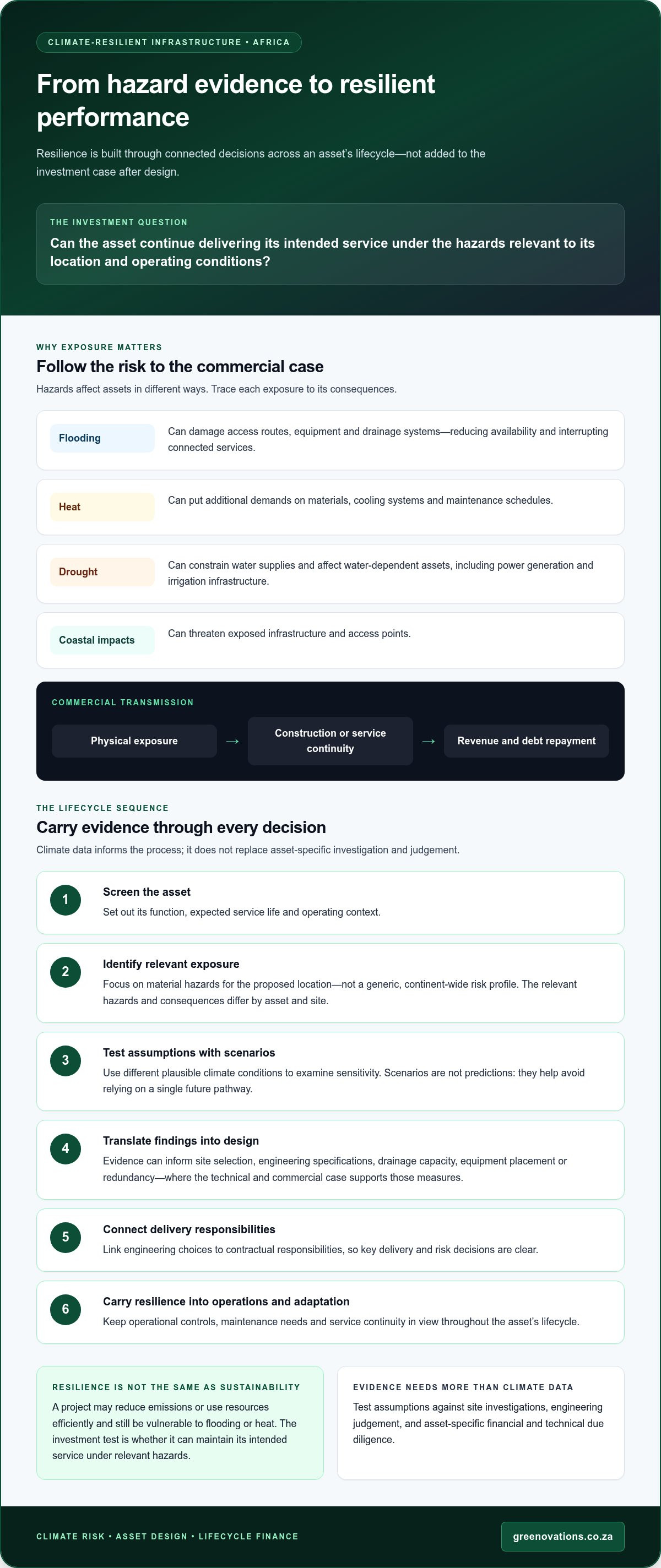
Resilience is not a synonym for sustainability. A project may reduce emissions or use resources efficiently yet remain vulnerable to flooding or heat. The investment test is whether the asset can continue delivering its intended service under hazards relevant to its location and operating conditions. Measures that protect performance should be reflected in engineering, maintenance and financial decisions.
Weak assumptions can lock in avoidable exposure. A transport link designed using incomplete flood information may face more frequent service disruption. A water or power asset that overlooks changing water availability may need operational changes or additional maintenance. These risks are not uniform across the continent. Exposure depends on the asset, its precise location, design, supporting networks and operating context. For investors, climate resilient infrastructure investment Africa therefore calls for asset-level analysis, not a generic regional risk label.
Which climate hazards can affect African infrastructure assets?
Flooding can damage access routes, equipment and drainage systems, reducing availability and interrupting connected services. Heat can put additional demands on materials, cooling systems and maintenance schedules. Drought can constrain water supplies and affect assets that depend on water, including power generation and irrigation infrastructure. Coastal impacts can threaten exposed infrastructure and access points. Each hazard has a different transmission path, so diligence should connect physical exposure to asset function, maintenance requirements and service continuity.
The Climate Resilient Infrastructure Development Facility (CRIDF) focuses on climate-resilient infrastructure development. Its work illustrates why climate exposure should be assessed alongside the assets and services that depend on shared water resources.
Why the investment gap is also a project-quality challenge
Infrastructure demand creates a need for capital, but mobilising capital alone does not produce investable resilience. Projects also need robust climate-risk appraisal, credible engineering responses, prepared documentation and clear responsibility for ongoing operations. Without these foundations, investors may struggle to distinguish a priced and managed risk from an untested assumption.
The African Union Executive Council formally adopted the Continental Policy on Climate Resilient and Smart Infrastructure in February 2025. The African Union Commission’s 16 July 2026 publication describes its mandate to integrate resilience, low-carbon strategies and smart technologies across infrastructure sectors. For investors, that policy direction reinforces the need to translate climate considerations into project decisions, rather than treating them as a separate sustainability narrative.
Investment-needs estimates need clear attribution. Report the National Development Fund (NDF) estimate only with its original publication date, timeframe and scope. A figure without those details cannot support a sound comparison. Mobilising more capital can close a financing shortfall; rigorous climate-risk integration shows whether projects are built to perform under stress.
How climate resilience is built into an infrastructure project lifecycle
Climate resilience comes from connected decisions, not a single climate assessment attached to a completed design. For climate resilient infrastructure investment Africa, the process needs to link hazard evidence to engineering choices, contractual responsibilities and operational controls. Climate data informs these decisions, but it does not replace site investigations, engineering judgement or financial and technical due diligence.
Climate-risk integration is a sequence of decisions that carries evidence from initial screening through design, delivery, operations and adaptation.
From climate screening to project design
Start with the asset’s function, expected service life and operating context. Identify material hazards for the proposed location rather than applying a continent-wide risk profile. A water-dependent asset, for example, may need scrutiny of drought and water availability, while a transport route may require analysis of flood exposure, drainage and access. Relevant hazards and consequences differ by asset and site.
Scenario analysis tests whether design assumptions remain robust under different plausible climate conditions. Scenarios are not predictions. They help decision-makers examine sensitivity and avoid relying on a single future pathway. Findings can inform site selection, engineering specifications, drainage capacity, equipment placement or redundancy where the project’s technical and commercial case supports those measures.
- Screen exposure. Map the asset and associated infrastructure against relevant hazards, recording the data source, resolution and limitations.
- Assess vulnerability. Determine how hazards could affect components, service availability, maintenance needs and dependencies such as water, power or access.
- Select measures. Compare project-specific responses with the identified failure pathways, then document their design basis, lifecycle implications and residual risks.
From construction to operation and adaptation
Design controls create value only if they are built, tested and operated as intended. Construction plans should translate resilience specifications into quality checks, material requirements and clear responsibility for managing deviations. Commissioning then tests whether systems perform against their design requirements. These are separate controls: a sound design does not demonstrate correct construction, and commissioning does not replace ongoing operational readiness.
- Allocate risk. Define which parties own climate-related decisions and responsibilities during construction and operation, including maintenance, contingency procedures and escalation when performance falls short.
- Monitor performance. Track indicators tied to the asset’s exposure and function, such as service interruptions, maintenance patterns, system downtime or relevant water and heat conditions. Set out how information is recorded, reviewed and acted on.
Operational readiness includes trained personnel, maintenance budgets, access to critical inputs and workable contingency arrangements. It is a delivery requirement, not a design feature. Adaptation planning should also be iterative. Review assumptions at defined project milestones and when monitoring, updated climate information or asset performance indicates that operating procedures or engineering responses need adjustment.
Integrated delivery models can align these stages by connecting design, construction, finance and operations under a coherent project structure. Greenovations Venture Studio’s model can combine these responsibilities through design-build-finance-operate-transfer concessions. Its infrastructure project approach reflects the importance of considering capital structure and operations together, while project-specific diligence determines which arrangement fits.
How investors can compare resilience, bankability and conventional infrastructure returns
Resilience should strengthen an investment case, not obscure its underlying economics. Assess commercial performance first, then test how climate exposure could alter that case and what specific measures change. For climate resilient infrastructure investment Africa, this separation helps investors distinguish an investable asset from a resilience claim that lacks a traceable link to performance.
| Assessment layer | What to examine | Investor test |
|---|---|---|
| Base-case commercial performance | Demand, counterparties, revenue logic, operating requirements and lifecycle costs. | Can the project meet its financial obligations under documented base-case assumptions? |
| Climate exposure | Relevant hazards, vulnerable components, dependencies and potential interruption pathways. | Which assumptions could climate stress weaken, and how would the effect reach revenue or costs? |
| Resilience measures | Specified interventions, implementation costs, operating responsibilities and performance indicators. | What changes against the baseline, and what evidence will demonstrate the effect? |
Additionality is the difference resilience investment makes compared with a credible project baseline. The baseline should describe the asset and its performance without the proposed resilience measure. Then identify the intervention, its incremental cost, the risk pathway it addresses and the evidence that would show whether it improves asset availability, service continuity or recovery. Avoided losses may inform the analysis, but they are not automatically project revenue. Keep financial returns, avoided-loss estimates and wider development benefits distinct.
What makes a resilience project commercially assessable?
A project becomes assessable when its demand case, counterparties, revenue mechanism, operating model and lifecycle costs can be examined alongside its climate assumptions. Investors should be able to trace each proposed measure to an exposed asset function and a measurable outcome. Greenovations’ commercial and industrial solar utility hubs, for example, use contracted power purchase agreements. That revenue structure is a commercial feature, not proof of a quantified resilience result.
The Global Center on Adaptation (GCA) has cited research reporting potential returns of two to fifteen times initial investment for adaptation measures. Treat this as a reported range, not a forecast or premium for a specific project. Results depend on the underlying study’s methodology, project type, time horizon and treatment of avoided losses and wider benefits. The range does not establish that an individual intervention will generate equivalent cash returns.
How different capital sources can contribute
Commercial lenders generally assess repayment capacity and risk allocation. Institutional investors consider mandate, duration and risk-adjusted performance. Development and climate-finance providers may support objectives or risks that commercial capital cannot carry alone. Blended finance can allocate defined risks between capital sources, but it is a structuring option, not a default requirement. Use it where the allocation addresses a demonstrable project constraint.
Fund announcements also need careful interpretation. Africa50’s Infrastructure Acceleration Fund reported a first close in August 2025 and announced additional support in August 2026. These dates describe financing milestones, not evidence that announced capital has been deployed into projects or generated resilience outcomes. Assess actual commitments, disbursements, project selection and performance separately.
A practical due-diligence framework for climate-resilient infrastructure in Africa
Climate-risk diligence needs to connect physical exposure to engineering, governance and cash flow. For climate resilient infrastructure investment Africa, a risk register alone is not enough. The investment case needs traceable evidence, explicit assumptions and named responsibility for decisions. Assess each proposed measure against the asset’s service obligations, expected lifespan and financing structure, rather than as a stand-alone technical addition.
Use five workstreams to organise the review:
- Exposure: Identify relevant hazards, the period over which exposure is assessed, affected asset components and critical dependencies. Record data sources, limitations and uncertainty rather than presenting projections as certain outcomes.
- Engineering response: Link each measure to a specific vulnerability and test whether it protects the required asset function. Review design evidence, residual risk and implications for construction and lifecycle costs.
- Permits and governance: Map approval processes, decision rights and accountability across relevant public and private parties. Check applicable country-level rules and project-specific permissions without assuming that one jurisdiction’s requirements apply elsewhere.
- Revenue and counterparties: Trace income to demand, offtake or service obligations, contract counterparties and dependencies. Assess how disruption could affect delivery, revenue collection and financial obligations.
- Ongoing operations: Confirm who is responsible for maintenance, monitoring, contingency procedures and responding when evidence indicates changing exposure or weaker asset performance.
Climate-risk and technical diligence questions
Test the evidence behind the risk assessment. Which hazards were analysed, what exposure periods were used, and how were vulnerability assumptions established? Where is the evidence uncertain or incomplete? Then examine whether the proposed design response addresses the identified failure pathways without compromising the asset’s required service. A measure that appears technically sound still needs an implementation plan, maintenance provision and operating procedures that work under changing conditions.
Documentation should let another reviewer follow the reasoning from source data to engineering decision. Record why a measure was selected, which alternatives were considered, what risks remain and what evidence would trigger a review. Keep operational and contingency procedures specific to the asset and the people responsible for carrying them out.
Commercial, governance and delivery diligence
Map the delivery chain from financing through construction, operation and maintenance. Set out which parties carry each responsibility, how climate-related decisions are escalated, and who records and reports performance. Review this against the project’s actual agreements and governance arrangements. Don’t assume a concession, public-private partnership or other contract model assigns risk in the same way.
Finally, test whether resilience measures fit the financing structure. Capital expenditure, maintenance obligations, contingency provisions and service commitments need to align over the asset lifecycle. A measure with no accountable owner or operating budget may not deliver the intended performance, even if it appears in the design documentation.
Greenovations Venture Studio brings design, build, finance and operational considerations together in infrastructure project development. Explore Greenovations’ infrastructure project approach to see how integrated delivery can support project preparation and accountability.
How investment structures can connect resilience with long-term infrastructure delivery
Capital structure determines more than who funds construction. It allocates decision rights, performance obligations and exposure to lifecycle risks. In climate resilient infrastructure investment Africa, the structure needs to connect climate-risk findings to the parties able to design for, finance and manage those risks. A financing instrument cannot compensate for unclear accountability or weak project economics.
Different structures serve different functions:
- Funds pool capital across a portfolio and allocate it to investments under a defined mandate. They can diversify exposure across projects, but each asset still needs its own diligence, delivery plan and operating accountability.
- Project finance assesses a defined asset or project, with funding and repayment linked to its cash flows and contractual arrangements. Revenue assumptions, counterparties and risk allocation are central to lender and investor analysis.
- Concessions can assign specified delivery and operating responsibilities to a private partner for an agreed period, subject to contract design and project conditions. They can link stages of delivery, but do not eliminate public-sector responsibilities or underlying project risk.
Long-term contracts can align funding, construction standards and operating performance when the asset’s revenue model, counterparties and service obligations support that arrangement. Contracted power purchase agreements, for example, provide a revenue framework for commercial and industrial solar utility hubs. The contract’s existence alone does not establish climate resilience; the asset’s exposure, technical response and ongoing operating arrangements still need assessment.
No-CAPEX and concession models in context
A no-CAPEX deployment shifts the upfront capital requirement through a structured commercial arrangement. It does not remove cost. The project still needs a viable payment mechanism, defined responsibilities and a credible allocation of operating and performance risks. This approach may affect how an organisation deploys its balance sheet, but its suitability depends on project economics, counterparties and contractual terms.
A design-build-finance-operate-transfer (DBFOT) concession can bring design, construction, finance and operations into one delivery framework before transferring the asset under agreed conditions. This may strengthen lifecycle alignment where the contract makes responsibilities measurable and enforceable. It is not a universal template: asset characteristics, revenue certainty, service obligations and risk allocation determine whether the model is workable.
From investment thesis to an executable project
Greenovations Venture Studio invests in and builds green-economy businesses across Africa, including infrastructure and energy ventures. Its project model can combine design, build, finance, operation and transfer, treating capital structuring and delivery as connected decisions rather than separate workstreams. The investment thesis still needs to become an asset-specific plan: climate evidence informs technical choices, those choices are reflected in financing and contracts, and an accountable operator manages the asset over time.
Solar utility hubs and municipal waste-management public-private partnerships are portfolio examples of infrastructure orchestration. They are not, by themselves, evidence of quantified resilience outcomes. For each project, investability rests on the strength of the evidence, the credibility of the revenue and delivery model, and disciplined lifecycle execution. Resilience becomes commercially relevant when it is specified, financed, assigned and managed, not merely stated as an ambition.
Turn climate-risk priorities into an investable pipeline
Convert climate-risk priorities into a defined investment mandate: identify which asset classes fit your capital strategy, what evidence is required before commitment, and who will remain accountable through delivery and operation. That discipline gives climate resilient infrastructure investment Africa a practical basis for moving from screening to project development, without treating a resilience label as a substitute for commercial assessment.
Greenovations is a venture studio building green-economy businesses across Africa, with a portfolio spanning energy, mobility, materials and infrastructure project development. This cross-sector perspective connects infrastructure concepts with the capital structures and operating models needed to develop them. The objective is not to promise a particular outcome, but to build projects around clear assumptions, credible delivery responsibilities and investable commercial logic.
For investors and project stakeholders ready to assess that approach, explore Greenovations’ infrastructure investment approach. With disciplined preparation and accountable execution, climate resilience can become part of a stronger, more investable infrastructure pipeline.
Frequently Asked Questions
What is the difference between climate resilience and climate adaptation in infrastructure?
Climate adaptation describes adjustments made to address actual or expected climate effects; resilience concerns an asset or system’s capacity to keep functioning, recover or adapt under stress. For example, raising electrical equipment above a flood level is an adaptation measure. Whether the wider facility can maintain its essential service during and after flooding is a resilience question. The terms overlap, but evaluating an intervention and evaluating asset performance are distinct tasks.
Can climate-resilient infrastructure attract private investment in Africa?
Yes, if the project’s commercial fundamentals and evidence meet investor requirements. A resilience designation alone won’t secure investment. For example, a lender assessing an energy project may examine whether the revenue model can withstand interruptions, whether counterparties can meet their obligations and how climate-related disruption affects cash flow. Clear risk allocation and credible project preparation help investors assess exposure. Public or climate finance may complement commercial capital where the project’s risk profile and structure justify it.
How much climate adaptation finance does Africa need?
The Global Center on Adaptation cites Climate Policy Initiative’s estimate of annual adaptation and resilience financing needs for Africa by 2030. This is a forward-looking estimate, not a total of funds committed or spent. Because the cited figure is in a foreign currency, it should not be presented as a rand amount without a dated, verified conversion. Any publication should also identify the source’s geographic scope, methodology and date.
What happens if climate risk is excluded from infrastructure planning?
Excluding climate risk can leave investment decisions reliant on assumptions that don’t reflect an asset’s operating conditions. For example, a facility may depend on an access route or utility connection exposed to a different hazard than the facility itself. If that dependency is missed, the main asset may be technically sound yet unable to deliver its service during disruption. Early review helps surface these links, although consequences depend on the project and its context.
Is climate-resilient infrastructure the same as green infrastructure?
No. Green infrastructure generally incorporates ecological processes or nature-based systems, though usage varies across sectors. Climate resilience is about managing relevant climate risks and maintaining or restoring function. A drainage project that uses wetlands, for instance, may be both green and resilience-focused, but the labels alone don’t establish performance. Assess the design purpose, evidence of risk reduction and maintenance arrangements independently before drawing conclusions about either claim.
Which sectors are relevant to climate-resilient infrastructure investment in Africa?
Relevant sectors include energy, transport, water, irrigation, housing, manufacturing and green infrastructure. Their investment cases differ: a water-dependent industrial facility, for instance, has different operational dependencies from a transport corridor or an electricity network. Start with the service the asset must provide, then examine its supply chains, connected infrastructure and operating context. A sector’s relevance identifies where to investigate, not whether a particular project is resilient or commercially investable.
Visual summary
Planning a project like this?
Talk to the Greenovations venture desk about a No-CAPEX structure.