

Fleet electrification is an operational and capital-allocation decision, not simply a vehicle-buying decision. A practical guide to commercial EV fleet electrification Africa-wide starts with the work each vehicle performs, not a target number of vehicles to replace. Route length, payload, daily utilisation and return-to-base patterns help determine which vehicles can transition without compromising service.
Charging access, grid capacity and vehicle availability vary by market, while upfront investment can obscure the operating requirements that shape long-term value. The answer is not to electrify every vehicle at once. Use duty-cycle data to identify suitable routes, plan infrastructure around operational needs and compare financing structures against the fleet’s actual utilisation.
This guide sets out a practical process for African operators. It covers fleet readiness, charging infrastructure and resilience, local considerations, and the capital implications of ownership and alternative operating structures. Greenovations Venture Studio develops and deploys electric-vehicle ecosystem projects through a no-CAPEX model. The aim is a phased, commercially grounded plan that protects continuity and allocates capital with discipline.
Key Takeaways
- Use route length, dwell time, payload and daily utilisation to identify which fleet roles are practical candidates for electrification.
- Assess depot, destination and public charging against operational control, availability and the demands of each duty cycle.
- Compare a phased pilot with full-fleet conversion to understand the trade-offs in continuity, infrastructure and capital allocation.
- For commercial EV fleet electrification Africa, organise the assessment around baseline data, feasibility, pilot review and disciplined scale-up.
- Consider how an EV ecosystem project, including a no-CAPEX structure, allocates capital, contractual responsibilities and operating requirements.
Commercial EV fleet electrification in Africa: assess the operational case first
Start with the work the fleet performs, not the vehicle catalogue. A vehicle that completes repeatable routes and returns to base for a predictable dwell period presents a different operating case from one that travels variable distances, carries changing payloads or must remain available across shifts. Those differences shape vehicle selection, charging access and the energy arrangements needed to support service.
Commercial fleet electrification is the coordinated alignment of vehicle deployment, charging infrastructure and energy operations with a fleet’s duty cycles. It is not simply the purchase of electric vehicles. Replacing vehicles without planning where, when and how they charge can transfer risk from fuel supply to vehicle availability. The case for commercial EV fleet electrification in Africa therefore rests on evidence about actual work patterns, not assumptions based on vehicle category alone.
Which fleet duty cycles are suitable for electrification?
Segment the fleet by route length, repeatability, mileage and return-to-base patterns. Then compare each segment’s operating schedule with realistic charging windows and turnaround requirements. A vehicle that returns to a depot overnight may have a different charging opportunity from one that works across sites or runs back-to-back shifts.
Use dispatch records, odometer data, load profiles and time at each stop to identify candidates. A delivery van and a similar-sized service vehicle may have very different daily patterns, so evaluate the work, not just the body type. Prioritise pilot routes with documented schedules, repeatable patterns and charging that can fit into existing downtime.
What should an African fleet readiness assessment include?
Map each operating site against grid access, existing energy assets, parking and vehicle turnaround. Record charging constraints alongside fleet requirements, including where vehicles are based and whether their schedules allow them to remain connected. This establishes the operational footprint before infrastructure is specified.
Assess each South African operating site against its local policy, vehicle availability, charging access and grid conditions. Requirements and infrastructure constraints can vary across the country, so assess them for each project rather than assuming a plan developed for one site will transfer unchanged to another.
Establish a baseline before changing vehicles or charging arrangements. Track utilisation, energy use, downtime and service performance using consistent definitions, then compare pilot results against the same measures. Assign responsibility for data quality across fleet operations, facilities and energy management. Without a reliable baseline, operators cannot distinguish a genuine improvement from changes in workload, route allocation or vehicle availability. Use that evidence to decide whether to proceed, adjust the operating model or defer wider deployment.
How to design an EV fleet system around vehicles, charging and energy
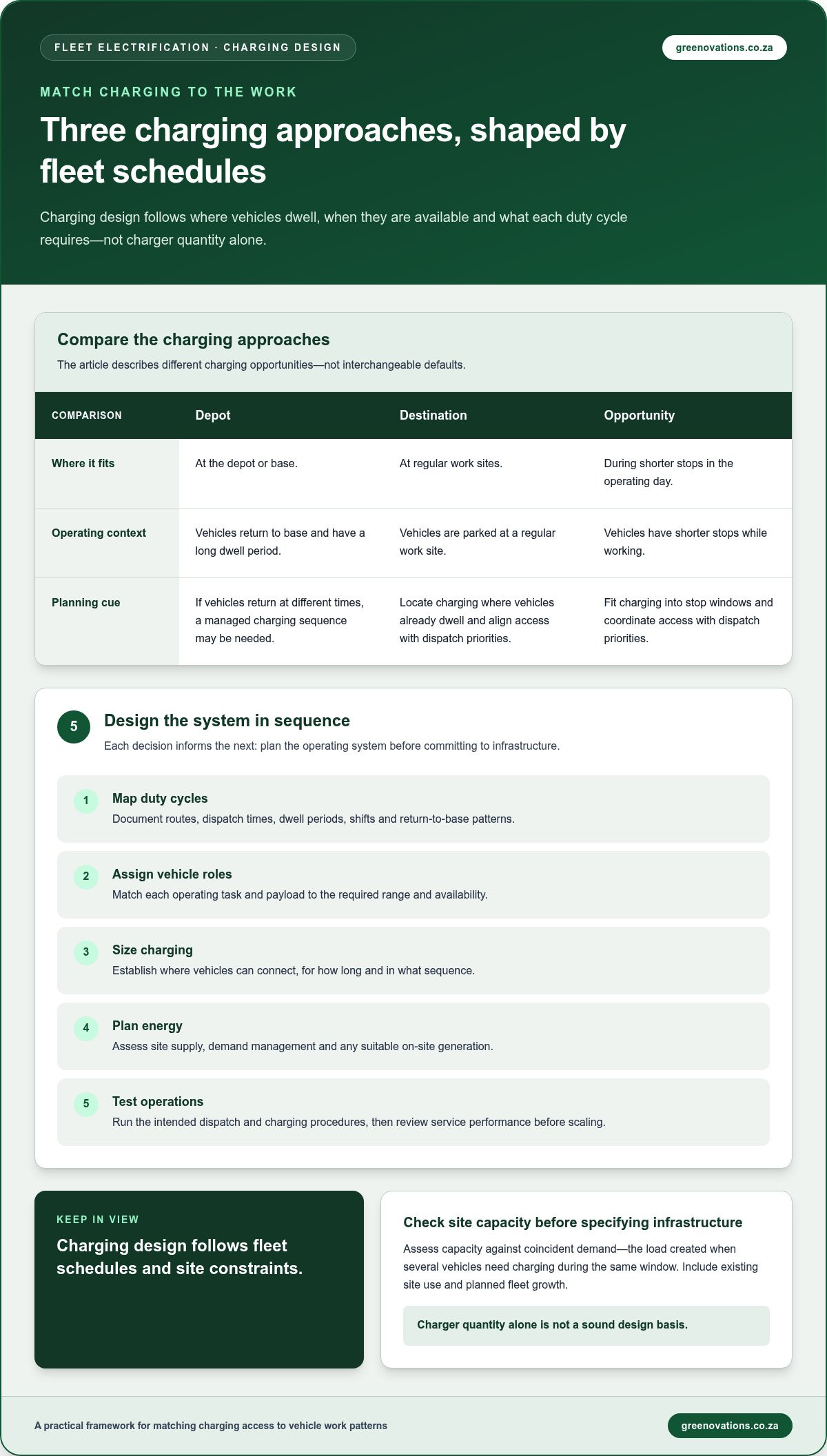
Design the operating system before committing to infrastructure. The sequence is straightforward, but each decision affects the next: map duty cycles, assign vehicle roles, size charging around schedules, plan site energy and test the operating model. This turns commercial EV fleet electrification Africa into an engineered transition rather than a collection of disconnected vehicle and charger purchases.
Charging design must follow fleet schedules and site constraints, not the other way round. Depot charging may suit vehicles that return to base for long dwell periods. Destination charging can serve vehicles parked at regular work sites, whilst opportunity charging uses shorter stops during the operating day. These approaches are not interchangeable defaults. A fleet may use more than one, depending on its routes and turnaround requirements.
- Map duty cycles: document routes, dispatch times, dwell periods, shifts and return-to-base patterns.
- Assign vehicle roles: match each operating task and payload to the vehicle’s required range and availability.
- Size charging: establish where vehicles can connect, for how long and in what sequence.
- Plan energy: assess site supply, demand management and any suitable on-site generation.
- Test operations: run the intended dispatch and charging procedures, then review service performance before scaling.
How should fleet operators plan charging infrastructure?
Locate charging where vehicles already dwell, then align access with dispatch priorities. A depot serving vehicles that return at different times may need a managed charging sequence. At a site with tightly scheduled departures, charging availability must be coordinated with those departures. Charger quantity alone is not a sound design basis.
Assess site capacity against coincident demand, meaning the load created when several vehicles need charging during the same window. Include existing site use and planned fleet growth before specifying infrastructure. Define monitoring and access procedures around vehicle roles, staff responsibilities and operating hours, so charging supports dispatch rather than creating a new bottleneck.
How do energy systems support reliable fleet charging?
At each operating site, assess grid supply, expected charging demand, load management and the consequences of supply interruptions. The design must account for when vehicles need energy, not just the total energy they consume. Backup requirements depend on service-continuity risk and site operating conditions.
Solar PV may complement charging where site conditions and fleet schedules support useful integration. It is not a universal substitute for grid capacity or operational planning. Specify energy-system components and responsibilities through project-specific engineering, including how the system will be operated as fleet size changes.
Greenovations develops electric-vehicle ecosystem projects that bring infrastructure planning into the wider deployment model. Explore electric-vehicle ecosystem development to consider how project orchestration can fit fleet and site requirements.
Compare fleet electrification options, infrastructure constraints and financing
There is no single transition model for every fleet. A phased pilot limits the initial operational change and tests assumptions against live service conditions. Full-fleet conversion can coordinate procurement and infrastructure at scale, but concentrates execution risk. Compare both approaches against duty cycles, site readiness and tolerance for disruption. Build the commercial EV fleet electrification Africa case from project inputs, not a market-wide cost assumption.
| Approach | Operational advantage | Trade-off to assess |
|---|---|---|
| Phased pilot | Tests vehicle, charging and dispatch arrangements on a defined part of the fleet. | Requires parallel management of electric and existing vehicles during transition. |
| Full-fleet conversion | Allows the operating model and infrastructure plan to be designed for the target fleet together. | Concentrates procurement, site-readiness and continuity risks into a larger change programme. |
Charging access also involves trade-offs. Depot charging offers greater site control where vehicles return regularly, but depends on depot capacity and suitable dwell windows. Destination charging can align with scheduled stops, though access and availability depend on the site. Public charging may extend route options, but operators have less control over access and availability. Test each option against actual schedules and service requirements.
How do grid and charging constraints affect the business case?
Model charging demand by site and time, including periods when multiple vehicles need energy simultaneously. Compare this demand with verified information on site capacity, connection lead times and supply reliability. Then test whether vehicles can complete planned work under the proposed charging arrangement, including the effect of a delayed connection or supply interruption.
Translate service requirements into resilience criteria rather than assuming a standard backup solution. The appropriate response depends on site conditions, route criticality and the consequences of vehicle unavailability. Include these requirements in the project case alongside vehicle deployment and infrastructure scope.
What should decision-makers compare in financing structures?
With direct capital expenditure, the fleet or infrastructure owner commits capital and carries the responsibilities assigned to it for asset ownership, maintenance and performance. A no-CAPEX structure can reduce initial capital allocation, but it does not remove project obligations. Contract terms still need to define who owns and maintains assets, which party carries each delivery or operating risk, and what happens over the contract period.
Compare contracted operating payments with internal budget cycles and balance-sheet priorities. The commercial model should specify measurable service and performance requirements, reporting responsibilities, remedies and risk allocation. Test the case using project-specific inputs: vehicle utilisation, energy demand, charging access, maintenance scope, contract duration and service-continuity requirements. Greenovations’ no-CAPEX infrastructure model gives operators a structure to assess alongside operational feasibility and contractual diligence.
How to phase commercial EV fleet electrification across African operations
Scale only when evidence supports the next commitment. A disciplined rollout moves from baseline data to feasibility, pilot, review and controlled expansion, with a decision gate at each stage. This approach avoids treating different markets as one operating environment and makes assumptions visible before they are embedded in procurement or infrastructure contracts.
- Establish the baseline: record route performance, utilisation, downtime, energy use, maintenance inputs and service levels for the vehicles under consideration.
- Complete market and site feasibility: assess vehicle suitability, charging access, grid conditions and the country-specific approvals, safety and technical requirements that apply before deployment.
- Run a representative pilot: select vehicles and routes that reflect normal work patterns, then operate them using the intended charging and dispatch procedures.
- Review performance: compare results with the baseline, document variances and reassess assumptions about vehicles, sites and energy demand.
- Scale in controlled stages: expand only where operational evidence, infrastructure readiness and agreed commercial responsibilities support the next deployment.
Make governance explicit. Fleet operations owns route selection, dispatch and service continuity; finance assesses capital allocation and budget exposure; facilities oversees site readiness; procurement manages vehicle and infrastructure requirements; energy management evaluates supply, demand and charging performance. Name an accountable decision-maker for each workstream and define who approves movement through each stage. This prevents a technically ready site from being mistaken for an operationally or financially ready project.
What should an EV fleet pilot prove before expansion?
A pilot should test representative routes and charging schedules under normal operating conditions, not just demonstrate that vehicles can complete a planned journey. Track availability, utilisation, service continuity, downtime, charging performance, energy demand and maintenance inputs against baseline measures. Set scale-up criteria before launch, and record which assumptions need reassessment if workload, site conditions or operating procedures change.
How can operators manage transition risk across markets?
Sequence deployment by local infrastructure readiness and operating evidence, not by a fixed regional template. Define a response for charging disruption and vehicles returning outside expected schedules, including the decisions needed to protect priority services. As the scope changes, review contractual responsibilities, performance measures and risk allocation so expansion does not leave gaps between asset ownership and day-to-day operating accountability.
Before deployment in each market, verify applicable approvals and technical and safety requirements against current local rules. Keep that review separate from assumptions carried over from another country. A prior project is a reference point, not a substitute for local diligence. Record decisions, owners and unresolved dependencies in a deployment register, then use it to govern readiness and subsequent changes.
Greenovations develops electric-vehicle ecosystem projects and supports project orchestration as operators plan infrastructure responsibilities and deployment stages. Discuss an EV ecosystem deployment as part of a structured transition plan.
How Greenovations approaches commercial EV ecosystem deployment
Vehicles, charging infrastructure and energy arrangements must work as one commercial system. Greenovations develops and deploys electric-vehicle ecosystem projects, approaching deployment as an infrastructure orchestration challenge rather than a standalone vehicle purchase. Fleet readiness, site conditions and service requirements establish the project scope; commercial and contractual design then determines how infrastructure is delivered and operated.
Greenovations uses a no-CAPEX model for infrastructure deployments, allowing partners to avoid upfront capital expenditure. This does not mean the project has no cost or obligations. Each project still needs a defined scope, clear responsibilities, measurable performance requirements and an allocation of delivery and operating risks. Assess the commercial EV fleet electrification Africa opportunity against operating evidence first, then structure it around the needs and constraints that evidence reveals.
What does a no-CAPEX EV ecosystem model change?
A no-CAPEX structure changes how infrastructure investment is arranged, so the fleet operator’s assessment should extend beyond initial capital outlay. Establish which assets and services sit within the project, who is responsible for delivery and ongoing operation, how performance is measured, and what contractual obligations apply over time.
Greenovations’ broader project approach includes design-build-finance-operate-transfer concessions. The relevant structure depends on project scope and agreed responsibilities; the label alone does not determine who carries each risk. Contract documentation should make accountabilities, reporting and performance measures explicit. EV ecosystem terms should be developed for the project rather than assumed to follow tariff arrangements used in other infrastructure contexts.
What are the next steps for a fleet electrification assessment?
Bring the operational and commercial evidence into one assessment. Assemble:
- Fleet records covering vehicle roles, routes, utilisation, downtime and maintenance inputs.
- Site information on operating locations, grid access, existing energy assets and charging constraints.
- Energy and operating-cost baselines, with consistent measures for comparing existing and proposed operations.
- Commercial priorities, including capital allocation, service-continuity requirements and the responsibilities the organisation may retain or allocate through contracts.
Use that baseline to prioritise pilot operations where routes and charging arrangements can be evaluated against defined service requirements. State what the pilot must resolve, such as charging performance, vehicle availability, site readiness or the allocation of operating responsibilities. Those questions give the project a decision framework and a clear route from pilot to scale.
Greenovations develops and orchestrates electric-vehicle ecosystem projects through a no-CAPEX model. Explore Greenovations’ commercial EV ecosystem approach to assess infrastructure scope, capital allocation and contractual responsibilities together.
Turn fleet evidence into an investable next step
The next decision is not whether electrification belongs in the strategy. It is whether a defined fleet segment can support a disciplined investment case under its market’s operating conditions. Convert the assessment into a decision brief that records commercial assumptions, unresolved dependencies, accountable owners and criteria for proceeding. This gives leadership a basis to allocate capital, structure responsibilities and authorise the next stage without treating ambition as evidence.
For commercial EV fleet electrification Africa, sound project orchestration connects infrastructure scope with financing and operating obligations. Greenovations develops electric-vehicle ecosystem projects through a no-CAPEX model, and its broader project experience includes design-build-finance-operate-transfer concessions. Assess these structures against the fleet’s requirements rather than treating them as predetermined outcomes.
Bring together the fleet and site evidence, then define the project’s commercial questions and responsibilities. Explore Greenovations’ commercial EV ecosystem approach to take the next step towards a structured deployment decision. A well-defined case gives the organisation a sound basis for moving forward with discipline.
Frequently Asked Questions
How do you electrify a commercial fleet in Africa?
Start with a documented operating case for each vehicle group, then develop the vehicle, charging, energy and contractual plan around the work. For commercial EV fleet electrification Africa, keep country assumptions distinct: local grid conditions, vehicle availability and applicable requirements can alter the sequence. A useful first step is to select an operation with stable schedules and clear service measures, then use the results to decide whether the next deployment is justified.
Which commercial vehicles are best suited to fleet electrification?
Vehicles with repeatable work patterns and predictable periods of inactivity are often the clearest candidates for assessment, provided their required range and payload can be met. For example, a service van returning to base on a regular schedule may be easier to plan around than a vehicle whose daily assignments change substantially. Compare each vehicle’s actual tasks and dispatch requirements; broad labels such as “delivery fleet” are not enough to establish suitability.
What charging infrastructure does an electric commercial fleet need?
The required infrastructure depends on where vehicles can park, how long they remain there and which departures take priority. A depot-based operation may plan charging at its own site, whilst vehicles working across fixed destinations may need charging access at those locations. Public charging can form part of a route plan, but should not be treated as guaranteed capacity. Include site access, connection arrangements, charging procedures and future fleet changes in the design brief.
Can an electric fleet operate reliably where grid capacity is constrained?
It may be feasible, but reliability depends on matching charging demand to verified site supply and operational requirements. Assess whether vehicles can charge in staggered windows, whether site loads can be managed, and what a supply interruption would mean for priority services. The appropriate resilience measures are project-specific. Model constrained and disrupted operating scenarios before committing, including how dispatch would respond if vehicles return later than scheduled or charging is unavailable.
How can a business assess the cost of commercial fleet electrification?
Build a like-for-like financial model using the fleet’s own operating records rather than relying on generic savings claims. Include vehicle acquisition or contracted payments, charging infrastructure, energy, maintenance, downtime and the cost of operational changes. Compare these with the current fleet’s fuel, maintenance and service costs over a consistent evaluation period. Test how the result changes if utilisation, energy requirements or infrastructure scope differs from the initial assumption.
What does no-CAPEX mean for commercial EV fleet infrastructure?
No-CAPEX means infrastructure deployment is structured without requiring upfront capital expenditure from the partner. It does not mean the project has no cost or obligations. Greenovations deploys electric-vehicle ecosystem infrastructure through a no-CAPEX model. The commercial assessment should define the contracted scope, operating responsibilities, asset arrangements, performance measures and risk allocation. Develop these terms for the EV project rather than assuming they follow another infrastructure agreement.
How should a business pilot electric vehicles before converting its fleet?
Choose a pilot that reflects normal operations, not an unusually simple route or schedule. Agree in advance what evidence will support expansion, such as vehicle availability, completed work, charging performance, downtime and maintenance requirements. Record exceptions and their causes, then compare pilot results with the existing operation using consistent measures. A decision to scale should also account for site readiness, local requirements and whether the operating arrangements remain workable at a larger fleet size.
Visual summary
Planning a project like this?
Talk to the Greenovations venture desk about a No-CAPEX structure.