
A no-CAPEX electric vehicle fleet preserves upfront capital, not the obligation to pay for vehicles, charging infrastructure and operations. In South Africa, where imported EVs face a 25% import duty and fleet performance depends on practical charging arrangements, the structure behind deployment matters as much as the headline cost.
Replacing vehicles is only one part of the decision. Routes, daily mileage, charging access, maintenance and accountability all shape whether electrification can meet operational requirements. A no-CAPEX model is not cost-free: it reallocates capital commitments and responsibilities through a project structure that must be assessed against the fleet’s needs.
This case study explains how vehicle and charging assets can be matched to operating requirements, and how responsibilities can be defined across project development, deployment and ongoing performance. It also shows how to compare a no-CAPEX structure with direct investment, using consistent assumptions and relevant fleet data. The objective is commercial clarity: understand each party’s commitments before treating capital preservation as a project benefit.
Key Takeaways
- A no-CAPEX electric vehicle fleet avoids upfront partner capital, but replaces that investment with contractual commitments that need careful assessment.
- Align vehicle requirements, charging infrastructure and operating responsibilities across the project lifecycle before deployment.
- Compare no-CAPEX and direct investment on a consistent basis, including energy, maintenance, utilisation and end-of-contract assumptions.
- Build a credible assessment from fleet, route, energy, infrastructure and operational data, then establish clear contract governance.
- Use an illustrative case to see how project scope, financing, deployment and accountability can fit together, without treating a model as verified results.
Why South African fleets consider a no-CAPEX electric vehicle fleet
Fleet renewal competes for capital with charging infrastructure and investments that keep core operations productive. A no-CAPEX electric vehicle fleet can change when and how a partner commits capital, but it does not remove the cost of deploying or operating the system. The commercial case depends on whether the project structure fits the fleet’s day-to-day work.
In South Africa, the assessment needs to account for the operator’s sites, available power, charging requirements and continuity needs. Grid constraints can affect deployment planning, but their impact varies by site and operation. Assess a no-CAPEX electric vehicle fleet using site-specific energy and infrastructure evidence, rather than assumptions treated as universal market conditions.
What no-CAPEX means for a commercial fleet
Capital expenditure (CAPEX) generally refers to spending on assets, while operating expenditure relates to ongoing costs. In a no-CAPEX structure, the partner avoids upfront capital investment under the agreed project model, but may still make contracted payments and carry operating obligations. The agreement sets out the scope, payment arrangements, asset responsibilities and allocation of risk.
No-CAPEX changes the timing and allocation of capital commitments; it does not mean zero cost or a lower total cost of ownership. A no-CAPEX electric vehicle fleet can preserve upfront capital while creating recurring commitments. The financial assessment must therefore cover the full contract period and the responsibilities assigned to each party.
The fleet conditions that make a structured model worth assessing
Start with the duty cycle, not a headline claim about savings. Fleet size, utilisation, predictable routes and replacement timing help establish whether vehicles can perform their assigned work and whether charging can fit around operating patterns. Variable routes, long shifts or low utilisation can change both the infrastructure requirements and the commercial case.
Charging access, power requirements and continuity are linked. Depot charging may suit predictable return-to-base operations, while other patterns may need a different infrastructure plan. Assess site capacity and energy needs alongside schedules, downtime tolerances and operational contingencies. These are project inputs to resolve before selecting vehicles.
Separate measured needs from projected benefits. Use fleet records to establish mileage, route patterns, vehicle availability and replacement cycles. Assess energy and infrastructure requirements at the relevant operating sites. Calculate savings and emissions reductions from documented assumptions rather than treating them as guaranteed features of the model. This evidence gives decision-makers a disciplined basis for judging whether a no-CAPEX electric vehicle fleet fits their requirements.
How a no-CAPEX electric vehicle fleet deployment is structured
A no-CAPEX electric vehicle fleet is developed as an integrated project, not as a vehicle order followed by separate infrastructure decisions. Fleet requirements inform the design, and the agreed scope connects delivery, financing and operations. This sequence makes dependencies visible before commitments are made and helps align deployment with the operator’s working requirements.
From fleet assessment to an agreed project scope
Project development begins with duty cycles, route patterns, utilisation, replacement timing and charging windows. These inputs define which fleet operations the project is intended to support. Site and power assessments then inform infrastructure requirements, deployment sequencing and dependencies that could affect continuity. The resulting scope should distinguish defined work from assumptions that still need assessment.
Before financial modelling, establish measurable delivery and reporting requirements. Depending on the agreed scope, these may cover infrastructure milestones, asset responsibilities, operational measures and data reporting. A documented baseline gives both parties a reference for evaluating delivery and helps prevent broad claims about performance or savings from being mistaken for agreed outcomes.
How project finance and operating responsibilities connect
A design-build-finance-operate-transfer structure organises responsibilities across project stages. Project development turns fleet needs into a defined scope; delivery parties undertake specified design and build obligations; the financing structure funds the project; and operating duties are allocated for the agreed period. Where transfer applies, the contract identifies which assets or responsibilities transfer and sets the handover conditions.
The framework does not set universal terms. The agreement determines asset ownership or management, included services, payment arrangements, and each party’s delivery, maintenance and continuity obligations. It should also explain how performance is reported, how exceptions are escalated and how changes to fleet requirements are managed. Even when the partner avoids upfront capital, a no-CAPEX electric vehicle fleet depends on clear accountability.
For example, predictable depot returns and variable route patterns create different infrastructure design requirements. The project scope should reflect the operator’s actual pattern rather than assume a standard combination of vehicles, charging equipment or services. Define all included elements and responsibilities expressly in the agreement.
Contract duration and end-of-term arrangements are specific to each project. The agreement should state whether transfer applies, which assets it covers and what the handover requires. Greenovations Venture Studio’s project-orchestration approach aligns design, build, finance and operations around fleet requirements. A no-CAPEX electric vehicle fleet is structured through a defined scope and contractual responsibilities, not through the label alone.
No-CAPEX versus direct investment: compare the fleet economics
Compare cash flows over the same operating period, not just the initial outlay. Direct investment places vehicle and charging infrastructure costs upfront or through the operator’s own funding arrangements. A no-CAPEX electric vehicle fleet avoids the partner’s upfront capital commitment under the agreed structure, but introduces contracted payments and specified obligations. Neither approach is automatically cheaper: the result depends on utilisation, energy, maintenance, asset life and contract terms.
A lower upfront requirement does not prove a lower lifecycle cost. Only a like-for-like model of all fleet and infrastructure obligations can establish the difference.
What to compare in a fleet investment model
Keep fleet size, operating period, vehicle utilisation and replacement assumptions consistent. Separate capital outlay from recurring payments, then include energy, charging infrastructure, maintenance, downtime exposure and end-of-contract treatment in both cases. Model the same routes and duty cycles so that any difference reflects the funding and operating structure, not a change in the fleet being assessed.
Use verified fleet records and project documents for confirmed inputs. Label estimates as assumptions and list unknowns separately instead of burying them in a single total.
| Cost or input | Direct investment | No-CAPEX structure | Evidence status |
|---|---|---|---|
| Vehicles and charging | Upfront or separately funded asset expenditure | Included only if defined in the project scope; reflected in agreed payment arrangements | Confirm asset scope; model any unpriced assumptions |
| Energy and utilisation | Use actual operating patterns and site-specific energy inputs | Apply the same usage and energy assumptions; identify responsibility for each cost | Validate with fleet, route and site data |
| Maintenance and service | Model internal or contracted service obligations | Include only the services and obligations assigned by contract | Confirm scope; test service-level assumptions |
| End of operating period | Model residual asset value, continued use or disposal assumptions | Model the agreed transfer, return or other end-of-contract treatment | Contract conditions may remain unresolved until specified |
Then test how changes in energy use, utilisation, service requirements and asset life affect the comparison. In South Africa, use the relevant site’s applicable energy information rather than a generic tariff assumption. Show the effect of each change on total cash flow and record who bears that exposure.
When preserving capital may outweigh direct ownership
Capital preservation may matter when fleet renewal competes with investments central to production or service delivery. A structured contract can also suit an operator that does not want to manage infrastructure delivery and ongoing operations internally. That trade-off is not free: contracted commitments can reduce flexibility, create dependency on agreed service arrangements and defer or limit direct asset control.
Direct ownership may offer more control over asset use and end-of-life decisions, while requiring the operator to organise funding, delivery and operations. Make the decision by comparing the value of retained capital, internal capability, contract exposure and ownership preferences against the same operating assumptions.
How to assess and prepare a no-CAPEX fleet project
A credible assessment turns operating records into a defined project scope, then tests whether the proposed contractual structure fits the fleet. A no-CAPEX electric vehicle fleet is not made viable simply by removing an upfront payment. Decision-makers need evidence on vehicles, routes, sites and responsibilities before assessing commercial terms.
- 1. Establish the fleet baseline. Record fleet composition, vehicle age and replacement timing, daily distance, duty cycles, utilisation and downtime. Separate vehicles with predictable, repeatable work patterns from those with variable routes or loads. This baseline defines the operating requirements the project must meet.
- 2. Map routes and charging windows. Identify route patterns, return times, parking locations and how long vehicles are stationary. Note depot access and any operational constraints on where vehicles can be parked or charged. These details show whether proposed charging arrangements fit the working day, rather than relying on assumed availability.
- 3. Assess energy and infrastructure at each relevant site. Gather available electrical-capacity information, existing site drawings or infrastructure records, and current energy bills. Compare expected charging demand with those records, then identify where further technical assessment is needed. For South African projects, use current, site-specific energy and regulatory information. Avoid applying a national assumption where local conditions determine feasibility.
- 4. Define continuity and reporting requirements. Specify operational uptime needs, acceptable downtime, maintenance interfaces and the fleet data required for oversight. Identify internal decision-makers, approval steps and capital constraints. If ESG outcomes form part of the project case, set measurable baselines and reporting methods before projecting results.
- 5. Model the project against the evidence. Use the collected inputs to define the fleet and infrastructure scope, deployment dependencies and operating assumptions. Mark confirmed data separately from estimates and unresolved variables. Test how changes in utilisation, routes, energy requirements or fleet size could affect the proposed structure.
- 6. Put governance and responsibilities in writing. Define scope boundaries, payment obligations, service responsibilities, performance measures and reporting frequency in the agreement. Set a change-control process for fleet growth, altered routes or sustained changes in utilisation. Specify escalation paths for delivery or operating issues, along with the contract term, asset ownership and any transfer provisions.
Visible assumptions and explicit accountabilities help manage implementation risk, but do not remove it. Greenovations develops electric vehicle ecosystems around defined project requirements. Structure a fleet ecosystem project around documented operating data, clear responsibilities and measurable outcomes.
Illustrative South African no-CAPEX electric vehicle fleet case study
This is an illustrative scenario, not a completed Greenovations project or a verified customer outcome. It shows how a South African operator could assess a no-CAPEX electric vehicle fleet without assuming that avoiding upfront capital guarantees savings or operational fit.
Illustrative deployment scenario: from fleet baseline to project scope
A commercial operator wants to electrify a defined part of its fleet while preserving capital for core operations. First, it identifies vehicles with predictable work patterns for assessment, then gathers records on routes, daily distance, utilisation, replacement timing and periods when vehicles are parked. The operator also maps potential charging locations, charging windows and available electrical capacity at relevant sites.
This evidence informs a project scope, not a pre-set package. The operator and project partner establish which fleet and infrastructure requirements are in scope, what further site assessment is needed and how deployment could be sequenced around service continuity. If charging access or operating patterns do not support the proposed duty cycle, reconsider the scope or deployment approach before making a commitment.
Next, the parties model the proposed structure. The assessment distinguishes avoided upfront partner capital from contractual payments and ongoing obligations. It defines which party is responsible for delivery, operations, maintenance and performance reporting, where applicable. The agreement also sets out payment arrangements, change control and any end-of-contract or transfer provisions. These terms are specific to the project.
What the operator and project partner would evaluate next
The decision turns on trade-offs, not a headline claim. The operator compares the proposed scope with service continuity requirements, internal delivery capacity and competing capital priorities. It tests the financial model against documented fleet and site data, then reviews how changes in routes, utilisation or operating needs would be managed. Any expected cost or emissions benefit remains a projection until supported by measured inputs and agreed reporting.
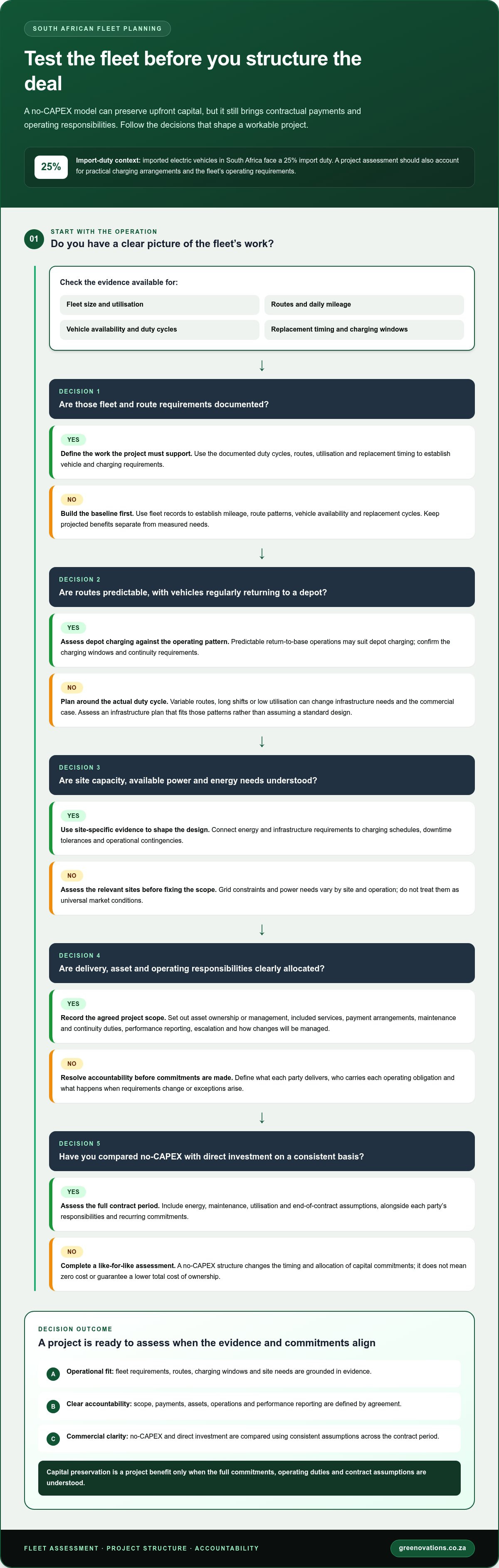
Before proceeding, decision-makers should be able to answer these project-fit questions:
- Are fleet duties, routes, utilisation and charging windows documented?
- Have site energy and infrastructure requirements been assessed for the intended deployment?
- Are scope boundaries, payment obligations, and delivery and operating responsibilities explicit?
- Are performance measures, reporting, escalation and change-control processes defined?
- Do the contract term, ownership arrangements and transfer conditions fit the operator’s priorities?
When these conditions are clear, the project can be evaluated on its actual allocation of capital, responsibilities and risk, rather than the label “no-CAPEX”. Greenovations develops electric vehicle ecosystems using structured project approaches shaped around operational requirements. Assess a no-CAPEX fleet deployment with Greenovations.
Make the fleet decision on evidence and contract design
A no-CAPEX electric vehicle fleet is a capital structure, not a cost-free deployment. Its viability depends on whether fleet duty cycles, charging requirements and operating responsibilities support a clear project scope. Compare the full contractual commitments with direct investment using consistent assumptions, then test how changes in utilisation, energy needs and asset life affect the economics.
Execution depends on more than financing. Define scope, service obligations, reporting, change control and end-of-contract arrangements before commitment. Greenovations develops electric vehicle ecosystems through a no-CAPEX model, with project orchestration that can include design, build, finance, operate and transfer structures. Include commercial delivery and measurable ESG objectives in the assessment, grounding projected outcomes in agreed measures and project evidence.
For fleet leaders, the next step is to review operational data, capital priorities and accountability across the project lifecycle. Assess a no-CAPEX fleet deployment with Greenovations and determine whether the structure fits your requirements. A well-defined assessment gives your team a stronger basis for making the decision with confidence.
Frequently Asked Questions
What does no-CAPEX mean for an electric vehicle fleet?
No-CAPEX means the partner does not provide upfront capital for the project under the agreed structure. It does not mean the fleet has no costs. Contracted payments and operating obligations may still apply, depending on the scope and agreement. For a no-CAPEX electric vehicle fleet, clarify which assets and services are included, who is responsible for them, how payments work and what happens at the end of the contract.
Can a fleet electrification project avoid all upfront costs?
A project can be structured without requiring upfront partner capital, but that does not establish that every related expense is avoided. The agreement defines the project scope and the parties’ responsibilities; costs outside that scope may remain with the operator. For example, internal staff time or site work may need separate consideration, depending on the project. Assess initial obligations and recurring payments before treating the model as cost-free.
How is a no-CAPEX electric vehicle fleet project financed?
Financing is organised through the project structure and contract, rather than a single universal arrangement. A design-build-finance-operate-transfer approach can coordinate project development, delivery, financing, operations and any agreed transfer. The agreement should define the financing party’s role, the assets in scope, payment arrangements and each party’s obligations. Greenovations develops electric vehicle ecosystems under a no-CAPEX model, with responsibilities structured around project requirements.
Is a no-CAPEX fleet model cheaper than buying infrastructure outright?
Not necessarily. Avoiding upfront capital does not prove that total lifecycle cost is lower. Compare both options over the same operating period using consistent assumptions for fleet size, utilisation, vehicle and charging assets, energy, maintenance and end-of-contract treatment. Include contracted payments and the operator’s own costs in the no-CAPEX case. In South Africa, use relevant site-specific energy inputs rather than assuming one cost profile applies to every operation.
What information is needed to assess a no-CAPEX electric vehicle fleet?
Start with fleet composition, replacement timing, daily distance, routes, duty cycles and utilisation. Add depot access, parking patterns, charging windows and available electrical-capacity information for the relevant sites. Document service continuity requirements, maintenance responsibilities, internal approval processes and the fleet data needed for reporting. These inputs support a credible scope and financial assessment. Clearly label estimates and unresolved items instead of treating them as verified operating facts.
What happens if fleet requirements change during the contract?
The agreement should set out a change-control process before deployment. If fleet size, routes, utilisation or charging needs change, the parties can assess the effect on project scope, delivery, payment obligations and operating responsibilities under that process. The contract should also identify approval and escalation steps, and specify how agreed changes are documented. Without clear provisions, operational changes can create uncertainty about cost, accountability and service expectations.
Visual summary
Planning a project like this?
Talk to the Greenovations venture desk about a No-CAPEX structure.