
An EV project isn’t commercially viable simply because vehicles are available. The electric vehicle ecosystem South Africa needs to make projects investable depends on charging access, energy supply, finance and accountable operations working as one system. Treat these as separate purchases and the gaps between them can become unpriced risks.
That’s the central challenge for fleet owners, property operators and investors. Vehicle options and charging networks are developing, yet every project still needs evidence that sites can support the required load, utilisation can sustain the model, and responsibility for maintenance and performance is contractually clear. A collection of assets is not a scalable operating model.
This guide explains how the ecosystem’s components connect and what to test before committing capital. It covers vehicles, charging, grid capacity, energy strategy, finance and long-term operations, then considers broader infrastructure structures such as no-CAPEX deployment and design-build-finance-operate-transfer concessions. These are models to assess, not assumptions of fit for every EV project. Greenovations Venture Studio builds green-economy businesses and lists an Electric Vehicle Ecosystem among its offerings. Confirm project-specific scope and terms directly. The aim is to identify the commercial, technical and contractual evidence a project needs to proceed with discipline.
Key Takeaways
- Assess the electric vehicle ecosystem South Africa requires as an integrated commercial system, not a collection of vehicles and chargers.
- Test site access, available power, energy supply and operating requirements together before setting infrastructure scale or utilisation assumptions.
- Compare direct ownership, third-party-funded deployment and concession structures against capital exposure, control, maintenance, utilisation risk and contract duration.
- Validate fleet or user demand before committing to site selection, power requirements or utilisation forecasts.
- Evaluate Greenovations Venture Studio’s stated no-CAPEX infrastructure approach alongside project-specific scope, risk allocation and operating accountability.
What the electric vehicle ecosystem in South Africa includes, and why it matters commercially
A commercial EV project is more than a vehicle purchase followed by charger installation. The electric vehicle ecosystem South Africa depends on connected assets, energy, users, capital and accountable operations. If one link fails, the others may not deliver their intended commercial value.
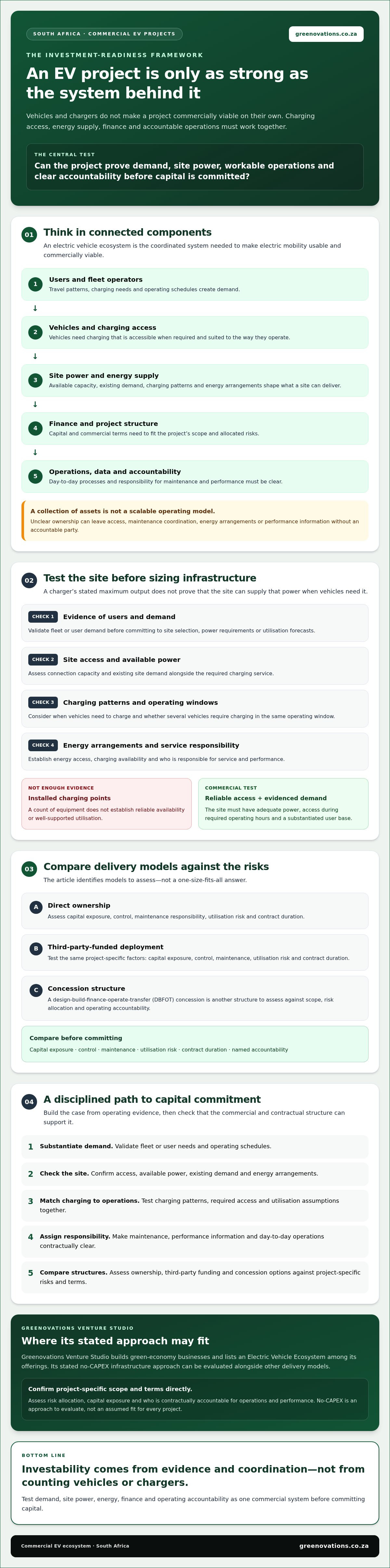
Quotable definition: An electric vehicle ecosystem is the coordinated system of vehicles, charging assets, energy supply, users, data, finance and operations required to make electric mobility usable and commercially viable.
A charger alone does not make a functioning ecosystem. Its value depends on whether users need it, the site has suitable power access, charging fits operating requirements and a named party is accountable for performance. Without those conditions, equipment may sit underused or fail to support fleet activity. The commercial test is reliable access and viable asset utilisation, not the number of components procured.
This is distinct from passenger EV sales. Vehicle availability is one part of the market; commercial stakeholders must also consider the infrastructure and services that enable vehicles to operate. The New energy vehicles in South Africa overview provides wider market context, but each project still needs its own assessment of demand, power, responsibilities and economics.
Which participants make up the South African EV ecosystem?
Each participant supplies a different input. Project design should assign responsibility across them:
- Vehicle users and fleet operators create demand through travel patterns, charging needs and operating schedules.
- Charging providers and electricity suppliers contribute charging assets and energy access. Establish site capacity and service responsibilities before deployment.
- Financiers provide project capital under agreed commercial terms, while public institutions shape the wider policy and institutional environment.
- Project operators coordinate day-to-day processes, data and accountability. These responsibilities may sit with one party or be allocated across contracts.
Unclear ownership creates delivery gaps. If no party is explicitly responsible for access, maintenance coordination, energy arrangements or performance information, operators may inherit risks that were never priced or assigned.
Why does an integrated ecosystem matter to commercial operators?
Charging availability affects fleet scheduling, vehicle access and operational continuity. Energy constraints can limit the service a site provides, reducing practical availability and weakening utilisation assumptions. Coordinated planning tests demand, power access, charging assets and operating responsibility together. Disconnected procurement does not: vehicles may arrive before charging is ready, or chargers may be installed without a substantiated user base. Integration turns separate decisions into one assessable operating system.
How charging, energy and policy shape South Africa’s EV ecosystem
Charging readiness is determined at site level. A charger’s nameplate rating describes its maximum stated output, not the power a site can necessarily supply when vehicles need it. Assess connection capacity, existing demand, fleet charging patterns and energy procurement together before specifying equipment.
Installed charging points are not the same as reliably available, well-utilised infrastructure. A point contributes commercial value only when it has adequate power, is accessible during required operating hours and serves evidenced demand. If several vehicles need charging in the same operating window, the site load profile may constrain delivery even when the chargers’ combined rated capacity appears sufficient. Operating schedules, charging access and energy arrangements therefore belong in the same project assessment.
What role does electricity supply play in EV charging readiness?
Start with evidence for the specific site, not a blanket assumption about South Africa’s grid. Confirm available connection capacity with the relevant electricity supplier, review existing and planned site loads, and establish whether connection upgrades or constraints could affect the project timetable. Then compare the fleet’s charging demand by time of day with the site’s energy supply and procurement arrangements.
National electricity-system conditions can inform risk scenarios, but they don’t establish what a particular site can deliver. Obtain current, geographically relevant evidence and document who is responsible for managing supply constraints, changes to operating hours and any resulting impact on vehicle schedules.
Which South African policy and market signals should stakeholders verify?
Policy assumptions need a source, publication date and status. Before financial approval, check the latest official South African policy instruments and applicable regulations. Identify the responsible authorities and distinguish measures in force from proposals, targets or older announcements. Not every rule will apply to every EV charging project.
Apply the same discipline to market data. Compare publication dates and definitions, especially whether a figure covers battery electric vehicles alone or includes hybrids and plug-in hybrids. Charging-network counts may refer to sites, individual chargers or connectors, so don’t present older estimates as current without fresh verification. The IEA’s Global EV Outlook 2026 can provide international context, but it doesn’t replace South African site, policy or market diligence.
For operators, the practical output is a documented chain connecting demand to power access, energy arrangements, operating hours and assigned accountability. Greenovations’ Electric Vehicle Ecosystem offering is one potential project-orchestration route. Confirm the specific scope and responsibilities relevant to the proposed deployment.
Which EV ecosystem delivery model best manages capital and operating risk?
The right structure depends on who can fund, control and operate the assets, and who carries the downside if demand falls short. For the electric vehicle ecosystem South Africa projects require, compare delivery models against the same factors: capital, control, maintenance and utilisation risk. No-CAPEX is a funding structure, not the removal of project risk. Lower upfront investment can come with continuing contractual and performance obligations.
| Factor | Direct asset ownership | Third-party-funded deployment | Concession-style structure |
|---|---|---|---|
| Upfront capital | Client typically funds asset purchase and delivery. | Third party funds agreed assets; payment obligations depend on the contract. | Capital is arranged within a longer-term project structure, subject to agreed terms. |
| Asset control | Client generally has direct control, within operating requirements. | Control and access rights must be specified. | Governance and control are allocated for the concession period. |
| Maintenance | Client must assign and resource responsibility. | Responsibility may sit with the provider or be divided by contract. | Operating and maintenance duties need explicit allocation. |
| Utilisation exposure | Client bears the risk that assets are underused. | Allocation depends on payment mechanics and demand commitments. | Demand risk must be assigned and tested over the contract period. |
| Contract duration | Not necessarily tied to a service contract. | Set by the funding and service agreements. | Typically structured for a defined term; match it to asset life and obligations. |
How should stakeholders assess a no-CAPEX EV infrastructure model?
Map who finances, builds, operates and maintains each component, including any division of responsibility between parties. Then examine the actual contract rather than relying on its label. Check how payments are triggered, how energy charges are treated, what service levels apply and what remedies follow if obligations aren’t met. Test the economics against lower-than-forecast utilisation and identify which party absorbs the shortfall.
- Are tariffs and other charges transparent, adjustable and auditable?
- What demand assumptions underpin the commercial model, and who carries the downside?
- What are the exit conditions, and how are assets treated at termination?
When can a concession or long-term agreement be appropriate?
A concession can suit a project requiring coordinated design, finance, construction and continuing operations. Set its duration according to evidenced demand, asset life and measurable obligations, not simply a desire to defer capital expenditure. Require clear reporting, governance and change-control processes, alongside defined end-of-term asset treatment. Capital relief is commercially useful only when the resulting obligations remain transparent, manageable and enforceable.
How to assess and deploy a commercially viable EV ecosystem in South Africa
Move from evidenced demand to operating design in sequence. The investment case for an electric vehicle ecosystem South Africa project should separate verified inputs from assumptions. That makes it easier to identify a weak demand forecast or unresolved site constraint before procurement.
- 1. Validate demand. Identify fleet or user groups, vehicle duty cycles, expected charging windows and credible demand scenarios. Use operational records or documented user requirements where available. Don’t size infrastructure or forecast utilisation from untested interest alone.
- 2. Assess the site. Confirm access, space, operating constraints and practical charging locations. Record any site conditions that could change scope, cost or delivery sequencing.
- 3. Establish power feasibility. Ask qualified technical advisers to assess the site’s electricity connection, existing load profile and capacity for the proposed charging demand. Identify constraints and potential upgrades before choosing infrastructure specifications.
- 4. Confirm the compliance pathway. Verify current policy, permitting and technical requirements with relevant South African authorities and advisers. Record the source and date of each confirmation, and distinguish requirements in force from proposals or assumptions.
- 5. Allocate the commercial structure. Set out who funds, delivers and controls each project component. Test payment mechanics, demand assumptions and downside exposure against project evidence, not a generic model.
- 6. Design operations before procurement. Assign ownership for user access, operating processes, maintenance coordination, data reporting and escalation. Specify how interruptions and changing requirements will be documented and addressed.
What evidence should a project team gather before committing?
Build a diligence file that connects demand evidence to site and power assessments, then to the proposed commercial and operating arrangements. Include duty-cycle information, expected charging windows, demand scenarios, relevant electricity assessments and documented responses from authorities or advisers. If a material input remains unverified, label it as an assumption and show how it affects scope or viability.
How should teams test operational and financial resilience?
Stress-test the investment case against lower utilisation, restricted energy availability, maintenance delays and service interruptions. Define how performance will be measured, who supplies reports, how exceptions are escalated and which party owns each response. Update the analysis when verified inputs change. Approval should rely on a traceable evidence base, not an unreconciled forecast.
For fleet-specific implementation considerations, consult the planned commercial EV fleet electrification article as a companion resource when its link is available. Greenovations Venture Studio’s Electric Vehicle Ecosystem offering provides further context on its stated infrastructure approach; confirm whether that approach fits a specific project.
How Greenovations can fit into South Africa’s electric vehicle ecosystem
Greenovations Venture Studio builds green-economy businesses and lists an Electric Vehicle Ecosystem among its offerings. Its role is best assessed as a potential infrastructure project-orchestration partner, not as a seller of passenger vehicles. For organisations evaluating the electric vehicle ecosystem South Africa needs, the relevant test is whether a proposed structure connects project scope, capital, delivery and ongoing accountability.
Greenovations describes no-CAPEX deployment as an approach used across its infrastructure projects and includes design-build-finance-operate-transfer concessions in its broader project model. These are structures to examine, not confirmation that a particular EV project will be delivered without client capital or under a specific concession. Establish the project’s funding, ownership, operating duties, charges and risk allocation from its own proposal and contract.
Capital relief alone is not a bankable outcome. A project partner should show how the proposed structure responds to evidenced demand, site and energy constraints, and the operator’s requirements. Confirm what is included, which counterparties are involved and how the arrangement will be measured. Treat unverified assumptions as open diligence items, not agreed project facts.
What should a prospective project partner clarify with Greenovations?
Request a project-specific explanation of scope and accountability. Establish which party would be responsible for design, financing, delivery and operations, and confirm whether those responsibilities differ by project component. Review the proposed commercial structure and supporting evidence before relying on any anticipated outcome.
- Which entities are the proposed counterparties, and who holds each responsibility?
- What contract term, service obligations, performance measures and remedies are proposed?
- How are demand, energy supply, site capacity and policy requirements evidenced?
- Which party carries utilisation, delivery and operating risks, and how are changes managed?
What does a disciplined next step look like?
Prepare a concise project brief before discussing structure. Specify the use case, intended users, candidate sites, known power conditions, operating needs and decision timeline. Attach available demand evidence and identify unresolved technical, commercial or regulatory questions. This helps an initial discussion focus on fit and information gaps rather than unsupported savings, timelines or performance expectations.
Greenovations’ broader infrastructure approach may warrant consideration where capital allocation and coordinated delivery are central project questions. Confirm all EV-specific scope, financing, ownership and operating details directly. Don’t infer them from general infrastructure models.
Review Greenovations’ infrastructure approach for your EV project alongside the project objectives, available evidence and constraints that still require resolution.
Turn EV readiness into a disciplined project decision
A commercially viable electric vehicle ecosystem South Africa project depends on more than vehicle and charger procurement. Confirm demand before sizing assets, assess site-specific power access, and assign operational responsibilities before committing capital. Then compare ownership, third-party-funded and concession-style models against utilisation risk, contract obligations and measurable performance.
No-CAPEX can reduce upfront partner investment, but it doesn’t remove the need to scrutinise payment mechanics, service obligations, downside exposure and exit conditions. The commercial test is whether capital relief is matched by transparent, manageable commitments.
Greenovations Venture Studio is an independent green-economy venture studio and infrastructure project orchestrator. It states that its model can deploy infrastructure without upfront partner capital. That is a model to evaluate, not a confirmed EV-specific offer or outcome. Clarify the proposed scope, financing, operating responsibilities and terms directly.
Prepare the evidence and identify unresolved assumptions, then assess an EV ecosystem opportunity with Greenovations. A disciplined first assessment can turn a broad ambition into a project decision grounded in operational and commercial reality.
Frequently Asked Questions
What does the electric vehicle ecosystem in South Africa include?
The electric vehicle ecosystem in South Africa includes vehicles, charging infrastructure, electricity supply, users, data, finance and operations. Commercial viability depends on how these components work together, not simply on how many vehicles or chargers a project acquires. Fleet demand, for example, informs charging requirements, while site power and operating arrangements affect whether charging can meet that demand. Clear responsibilities across project partners help prevent delivery and operating gaps.
How developed is South Africa’s electric vehicle ecosystem in 2026?
South Africa’s EV ecosystem is developing, with vehicle availability and public charging infrastructure expanding, but project readiness still varies by site and use case. Avoid treating a single network count as definitive: sources may count charging sites, units or connectors, and figures change over time. For a 2026 decision, check the publication date and definition behind each market claim, then assess local demand, power access and operational requirements separately.
Is South Africa’s electricity grid ready for widespread EV charging?
There is no reliable single national answer for every charging project. Readiness depends on the electricity connection, existing site load, charging demand and the hours when vehicles need power. A project team should obtain a site-specific assessment from qualified technical advisers and confirm relevant connection information with the electricity supplier. National electricity-system conditions can inform diligence, but they don’t establish available capacity or service reliability at an individual site.
Can commercial EV infrastructure be deployed without upfront capital expenditure?
Yes, a third-party-funded or concession-style structure can be designed to avoid upfront partner capital, subject to the project’s actual terms. Greenovations Venture Studio states that its no-CAPEX model can deploy EV ecosystems without requiring upfront capital from partners. That does not mean a project has no cost or obligations. Review the proposed payment structure, contract term, service responsibilities, risk allocation and exit conditions before deciding whether capital relief is commercially worthwhile.
How should a business assess an electric vehicle ecosystem project?
Start by documenting users, vehicle duty cycles, charging windows and credible demand scenarios. Then assess candidate sites, electricity capacity and applicable policy or technical requirements with qualified advisers and relevant authorities. Compare delivery structures against capital exposure, utilisation risk and operating responsibilities. Before approval, stress-test the investment case and distinguish verified information from assumptions. This evidence-led sequence helps businesses avoid sizing assets around unproven demand or unresolved site constraints.
What is the difference between an EV charging network and an EV ecosystem?
An EV charging network is the connected set of charging locations or assets available to users. An EV ecosystem is broader: it includes the vehicles and users, energy supply, finance, data and operating arrangements that make charging useful and commercially supportable. A network may provide access to chargers, but it doesn’t by itself establish site power, fleet demand, maintenance responsibility or the project economics required for a viable commercial operation.
What should a no-CAPEX EV infrastructure contract cover?
A no-CAPEX contract should clearly identify the parties and allocate responsibility for project scope, funding, delivery, operations and maintenance. It should set out payment triggers and energy charges, service obligations, performance measurement, reporting, remedies, change control, termination and end-of-term asset treatment. Check which party carries utilisation and interruption risks, and what assumptions underpin demand and energy supply. Assess terms in the actual agreement, rather than inferring them from the no-CAPEX label.
Visual summary
Planning a project like this?
Talk to the Greenovations venture desk about a No-CAPEX structure.