
Solar access doesn’t have to begin with an asset purchase. Commercial solar energy as a service separates energy procurement from equipment ownership: the project is financed and maintained by the provider, while the business pays an agreed tariff for the kilowatt-hours it consumes. For businesses searching “commercial solar energy as a service South Africa”, the key question is how that contract fits their energy demand, responsibilities and long-term costs. The structure can preserve upfront capital for core operations, but the contract and project economics need close attention.
For commercial and industrial off-takers, the decision is practical: capital committed to solar can’t be used elsewhere, while a service contract raises questions about who funds, operates and maintains the infrastructure. Greenovations finances and maintains solar utility hubs under multi-year contracts, with project delivery organised as a design-build-finance-operate-transfer concession. This is contracted energy procurement, not an equipment sale.
This guide explains how the model works and compares it with outright ownership and public-private partnership structures, which are not interchangeable with a commercial power purchase agreement. It also covers the commercial, technical and contractual factors to assess, from tariff and consumption terms to asset responsibilities and site suitability.
Key Takeaways
- Commercial solar energy as a service in South Africa is a contracted energy-procurement model, not a solar equipment package.
- Compare how funding, asset ownership, operation and payment differ between outright purchase, service-based contracts and renewable-energy PPPs.
- Review site demand, load patterns, available space and operating constraints before deciding whether a service structure is suitable.
- Weigh the value of preserving upfront capital against the control and ownership that come with purchasing infrastructure.
- Check the contract’s tariff and consumption basis, responsibilities and concession structure to understand the commercial commitment.
What Commercial Solar Energy as a Service Means in South Africa
Commercial solar energy as a service is a delivery model in which a provider funds and manages solar infrastructure while a business pays for the energy it consumes under an agreed contract. The customer procures energy, not the equipment itself. Solar-as-a-service is neither a panel type nor a generic installation package; it is a commercial arrangement that allocates capital, asset responsibilities and payment obligations between the parties. The search phrase “commercial solar energy as a service South Africa” reflects this procurement question, not a particular solar technology.
This distinction matters when organisations weigh competing demands on capital. Purchasing a system commits funds to an asset, while a service structure can preserve capital for other operational priorities. The decision still depends on the site: electricity demand, the timing of that demand, available installation space and the organisation’s exposure to supply interruptions all influence whether a project is a good fit.
Solar generation should be assessed against a site’s actual consumption, rather than treated as a complete supply solution by default. The Solar Power Overview describes the technology and its applications. For a commercial decision, the practical question is how the proposed system’s output aligns with the facility’s energy requirements. Design, operating conditions and contract terms shape the arrangement.
Buying solar means acquiring an asset; procuring solar as a service means paying for contracted energy while the provider funds and manages the infrastructure.
How does commercial solar-as-a-service differ from buying a system?
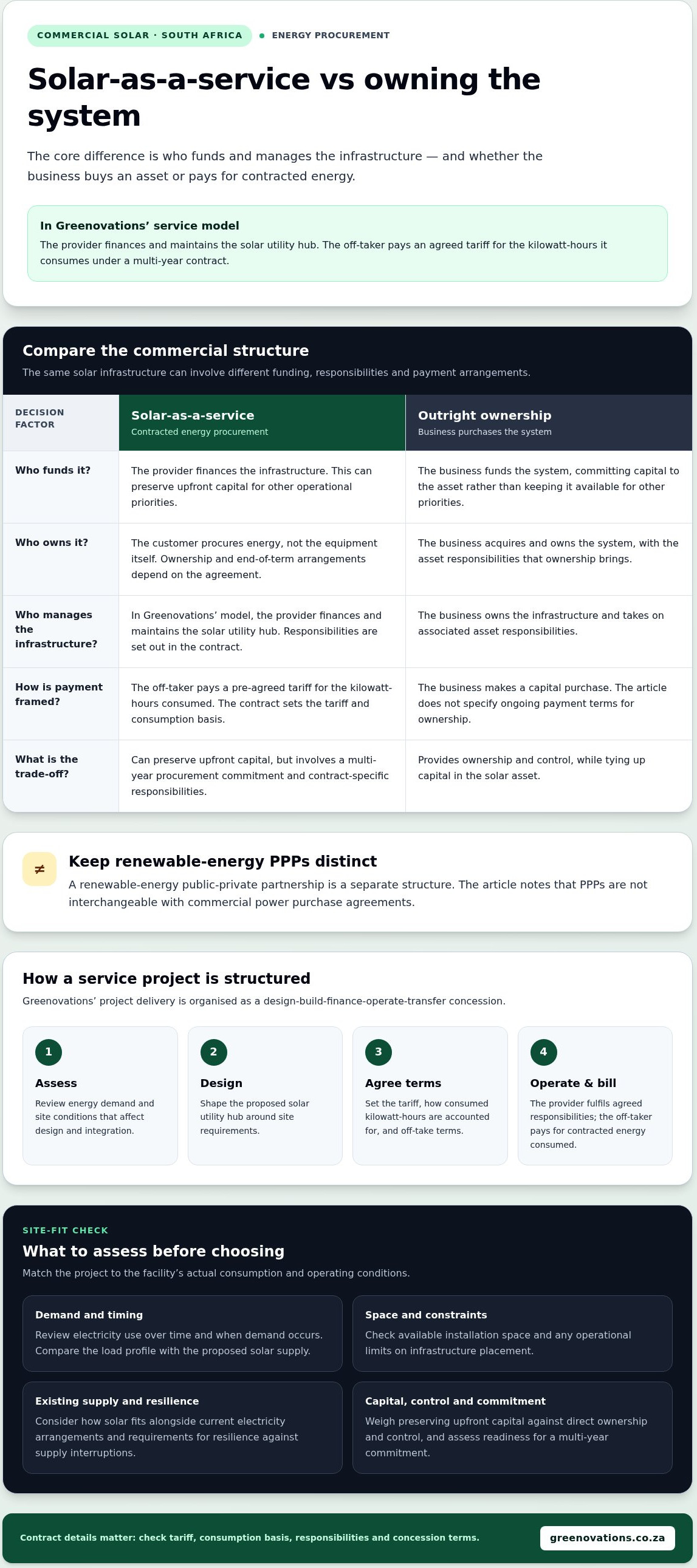
With an outright purchase, the business funds and owns the system, along with the asset responsibilities it takes on. Under Greenovations’ model, Greenovations finances and maintains the solar utility hub under a multi-year contract, while the off-taker pays a pre-agreed tariff for the kilowatt-hours consumed. Procurement shifts from a capital purchase to a contracted energy cost. Ownership, end-of-term arrangements and other obligations depend on the agreement, so review them as part of the commercial structure rather than making assumptions.
Which South African organisations might assess this model?
Start with the site’s recurring electricity demand, rather than a sector label. Commercial and industrial operators can compare their load profile and operating pattern with the proposed solar supply. Property owners and institutional decision-makers may also consider the model when a site has material energy demand and the organisation can make a long-term procurement commitment.
Screen the site against practical operating factors:
- Review electricity use over time and identify when demand occurs.
- Assess available space and any operational constraints on infrastructure placement.
- Consider how solar supply would fit alongside existing electricity arrangements and resilience requirements.
- Compare the value of preserving upfront capital with the preference for direct ownership and control.
No structure suits every facility. A site’s demand, operating conditions and appetite for a multi-year commitment determine whether contracted energy procurement is a credible alternative to owning the asset.
How a Commercial Solar Energy Service Is Structured and Operated
A service contract connects project development with the energy a site takes off. In commercial solar energy as a service in South Africa, the process moves from assessing demand and site conditions to designing and financing infrastructure, then operating it and billing for contracted consumption. The provider’s project and maintenance responsibilities are separate from the off-taker’s obligation to pay for energy used under the agreement.
Project delivery can follow a design-build-finance-operate-transfer concession. Each stage connects technical decisions with commercial terms:
- Assess demand and site conditions. Review electricity requirements and the practical conditions that affect infrastructure design and integration.
- Develop the project design. Shape the proposed solar utility hub around site requirements and establish the project’s delivery and operating structure.
- Set the commercial agreement. Define the tariff, how consumed kilowatt-hours are measured and accounted for, and the project’s off-take terms.
- Operate and bill. The provider fulfils the responsibilities allocated under the agreement, while the off-taker pays for contracted energy consumption.
What happens from project development to energy off-take?
Site demand informs both engineering and commercial design. A facility with substantial daytime use has a different demand profile from one whose consumption is concentrated outside solar-generating hours. Assess the implications against the proposed project rather than assuming the profiles are interchangeable. The agreement then records the project-specific tariff and off-take basis. System size, tariff formula and development timetable depend on the site and contract.
How are funding, maintenance and operating responsibilities allocated?
Under Greenovations’ model, Greenovations finances and maintains solar utility hub projects under multi-year contracts. The delivery structure includes design, build, finance, operation and transfer. The agreement sets out how those responsibilities apply to the project and allocates any additional operating duties between the parties.
South African projects also need a site-specific assessment of regulatory and grid interfaces. Address connection arrangements, approvals and relevant network requirements in the project and contract documentation. Requirements at one site may not apply at another, so clear allocation helps prevent gaps between infrastructure delivery and the off-taker’s payment obligations.
The provider finances the infrastructure; the off-taker pays the agreed tariff for the kilowatt-hours consumed. This links the provider’s investment to ongoing contracted demand rather than an upfront equipment sale. Because the agreement runs over multiple years, review the tariff and consumption provisions carefully.
Greenovations’ commercial solar utility hubs use this financed, maintained and contracted structure. Assess how the site’s demand translates into off-take obligations and how each party’s responsibilities are documented before the project proceeds.
Solar-as-a-Service vs Ownership and Renewable-Energy PPPs
These structures allocate capital, asset control and operating responsibility differently. A commercial solar energy as a service arrangement in South Africa is not automatically a public-private partnership (PPP), even when project delivery uses a concession structure. Compare the parties, obligations and payment basis rather than relying on labels alone.
StructureFunding and ownershipOperations and paymentTypical decision contextOutright purchaseThe organisation funds and acquires the solar asset. The owner takes on the asset-management and operating responsibilities it accepts. Payment is primarily for acquiring the system. A fit where direct ownership and control justify committing capital and internal resources. Solar-as-a-service or commercial PPAA provider funds the project; ownership follows the agreement. The agreement sets the provider’s duties and the off-taker’s contracted energy payments. Payment is linked to energy off-take according to its terms. A fit where the organisation prioritises contracted energy procurement over upfront asset acquisition. Renewable-energy PPPA public and private party allocate funding and project roles through a project-specific arrangement. Operations, public obligations and payment mechanisms depend on the concession and project documents. A fit for a project involving public-sector participation and defined public obligations. This comparison is a starting point, not a substitute for reviewing the transaction documents. Contract terms determine actual ownership, operating duties, payment obligations and end-of-term treatment. Tariff mechanics also vary by agreement. The key distinction is whether the organisation buys an asset, contracts for energy, or participates in a public-private project structure.
When does outright solar ownership fit the procurement decision?
With ownership, the organisation acquires the asset using its own capital or an independently arranged funding structure. That can suit a decision-maker seeking direct control, but asset management and operating responsibilities are part of the ownership decision. Assess the capital commitment, internal capacity and ongoing duties together. Tax and accounting treatment, as well as investment returns, depend on the specific project and shouldn’t be assumed from the procurement label.
How does a renewable-energy PPP differ from a commercial PPA?
A PPP is a public-private arrangement in which a public entity and private participant take defined roles, often under a project-specific concession with public obligations. A commercial PPA is an energy off-take agreement between a provider and a business. It doesn’t become a PPP simply because it is long-term or uses the word “concession”. Formal South African legal and procurement classification depends on the project structure and applicable requirements, so use the correct terminology for the transaction.
Greenovations’ solar utility hub projects use a design-build-finance-operate-transfer concession structure. That describes project delivery; it doesn’t, by itself, make every commercial off-take agreement a PPP. For more on tariff and payment mechanics, see the article’s dedicated PPA resources.
How to Assess Whether Solar-as-a-Service Fits a South African Site
Assess the site and contract together. A solar project may be technically feasible but commercially unsuitable if its generation profile doesn’t align with demand, or if the agreement conflicts with the organisation’s appetite for a long-term commitment. For commercial solar energy as a service in South Africa, use a structured assessment before moving from an initial concept to project terms.
- Demand: Gather interval electricity-consumption data and operating schedules. Identify when the site uses energy, how demand varies and whether that pattern aligns with the proposed supply.
- Space and infrastructure: Document available areas, existing electrical infrastructure and operational, access or safety constraints that may affect design and integration.
- Operating conditions: Record planned changes to the site, equipment or operating schedule that could alter future consumption or project requirements.
- Capital priorities: Compare preserving upfront capital for other business priorities with the organisation’s preference for owning and controlling the asset directly.
- Supply context: Identify the intended connection and energy-supply arrangement. Treat grid access, network interfaces and any wheeling assumptions as matters for current, project-specific verification.
Which technical and commercial inputs should a site assessment cover?
Start with usable consumption records, not a single monthly total. Interval data and operating schedules help show whether demand is concentrated during solar-generating hours or varies across shifts and seasons. Add site plans and information about electrical systems, access and operating restrictions. Project-specific engineering should assess physical, electrical and grid-interface constraints. Grid and wheeling requirements can change, so assess the assumptions against the requirements relevant to the site and project.
Which contract questions determine commercial fit?
Technical fit is only part of the decision. The contract should explain how energy is measured, billed and managed over the term, and how changes are handled. Review the provisions as a connected commercial framework:
- Tariff and billing: Identify the agreed tariff basis, metering method and calculation of payable consumption.
- Term and exit: Understand the contract duration, renewal or termination provisions and the consequences of ending the arrangement.
- Maintenance and operation: Define the provider’s maintenance scope and the off-taker’s responsibilities, including site access and coordination.
- Measurement: Establish how energy delivery and any agreed performance measures are recorded and reported, and how differences from expectations are addressed.
- Change management: Determine how the parties handle changes to consumption, site operations or project requirements during the agreement.
Contractual certainty isn’t the same as guaranteed savings or outcomes. A pre-agreed tariff and defined responsibilities clarify the commercial basis, but don’t establish a financial result without project-specific evidence. Model the agreement against site demand and plausible operational changes, then compare that commitment with the value of direct asset ownership and control.
Use this framework to shape a project around the site’s demand and contractual priorities. Explore Greenovations commercial solar solutions to learn about a no-CAPEX utility-hub structure based on financed and maintained infrastructure and contracted energy off-take.
Greenovations Commercial Solar Utility Hubs: From No-CAPEX Structure to Next Steps
Greenovations Venture Studio develops commercial and industrial solar utility hubs as infrastructure projects, not equipment sales. Under its no-CAPEX model, Greenovations finances and maintains the hub under a multi-year contract. The off-taker pays a pre-agreed tariff for the kilowatt-hours consumed. This structure avoids an upfront capital outlay for the solar infrastructure, allowing the organisation to assess the contracted energy cost alongside its other investment priorities.
Project delivery is structured around a design-build-finance-operate-transfer concession. These stages describe how the project is developed and delivered; the project agreement sets out transfer conditions and each party’s obligations. It also defines the applicable tariff, how consumption is measured and the responsibilities allocated to each party. For decision-makers researching “commercial solar energy as a service South Africa”, the central issue is how this commercial structure fits the site and its procurement requirements.
What the Greenovations model means for a commercial off-taker
For an off-taker, commercial solar-as-a-service shifts procurement from acquiring and managing a solar asset to paying for contracted energy use. Greenovations finances and maintains the solar utility hub under the agreement. No-CAPEX delivery can preserve upfront capital for other business requirements, but it doesn’t remove the off-taker’s contractual payment obligations or guarantee savings. Assess the arrangement against the site, its consumption and the specific agreement.
Review the contract as a complete allocation of rights and duties. Confirm how consumed kilowatt-hours are measured and billed, what maintenance Greenovations undertakes, and how the agreement treats operational changes or the end of its term. The tariff and obligations are project-specific. Evaluate them against the organisation’s demand profile, capital priorities and willingness to procure energy through a multi-year commitment.
What to prepare before progressing a project discussion
A focused discussion starts with site information and clear internal decision criteria. Assemble the material that can inform the technical and commercial assessment:
- Available electricity-consumption records, including interval data where held, and a summary of operating patterns.
- Known physical, electrical and operational constraints that could affect infrastructure design or site integration.
- Expected changes to the facility, equipment or operating schedule that may affect future energy demand.
- Internal priorities for capital allocation, contract duration, direct asset ownership and energy procurement.
This preparation helps decision-makers frame the project around actual site demand rather than a generic system specification. It also gives the parties a clearer basis for developing project-specific terms without assuming a tariff, saving or outcome in advance.
For organisations assessing a financed and maintained solar utility hub, a discussion grounded in site data and procurement priorities is a practical next step. Learn about Greenovations’ commercial solar utility hubs.
Turn the Site Assessment into a Commercial Decision
Move from general interest to a decision grounded in the site’s consumption profile, operating constraints and procurement priorities. Set out what the organisation needs from an energy arrangement, which responsibilities it intends to retain and how much flexibility it requires over the contract term. This gives the project discussion a practical basis.
For commercial solar energy as a service in South Africa, the decisive test is whether the contract aligns energy off-take with the organisation’s financial and operating requirements. Greenovations finances and maintains solar utility hub projects under multi-year contracts, with off-takers paying pre-agreed tariffs for consumed kilowatt-hours. Assess the agreement against the site’s actual needs, not an assumed outcome.
Bring your site information and priorities to Greenovations. Discuss a commercial solar utility hub.
Frequently Asked Questions
Is commercial solar energy as a service the same as leasing solar panels?
Not necessarily. A lease typically centres on access to equipment, while solar-as-a-service may link payment to the energy a business takes. The label alone doesn’t settle ownership or risk. Compare the agreement’s asset title, maintenance scope, metering method, billing basis and end-of-term provisions. For example, a proposal described as a lease may still impose consumption-based obligations, so base the comparison on enforceable terms rather than marketing language.
Can a business use solar-as-a-service alongside grid electricity in South Africa?
A commercial site can assess solar alongside its existing electricity supply, but the arrangement depends on the project’s design and contract. Review how the site connection, metering and energy accounting are intended to work together. A facility that still draws from the grid needs a clear view of how solar output relates to its residual demand. Verify current grid or market requirements for the specific project.
How much energy can a commercial solar service provide?
There’s no single output figure that applies to every site. Generation depends on the project design, installation conditions, available space and the site’s generation profile. A system’s nameplate capacity describes its rated capacity, not a guaranteed quantity of energy delivered to the business. Compare the proposed energy estimate with the facility’s consumption records, and review the engineering assumptions and contract provisions explaining how delivered energy will be measured and billed.
What happens if a business uses less energy than expected under a solar PPA?
The agreement determines the financial effect of lower consumption. Check whether billing is based only on metered energy consumed, or whether minimum off-take, fixed charges or other payment obligations also apply. For example, a planned reduction in production could change a site’s energy needs without changing its contractual commitments. Model realistic demand scenarios before signing, and ensure the agreement explains how consumption changes, interruptions and billing adjustments are treated.
Can a commercial solar-as-a-service project include battery storage?
Battery storage is a separate design consideration, not an automatic component of every solar service project. Its suitability depends on the site’s load, operating requirements, technical design and agreed project scope. A facility seeking to shift energy use or manage specific operational needs should define that requirement during project design. Don’t assume a battery is included or that it will provide backup during every interruption; the intended function and limits need to be specified in the project documents.
Is a public-private partnership required for commercial solar energy as a service?
No. A business can procure solar energy through a commercial agreement without the arrangement being a PPP. A PPP involves a public entity and a private participant, with roles and obligations defined by the project structure. A commercial off-take agreement doesn’t become a PPP simply because it is long-term or uses concession terminology. If a public entity is involved, confirm the relevant South African classification and procurement requirements for that specific project.
Visual summary
Planning a project like this?
Talk to the Greenovations venture desk about a No-CAPEX structure.