A long-term solar PPA is only as bankable as the parties and clauses behind it. In South Africa, solar PPA contract risks centre on contract duration, price changes, changes in law and whether buyer and seller can meet their obligations over time. Solar PPAs typically run for 15 to 25 years, so a favourable starting price alone cannot secure a favourable outcome.
A long-term solar PPA can make energy costs more predictable and support project financing, but it can also lock both parties into terms that become commercially misaligned. Price reopeners, floating rates, generation exposure and a financially weak counterparty can all change how risk is shared.
This article explains how those benefits and risks interact, what to review in escalation and change-in-law clauses, and why financial resilience matters throughout the contract term. Use the framework to assess whether the PPA’s pricing, protections and counterparties fit your business’s energy needs and financial requirements.
Key Takeaways
- Assess escalation and price-reopener wording together to understand when a fixed-rate commitment can shift away from market conditions.
- Compare generation timing with site demand: annual renewable coverage can mask hourly exposure to supply gaps and spot prices.
- Evaluate credit support and financial security as part of the PPA’s risk allocation, not as administrative details.
- Test whether the seller can remain financially resilient throughout the agreement, since contract-backed revenue depends on performance over time.
Contract duration and price reopener clauses
In South Africa, a solar power purchase agreement (PPA) is a legal contract between a renewable energy project owner and an energy buyer. The project owner arranges the system’s design, permitting, financing and installation, then sells the electricity generated to the buyer at an agreed rate.
Unlike buying a system outright or financing one with a solar loan, a PPA generally avoids an upfront system purchase by the buyer. The buyer pays for electricity supplied under the agreement, while the project owner earns contracted revenue instead of transferring the system to the buyer.
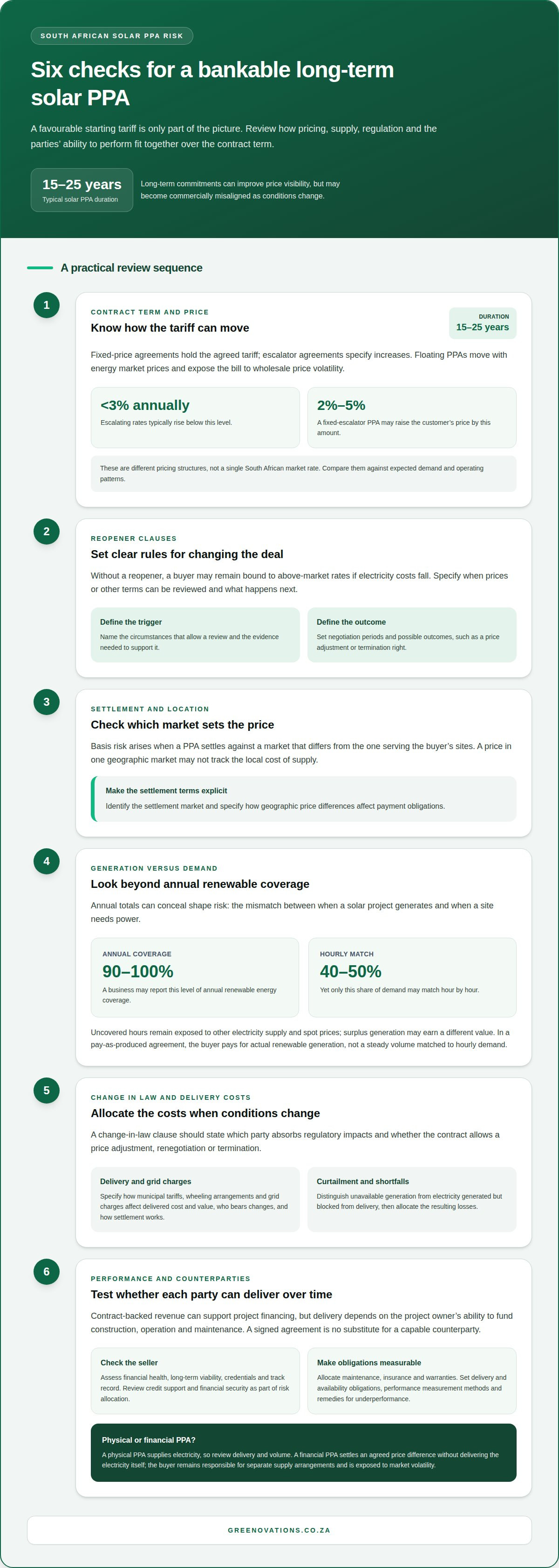
Solar PPAs typically run for 15 to 25 years. The contract rate depends on its pricing structure: fixed-price agreements hold the agreed tariff, while escalator agreements specify increases. Escalating rates typically rise below 3% annually, whilst a fixed-escalator PPA may raise the customer’s price by 2%-5%. Those are different structures, not a single South African market rate.
A long contract can trade flexibility for greater price visibility. If utility prices rise more slowly than expected, a fixed escalator may become less competitive; if prices rise, the contracted rate may protect the buyer. Floating PPAs move with energy market prices, exposing the bill to wholesale price volatility. Compare expected demand and operating patterns against each pricing structure before signing.
Reopener clauses specify when the parties can revise prices or other terms. Without one, a buyer may remain bound to above-market rates if electricity costs fall. Define specific triggers, supporting evidence, negotiation periods and outcomes, such as a price adjustment or termination right. Regulatory changes can also affect costs, so allocate that exposure clearly in the agreement.
Basis risk arises when a PPA settles against a market that differs from the one serving the buyer’s sites. A price in one geographic market may not track the local cost of supply. Identify the settlement market and specify how geographic price differences affect payment obligations.
Under a PPA, the developer generally owns the system, but maintenance, insurance and warranties require explicit allocation. Include measurable delivery and availability obligations, performance measurement methods, and remedies for underperformance. If a property is sold or tenants change, assignment, consent, termination or system-removal clauses determine the transition.
What is a change-in-law provision?
A change-in-law clause allocates costs when a regulatory change affects a power purchase agreement. It should state which party absorbs the impact and whether the contract allows a price adjustment, renegotiation or termination. In a long-term South African energy contract, that allocation can shape the commercial outcome when rules governing generation, delivery or settlement change.
Generation and consumption rarely align perfectly. A business may report 90-100% annual renewable energy coverage yet match only 40-50% of demand hour by hour. The uncovered hours remain exposed to other electricity supply and spot prices, while surplus generation may earn a different value. Annual totals can therefore conceal shape risk: the mismatch between when a solar project generates and when a site needs power.
In a pay-as-produced agreement, the buyer pays for actual renewable generation, not a steady volume matched to its hourly demand. Cloud cover, operational interruptions and changing consumption can create shortfalls or surplus. Curtailment creates a separate exposure: a project may be able to generate electricity but unable to deliver it because of transmission limits, grid conditions or other external factors. The contract should distinguish unavailable generation from electricity generated but blocked from delivery, then allocate the resulting losses.
South African municipal tariffs, wheeling arrangements and grid charges affect the delivered cost and value of electricity, not just the PPA’s headline rate. Specify how these charges are treated, who bears any changes, and how settlement works between the generation point and the consuming site.
Set the risk allocation against the business’s energy profile, financial goals and tolerance for variable supply. A stable-load operation may prioritise predictable delivered volumes; a flexible site may accept more pay-as-produced exposure. For infrastructure planning alongside generation and offtake decisions, review solar infrastructure options as part of the commercial assessment.
Counterparty creditworthiness and financial security
A PPA does not transfer all market exposure or delivery risk. The buyer’s creditworthiness and the project owner’s financial capacity both affect the reliability of the contractual commitments.
Revenue certainty and project financing
Contracted PPA revenue can support project financing by providing lenders and investors with a defined income stream. For the buyer, that link matters because delivery depends on the project owner’s ability to fund construction, operation and maintenance. Assess the project’s long-term viability alongside the seller’s financial health, credentials and track record. A signed agreement is no substitute for a capable counterparty.
Third-party financing and PPA structures
Third-party financing puts project funding with a project owner or financier, rather than requiring the buyer to purchase the system directly. A physical PPA supplies electricity to the buyer; a financial PPA settles an agreed price difference without delivering the contracted electricity itself. The distinction matters: physical supply requires careful review of delivery and volume, while financial settlement leaves the buyer responsible for separate supply arrangements and exposed to market volatility.
Credit support allocates the consequences if a party fails to pay or perform. PPA agreements may require a letter of credit, parent guarantee, cash collateral or performance security. Post-commercial-operation security may cover 6 to 18 months of anticipated PPA payments. The amount and form determine how much protection is available, and how quickly the beneficiary can access it after a default.
Separate buyer and seller exposure. Review the buyer’s ability to meet payment obligations, then examine the developer’s funding, operating record and project structure. Identify whether a parent guarantee remains effective if ownership changes, and whether security covers payment default, construction failure or operational underperformance. LevelTen Energy attributes about 15-20% of PPA value variation to six key risk factors, including stricter credit and counterparty terms. Storage and changing generation profiles can add commercial complexity, but they do not replace credit support or a solvent project developer.
Counterparty resilience over long contract terms
A power purchase agreement depends on more than its opening price: the seller must remain capable of supplying energy throughout the contract. Counterparty resilience matters over 10 or 15 years because financial distress, ownership changes or weak operations can disrupt supply when the buyer still has demand.
Assess the seller as an operating business, not just as a project vehicle. Examine how it earns revenue, funds ongoing obligations and responds when generation falls short of expectations. One company may hold the agreement and assets while another handles operations. Identify which party is responsible for each obligation and whether the contract preserves recourse if that structure changes.
Ownership and control can change during a long-term agreement. Review clauses on assignment, change of control, subcontracting and notice. A sale of the project company, for example, should not leave the buyer with a new counterparty whose capacity differs from the original seller’s without clear safeguards. Define consent rights and transition responsibilities, including continued supply and operational handover.
Test resilience against realistic pressures rather than relying on a single financial snapshot. Consider how the seller would respond to equipment failure, delayed maintenance, reduced project revenue or changing energy market conditions. Then identify the contractual remedy: replacement supply, performance remedies, cure periods or termination rights. The remedy matters: a payment alone does not restore electricity to an operating site.
Match the agreement’s exposure to the buyer’s demand profile and tolerance for interruption. A continuous industrial process has different supply consequences from a site able to shift consumption or use alternative sources. Record who monitors performance, reports operational issues and initiates remedies. A resilience review should connect counterparty capacity, project operations and contractual recourse, rather than treating them as separate checks. Assess industrial project requirements alongside these obligations before committing to long-term supply.
Greenovations Venture Studio: Drone-Powered Industrial Intelligence (GII)
Greenovations Venture Studio offers Drone-Powered Industrial Intelligence (GII) for industrial decision-makers assessing operational conditions alongside energy procurement and infrastructure choices. A solar PPA’s financial terms do not replace the need to understand how site operations, electricity demand and project performance interact. GII provides an industrial intelligence service to help organisations assess these operational considerations.
Use this perspective to assess how an energy arrangement fits wider industrial requirements, rather than treating the contract as a standalone price decision. The right assessment depends on the site’s operating context and the specific questions the business needs to resolve.
For industrial intelligence that supports operational assessment, visit greenovations.co.za.
Make the next decision operational
Treat a PPA review as the start of stronger energy governance, not a one-off contract exercise. Assign responsibility for monitoring delivery, payments and changes in site operations, then build those tasks into routine commercial oversight. This keeps decisions aligned with actual business demand as operating conditions evolve.
Managing solar PPA contract risks also means understanding how energy arrangements connect with wider industrial priorities. Greenovations Venture Studio offers Drone-Powered Industrial Intelligence (GII) for organisations assessing operations alongside infrastructure decisions. Its Electric Vehicle Ecosystem and Sustainable Seating Infrastructure-as-a-Service may also support broader infrastructure planning.
Discuss your industrial requirements with Greenovations Venture Studio and identify a practical next step. Contact Greenovations Venture Studio to begin that conversation. A disciplined review puts your next decision on firmer commercial ground.
Frequently Asked Questions
PPAs, what are the rewards vs the risks?
A PPA can provide a contracted route to renewable electricity without requiring the buyer to purchase the generation system outright. Its commercial value depends on how well the agreement fits the buyer’s demand and operating profile. The trade-off includes less control over project decisions and exposure to contractual performance, payment obligations and the seller’s ability to deliver. Weigh the expected savings and operational flexibility against those commitments.
What are the risks associated with a PPA?
The main exposures are price misalignment, supply shortfalls, settlement differences and counterparty failure. Costs can also arise if actual consumption changes while contracted obligations remain in place. Review how the agreement allocates metering errors, invoice disputes, force majeure events and default remedies. Solar PPA contract risks go beyond the tariff: they include how the parties resolve exceptions and maintain continuity.
What are the key components of a PPA?
A PPA should identify the parties, contracted electricity, delivery or settlement point, pricing method, invoicing process and contract term. It should also explain how generation is measured, how performance is assessed and what happens when obligations are missed. Define ownership of environmental attributes, reporting duties, dispute resolution, assignment and exit arrangements. For a multi-site buyer, specify the participating locations and how changes to the site portfolio affect the agreement.
What are the standard risks when negotiating a PPA?
Negotiation risks often lie in undefined terms, not the headline price. A vague delivery standard can make shortfalls difficult to establish, while an unclear change-control process can complicate site additions or demand changes. Compare each party’s remedies, notice periods and evidence requirements. For example, require invoices to show the applicable tariff, measured volume and each adjustment separately, allowing finance teams to reconcile charges with operational records.
What is a financial PPA, or a virtual PPA (vPPA)?
A financial or virtual PPA generally settles financially rather than delivering electricity directly to the buyer’s site. The parties compare an agreed contract price with a defined market reference price, then settle the difference under the contract. The buyer still arranges physical electricity supply separately. The reference market, settlement period, volume calculation and treatment of negative prices determine how closely the financial hedge tracks actual energy costs.
How are PPA price increases and tariff escalations calculated?
The contract sets the initial tariff and escalation method, then applies the formula on specified adjustment dates. A fixed escalator uses a pre-agreed percentage; an indexed mechanism follows its stated reference and calculation rules. Check whether adjustments apply to the original tariff or the previous period’s tariff, and how the contract handles rounding, billing dates and partial periods. These details determine the rate payable over time.
Visual summary
Planning a project like this?
Talk to the Greenovations venture desk about a No-CAPEX structure.