A high solar PPA tariff isn’t explained by panel size alone. The answer to why my solar PPA tariff is so high often lies in the contract’s annual escalator, the project’s risk allocation and how closely the system’s output matches the site’s electricity use. An annual escalator of about 2.9% is described as an industry-standard reference point, but the effect on your costs depends on the rate in your agreement and how it compares with changes in grid tariffs.
It’s reasonable to expect a power purchase agreement (PPA) to reduce electricity costs. But the headline tariff does not tell the whole story: contract length, time-of-use charges and the value of exported electricity all affect the savings you actually realise.
This article explains how PPA tariffs are set, why escalation clauses matter over the contract term, and how usage patterns and export compensation affect your bill in South Africa. You’ll learn which agreement terms drive costs and how to compare the tariff with the electricity it replaces.
Key Takeaways
- Assess the tariff against the electricity it replaces, not as a standalone rate; site and buyer risk can influence the offer.
- Read the escalation clause as a long-term cost driver and compare its effect with changes in grid tariffs.
- Test whether the contract term aligns with the site’s tenure and the system’s operating life before weighing its headline savings.
- Match PPA pricing to when electricity is used and how exported power is credited to understand the value delivered.
Annual tariff escalators and their effect on long-term savings
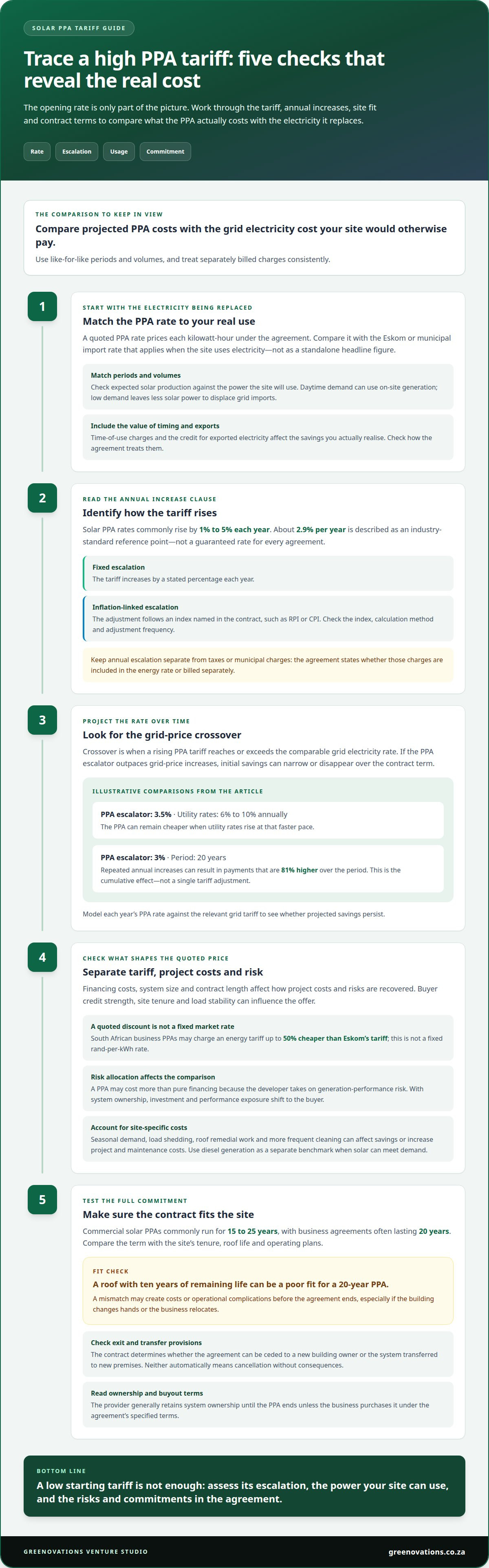
A PPA escalator raises the contracted electricity tariff annually, so the starting rate alone does not show its full long-term effect. In South Africa, about 2.9% per year is described as an industry-standard reference, while solar PPA rates commonly rise by 1% to 5% each year.
No single tax or municipal charge determines every PPA tariff. The agreement sets out whether charges are included in the energy rate or billed separately. When assessing total electricity costs, distinguish these items from the annual escalation clause.
Fixed and inflation-linked escalation clauses
A fixed clause raises the tariff by a stated percentage each year, while an inflation-linked clause adjusts it according to an index such as RPI or CPI. A fixed rate sets a predetermined increase; an index-linked adjustment varies with the measure named in the contract. Check the clause for the index, calculation method and adjustment frequency.
Escalators and grid-price crossover
Grid-price crossover occurs when a rising PPA tariff reaches or exceeds the comparable grid electricity rate. If the PPA escalator outpaces grid-price increases, the initial saving can narrow and may disappear over the contract term. Conversely, a 3.5% PPA escalator can remain cheaper when utility rates rise by 6% to 10% annually. Compare like-for-like rates and periods.
The cumulative effect matters. A 3% annual PPA escalator can result in payments that are 81% higher over a 20-year period. That figure reflects the effect of repeated increases, not a single tariff adjustment. Model each year’s rate against the relevant grid tariff to see whether projected savings persist.
Read the escalation clause alongside the starting tariff and the full contract term. A low opening rate may still deliver weaker long-term savings if it increases rapidly. The key comparison is the projected PPA cost against the grid electricity cost it replaces, treating separately billed charges consistently.
How PPA tariffs are set and compared with grid import rates
A PPA tariff reflects project risk and the value of electricity generated on site, not just the solar plant’s size. Compare the contracted rate with the grid electricity it replaces and the costs your site would otherwise incur.
Setting and checking quoted PPA rates
A quoted PPA rate prices each kilowatt-hour under the agreement, taking account of the buyer’s credit strength, site tenure and load stability. South African business PPAs may charge an energy tariff up to 50% cheaper than Eskom’s tariff, but that is not a fixed rand-per-kWh market rate.
If you’re asking why my solar PPA tariff is so high, compare the same consumption periods and volumes in the PPA and grid calculations. Check expected solar production, how much power the site will use, and any separately charged project costs. Seasonal demand or a short lease may increase the tariff or affect whether a developer makes an offer.
PPA costs compared with grid imports
Compare PPA electricity with the Eskom or municipal import rate that applies when the site uses power. Then assess the longer-term cost under each arrangement, including PPA tariff increases and the grid charges that remain payable.
Use diesel generation as a separate benchmark: compare its operating cost with PPA electricity during periods when solar generation can meet demand. A PPA may cost more than pure financing because the developer takes on generation-performance risk. With system ownership, investment and performance exposure shift to the buyer. Compare total costs and risk allocation, not just the energy rate.
Factors shaping PPA prices and savings
Financing costs, system size and contract length shape the tariff because they determine how project costs and risks are recovered. A longer term spreads project costs across more years. A buyer with a weaker covenant, short site tenure or unstable demand may face a higher tariff or receive no offer.
To understand why my solar PPA tariff is so high, consider how load shedding, usage patterns and solar production affect the savings from electricity the system can actually supply. Daytime demand can use on-site generation, while low demand leaves less solar power to displace grid imports. Roof remedial work and more frequent cleaning can also add project or maintenance costs, increasing the quoted tariff.
PPA contract terms and long-term commitments
A power purchase agreement (PPA) sets the terms for buying electricity generated by a solar system. Its duration, ownership provisions and exit conditions shape your commitment beyond the tariff itself.
Contract length and early exit
Commercial solar PPAs commonly run for 15 to 25 years, with business agreements often lasting 20 years. That duration matters because a company’s site tenure and operating plans must accommodate the contract, not just its initial electricity needs.
A roof with only ten years of remaining life can be a poor fit for a 20-year PPA. The mismatch can create costs or operational complications before the agreement ends, particularly if the building changes hands or the business relocates.
Early exit depends on the contract’s transfer provisions. A business may be able to cede the agreement to a new building owner or transfer the system to new premises. Neither option is the same as cancelling without consequences, so the contract determines how a change of site affects the commitment.
Buyout and other contract options
A buyout allows the business to purchase the system under the agreement’s specified terms, transferring ownership from the service provider. The provider generally retains ownership until the PPA ends unless the business purchases the system under those terms.
Buyout timing differs by contract. Some described terms allow a business to purchase from year 5 and choose ownership during the remaining 15-year period. Other PPA contracts do not allow a buyout until after Year 6, making the precise clause material to any ownership plan.
Compare the buyout trigger, transfer conditions and remaining obligations together. For example, before selling a site, establish whether the agreement can pass to the new owner or whether another option applies. The contract wording, not the headline tariff, defines that flexibility.
These provisions help explain why two PPAs with similar starting tariffs can have different commercial value. A longer commitment with limited transfer rights creates different exposure from an agreement with a defined purchase option or site-transfer route. Assess duration, exit and ownership as linked terms.
Time-of-use rates and export compensation
A PPA’s value depends partly on when the site uses solar electricity and how exported power is treated. The tariff alone cannot show whether generated electricity offsets expensive grid imports or earns a credit.
Time-of-use tariffs divide grid electricity into periods with different rates. Households often use the most electricity between 4 pm and 9 pm, when rates are highest. Solar generation may not align with those evening peaks, so assess the site’s load profile against the system’s production periods. For a business, daytime operations can use more solar power directly, reducing the amount bought from the grid during those hours.
Export compensation is the value assigned to electricity the system sends to the grid instead of using on site. A PPA may cover only electricity consumed at the site or include exported electricity. This distinction changes the savings calculation: unused generation cannot be treated as if it displaced grid power at the full import rate. The contract’s export terms determine how those kilowatt-hours affect the bill.
When assessing a statement, separate the two flows: electricity imported from the grid and solar electricity exported from the site. Identify the applicable time-of-use rate for imports and the credit or payment method for exports. For example, a site may generate surplus electricity during low demand, then buy grid power during a higher-rate period. Its net benefit depends on how both transactions are treated.
In South Africa, compare the site’s actual tariff structure and PPA wording rather than relying on a generic assumption about Eskom or municipal export credits. Check whether the agreement prices exported units separately, excludes them or applies a defined credit. High exports paired with limited compensation can weaken savings, even when the system produces substantial electricity.
For organisations assessing utility-scale solar infrastructure alongside their procurement model, explore solar utility hub infrastructure as a distinct project option.
Greenovations Venture Studio
Greenovations Venture Studio builds green-economy businesses around infrastructure and industrial challenges. For organisations assessing commercial and industrial solar supply, its Solar PV Utility Hubs provide renewable energy under a fully financed, No-CAPEX model, with off-takers paying agreed tariffs through long-term PPAs. Greenovations also offers licensed, auditable Solar PV Recycling for end-of-life panels, recovering materials for industry.
The useful next step is to define the commercial problem: whether it concerns electricity infrastructure, the lifecycle of solar assets, or another operational requirement. That clarity helps frame which solution is relevant, without treating a PPA tariff review as a substitute for infrastructure development.
Contact Greenovations Venture Studio to discuss your organisation’s infrastructure priorities.
Turn tariff analysis into a stronger energy decision
Understanding why your solar PPA tariff is so high is useful only if it informs your next commercial decision. Apply the same scrutiny to future infrastructure plans: identify the operational requirement, the assets involved and the risks to manage. This gives you a clearer basis for deciding which projects merit further evaluation.
Greenovations also works across industrial intelligence, mobility and infrastructure through Drone-Powered Industrial Intelligence (GII), an Electric Vehicle Ecosystem and Sustainable Seating Infrastructure-as-a-Service. These distinct offerings do not replace a review of an existing PPA, but may be relevant when your organisation assesses broader operational priorities.
Set out the challenge and the outcome your organisation needs, then discuss your priorities with Greenovations Venture Studio. A defined commercial objective is a practical starting point for the next decision.
Frequently Asked Questions
What is a PPA?
A power purchase agreement (PPA) is a contract to buy electricity from a generator on agreed terms. In a commercial solar arrangement, the provider may finance and maintain the system while the business pays for the electricity it consumes from it. The agreement defines how the tariff is charged, which energy counts as purchased and what happens if the site or business circumstances change.
How are solar PPA tariffs calculated in South Africa?
A solar PPA tariff reflects project costs, expected generation and the risks allocated to each party. The buyer’s credit strength, site tenure and demand profile can also affect the quoted rate. To understand the calculation, separate the energy tariff from other bill items, then compare projected charges with the electricity the system is expected to supply.
How does a solar PPA tariff compare with Eskom and municipal electricity tariffs?
Compare the PPA charge with the Eskom or municipal electricity costs the solar supply will actually displace. Use the same billing period and account for electricity still imported from the grid, applicable time-of-use rates and any fixed charges. Municipal tariffs and customer categories vary, so a general Eskom rate may not represent a site’s avoided electricity cost.
Can I renegotiate, exit, or transfer a high solar PPA contract in South Africa?
That depends on the signed agreement’s variation, termination and transfer provisions. Renegotiation requires both parties to agree on revised terms; an exit may trigger contractual charges or other obligations. For a building sale or relocation, the agreement may specify whether the contract can transfer to a new owner or premises. Identify the relevant clauses and calculate the financial consequences before making a change.
Visual summary
Planning a project like this?
Talk to the Greenovations venture desk about a No-CAPEX structure.