
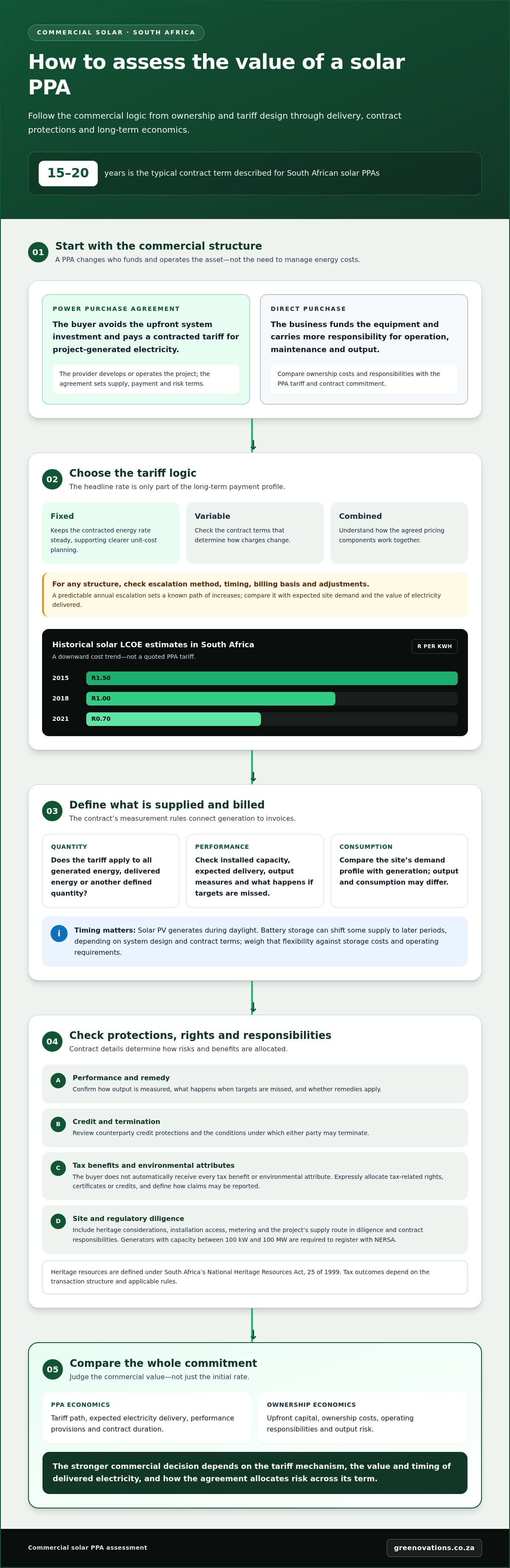
The lowest upfront-cost option isn’t automatically the strongest commercial solar decision. A commercial solar PPA in South Africa replaces the buyer’s upfront system investment with a contracted tariff for electricity generated by the project; agreements typically run for 15 to 20 years. Compared with purchasing a system, the PPA shifts the investment structure, while the tariff and contract terms determine the long-term economics.
That distinction matters: businesses need to weigh more than the headline rate. Tariff design, expected electricity delivery, performance provisions and contract duration all shape a PPA’s value and how it allocates risk.
This article explains how commercial PPAs compare with direct purchase and other arrangements, how fixed, variable and combined tariffs work, and which contract terms shape the financial outcome. It also looks at forces driving solar PPA growth in South Africa, helping you assess a PPA as a commercial procurement decision, not simply a choice between solar technologies.
Key Takeaways
- Compare a power purchase agreement with direct ownership by weighing upfront capital, operational responsibilities and the contract’s allocation of performance risk.
- Understand how fixed, variable and combined tariff structures affect payment predictability across typical 15 to 20-year agreements.
- Assess how corporate buyers and independent power producers structure projects around electricity demand, generation and commercial priorities.
- See how South Africa’s changing solar economics are shaping market growth, and which factors matter when evaluating a project’s long-term value.
How does a PPA compare to other commercial solar solution options?
A power purchase agreement changes who funds and operates the solar asset, not the buyer’s need to manage energy costs. Before assessing the tariff, compare ownership, energy delivery, performance risk and contract rights.
Energy supply performance guarantees
An energy supply performance guarantee sets measurable output or availability obligations for the solar provider. It matters because a shortfall can affect both electricity supply and expected savings. South African solar PPAs may specify installed capacity, expected electricity delivery and performance metrics. Check how the contract measures output, what happens when targets are missed and whether remedies apply. Contractual performance obligations are distinct from simply owning panels.
With direct purchase, the business funds the equipment and carries more responsibility for its operation, maintenance and output. A PPA instead links payment to an agreed supply arrangement, though the contract still determines how generated electricity is measured and billed. Solar PV produces power during daylight; battery storage can shift some supply to later periods, depending on system design and contract terms. Compare the value of that flexibility with storage costs and operating requirements.
Corporate renewable energy demand also shapes the choice. A manufacturer with daytime demand can use on-site generation directly, while a site with evening peaks may value storage or a broader supply arrangement more. Solar generation can reduce reliance on grid electricity, but the emissions impact depends on which electricity it displaces and the project’s operating profile.
Tax and renewable energy credits
Tax treatment and renewable energy credits depend on who owns the asset and holds the related contractual benefits. A PPA buyer does not automatically receive every tax benefit or environmental attribute linked to the project. The agreement should expressly allocate those rights, including any certificates or credits generated, and define how claims may be reported. Tax outcomes depend on the transaction structure and applicable rules.
Site diligence also has legal and operational consequences. South African Government states that heritage resources are defined under South Africa’s National Heritage Resources Act, 25 of 1999. A project’s site assessment and contract allocation should account for heritage considerations alongside installation access, energy delivery and performance obligations.
Solar PPA pricing models and tariff trends
South African solar PPAs use fixed, variable or combined pricing, with contract terms determining how charges change. Assess performance shortfalls, counterparty credit exposure and termination triggers, as each can affect the value of a competitive headline tariff.
Contract terms and tariff escalations
A tariff escalation clause sets how the electricity rate changes over the agreement’s term. It matters because the starting rate alone cannot show the buyer’s cumulative payment profile. South African solar PPAs typically run for 15 to 20 years, so clear terms should define the escalation method, timing, billing basis and any adjustments. The agreement should also specify performance obligations, credit protections and the conditions under which either party may terminate.
Fixed electricity tariffs and predictability
A fixed tariff keeps the contracted energy rate steady, while a predictable annual escalation increases it according to an agreed schedule. Both structures support budgeting, but allocate price risk differently. A fixed rate offers clearer unit-cost planning; an escalation clause sets a known path of increases rather than an unknown future rate. Compare that path with expected site demand and the value of the electricity delivered.
The contract determines whether the tariff applies to all generated energy, delivered energy or another defined quantity. That distinction affects invoices when output and consumption differ. Clear terms also explain how measurement data, underperformance and billing disputes are handled, reducing ambiguity over the life of a long-term agreement.
Upfront capital and solar tariffs
Upfront capital affects the tariff because a PPA prices electricity through a contract rather than requiring the buyer to purchase the generating asset. The buyer preserves capital for other uses, while the provider recovers project costs through contracted revenue. The commercial comparison should weigh the tariff against ownership costs, operating responsibilities and the length of the commitment.
South Africa’s estimated solar levelised cost of electricity fell from R1.50 per kWh in 2015 to R1.00 in 2018 and R0.70 in 2021. These historical estimates show the direction of cost change, not a quoted PPA tariff. For a wider view of commercial solar infrastructure, compare project economics with the contract’s full pricing mechanism.
Corporate buyers, IPPs and notable projects
Corporate buyers use power purchase agreements to procure electricity without buying the generating asset outright. An independent power producer (IPP) develops or operates the project and sells power under agreed commercial terms. This links the buyer’s demand profile to a generation asset, making delivery, credit support and payment obligations central to the project’s commercial structure.
For a South African project, generation registration can affect the delivery arrangement. Generators with capacity between 100 kW and 100 MW are required to register with NERSA. Buyers and IPPs need to align the project’s capacity, metering and supply route with its regulatory framework. The agreement should allocate project responsibilities clearly, including which party manages operational and delivery obligations.
Municipal buyers face specific governance considerations. The buyer must obtain the required authority under South Africa’s Local Government: Municipal Finance Management Act 56 of 2003, according to the South African Government. That requirement makes procurement authority and approval pathways material to project timing and contract execution. Corporate buyers follow their own approval processes, while their credit standing and payment structure remain relevant to an IPP’s financing case.
Projects involving distribution infrastructure require careful attention to the relevant licence and network arrangements. NERSA’s role in licensing distribution forms part of the regulatory context for municipal electricity supply, but does not determine an individual PPA’s commercial terms. Each project agreement still needs to define the buyer, delivery route, metering responsibilities and settlement arrangements.
Assess projects by their contract structure, not installed capacity alone. Compare the buyer’s consumption profile with expected delivery, identify who manages supply balancing, and examine payment security and termination provisions. A virtual PPA differs from physical supply: the buyer does not take delivery of electricity, but instead receives credits for renewable generation. It is a financial arrangement, not direct electricity supply to the buyer’s site.
South African solar PPA market drivers and growth
South Africa’s PPA market grows where electricity demand, project finance and viable delivery routes align. The commercial case depends on more than generation: regulation, network access and tariff treatment also shape bankability.
Regulations, licences and grid approvals
Regulatory and connection approvals establish whether a project can generate and deliver electricity through its proposed route. They matter because capacity, buyer type and network arrangements affect project obligations. Generators with capacity between 100 kW and 100 MW are required to register with NERSA. Municipal procurement has distinct controls: the buyer must obtain the required authority under South Africa’s Local Government: Municipal Finance Management Act 56 of 2003, according to the South African Government.
Grid connection involves the relevant network operator and the project’s technical and supply arrangements. A commercial assessment should map generation capacity, site demand, connection requirements and any distribution or wheeling route before contract terms are settled. For municipal projects, the City of Cape Town’s distribution licence is granted by NERSA under section 7(1) of South Africa’s Electricity Regulation Act No 4 of 2006.
Tariffs, wheeling charges and feed-in rules
Eskom or municipal tariffs influence solar’s value by setting the cost of imported electricity against which project supply is assessed. Wheeling charges apply when electricity moves across a network to a separate buyer, while feed-in arrangements determine how exported surplus is treated. The applicable network and settlement structure therefore changes the economics. Do not value exported energy as though it offsets every unit consumed.
Growth follows when contracted PPA supply aligns with the buyer’s demand and the delivery route’s charges. A buyer assessing an Eskom-connected site, for example, needs to distinguish on-site consumption from wheeled supply and surplus exports. These are separate commercial flows, each with distinct metering and settlement implications.
A quote and installation process begins with site demand, load profile and project location. The next stages assess system capacity, tariff structure, connection route, approvals, contract terms and installation requirements. This sequence lets the commercial model reflect actual delivery conditions rather than a headline tariff. Assess a solar infrastructure project against its operating and network requirements.
Greenovations Venture Studio: Drone-Powered Industrial Intelligence (GII)
Greenovations Venture Studio offers Drone-Powered Industrial Intelligence (GII), which provides organisations with industrial intelligence. It is relevant when operational decisions require intelligence capabilities, rather than another comparison of PPA tariffs. GII is distinct from a solar PPA: it is not an electricity supply agreement and should not be confused with the financing or delivery terms discussed above.
For businesses assessing infrastructure priorities alongside energy procurement, Greenovations Venture Studio also offers an Electric Vehicle Ecosystem, Sustainable Seating Infrastructure-as-a-Service and Solar PV Recycling. These offerings address separate operational requirements; they do not replace assessing a PPA’s tariff, delivery obligations or contract risks on their own merits.
Contact Greenovations Venture Studio to discuss Drone-Powered Industrial Intelligence and its other infrastructure solutions.
Put your next infrastructure decision into motion
A commercial solar PPA in South Africa is one part of a wider operating strategy. The next step is to connect energy procurement with the assets, data and infrastructure priorities that shape business performance. Set a clear internal brief: identify the operational constraint you want to address, define the outcome that matters and assign responsibility for evaluating the decision. This keeps commercial priorities in focus as plans move from analysis towards execution.
Greenovations Venture Studio offers Drone-Powered Industrial Intelligence (GII), an Electric Vehicle Ecosystem and Sustainable Seating Infrastructure-as-a-Service. These are distinct offerings for organisations considering industrial intelligence, electric-vehicle infrastructure or seating needs. They are not substitutes for a PPA, but offer separate ways to address other operational priorities.
For a practical discussion of these infrastructure options, contact Greenovations Venture Studio. Bring the priority you want to address, and take the next decision forward with focus.
Frequently Asked Questions
What is a PPA?
A power purchase agreement (PPA) is a contract under which a buyer pays for electricity supplied by a project on agreed commercial terms. It defines the energy product, tariff, billing method and each party’s responsibilities. For example, a business may contract for electricity generated at its site without owning the generating equipment. The agreement’s value depends on how clearly it allocates delivery, payment and operational obligations.
What is a commercial solar PPA in South Africa and how does it work?
A commercial solar PPA in South Africa is an agreement for a business to purchase electricity generated by a solar project. The buyer pays the contracted tariff for electricity supplied, while project ownership and operating responsibilities depend on the agreement’s structure. For example, a factory can match daytime production demand with on-site solar generation. Metering and billing provisions establish how the supplied electricity is accounted for.
What are typical commercial solar PPA tariffs and savings in South Africa?
There is no single tariff that applies to every South African commercial solar PPA. A project tariff depends on system capacity, generation profile, consumption timing, connection route and contract structure; pricing is provided after a quote request. Historical estimated solar levelised electricity costs were R1.50 per kWh in 2015, R1.00 in 2018 and R0.70 in 2021. Those estimates are not current PPA quotes or a savings forecast.
How are commercial solar PPA prices structured, escalated, and billed in South Africa?
South African PPA tariffs can be fixed, variable or combined, with the contract defining how the rate changes over time. Billing provisions should specify the metered energy quantity, applicable tariff, invoice timing and treatment of discrepancies. For instance, a combined structure could apply a fixed component alongside a variable one, provided the agreement defines each calculation. The buyer’s cost model should account for escalation over the contract term, not just the opening rate.
What are the typical contract terms, minimum commitments, and buyout options for South African solar PPAs?
South African solar PPAs typically run for 15 to 20 years. Minimum purchase commitments depend on the contracted energy quantity and the agreement’s treatment of shortfalls; buyout rights depend on expressly defined contract provisions. A buyer should distinguish a minimum payment obligation from a minimum energy delivery obligation. Those clauses affect exposure if business demand changes, a site closes or the project’s operating requirements shift.
How does a solar PPA compare with buying a system outright, leasing, or using a solar loan?
A PPA buys electricity under contract; outright purchase buys the asset, while a loan finances the buyer’s acquisition and a lease provides use in return for rental payments. Ownership can give the business greater control over the equipment, but also places more asset and operating responsibility with the buyer. Compare funding, maintenance duties, residual ownership, contract flexibility and total energy cost against the site’s capital priorities.
Visual summary
Planning a project like this?
Talk to the Greenovations venture desk about a No-CAPEX structure.