
A venue can convert seating capex to opex, but not simply by changing the label on a purchase order. It requires a different delivery and payment structure: managed seating capacity provided under a multi-year agreement, with contracted operational fees instead of an upfront asset purchase. That distinction matters when a major seating investment competes with other capital priorities.
Contracted fees can make cash-flow planning more predictable, but they do not automatically determine how an agreement is treated for accounting, tax or VAT. In South Africa, those outcomes depend on the agreement and applicable requirements, so obtain professional advice before committing.
This analysis explains how Sustainable Seating Infrastructure-as-a-Service works and how Greenovations’ design-build-finance-operate-transfer approach differs from outright procurement. It shows how to compare cash-flow timing and lifecycle responsibilities, assess the trade-offs between contracted fees and ownership, and identify the contract and accounting questions to address. The aim is a defensible financial comparison, not an assumption that OPEX is always the better outcome.
Key Takeaways
- Seating is a capital-allocation decision: compare the long-lived asset purchase with recurring operating expenditure in light of your venue’s priorities.
- To convert seating capex to opex, assess the managed-service structure, not just the payment label. Contracted fees provide access to managed seating capacity under a multi-year agreement.
- Compare purchase and service scenarios over the same analysis period, using consistent assumptions for cash-flow timing, delivery scope and lifecycle obligations.
- Test how capacity needs, utilisation, service scope, contract length and replacement assumptions affect the financial comparison.
- Before committing, review the contract and obtain qualified South African advice on accounting, tax and VAT treatment.
Why venues consider converting seating CAPEX to OPEX
Grandstand seating must be in place before it can serve an event. This creates a timing mismatch: the venue commits capital to capacity upfront, while its use and any related income may be spread across future events and seasons. For operators balancing several approved projects, seating can compete directly with other capital priorities, even when the capacity is essential.
The decision to convert seating capex to opex is not simply a choice between two budget labels. It is a comparison of payment timing, lifecycle responsibilities, contractual flexibility and total commitment over the relevant planning horizon.
What CAPEX and OPEX mean for venue seating
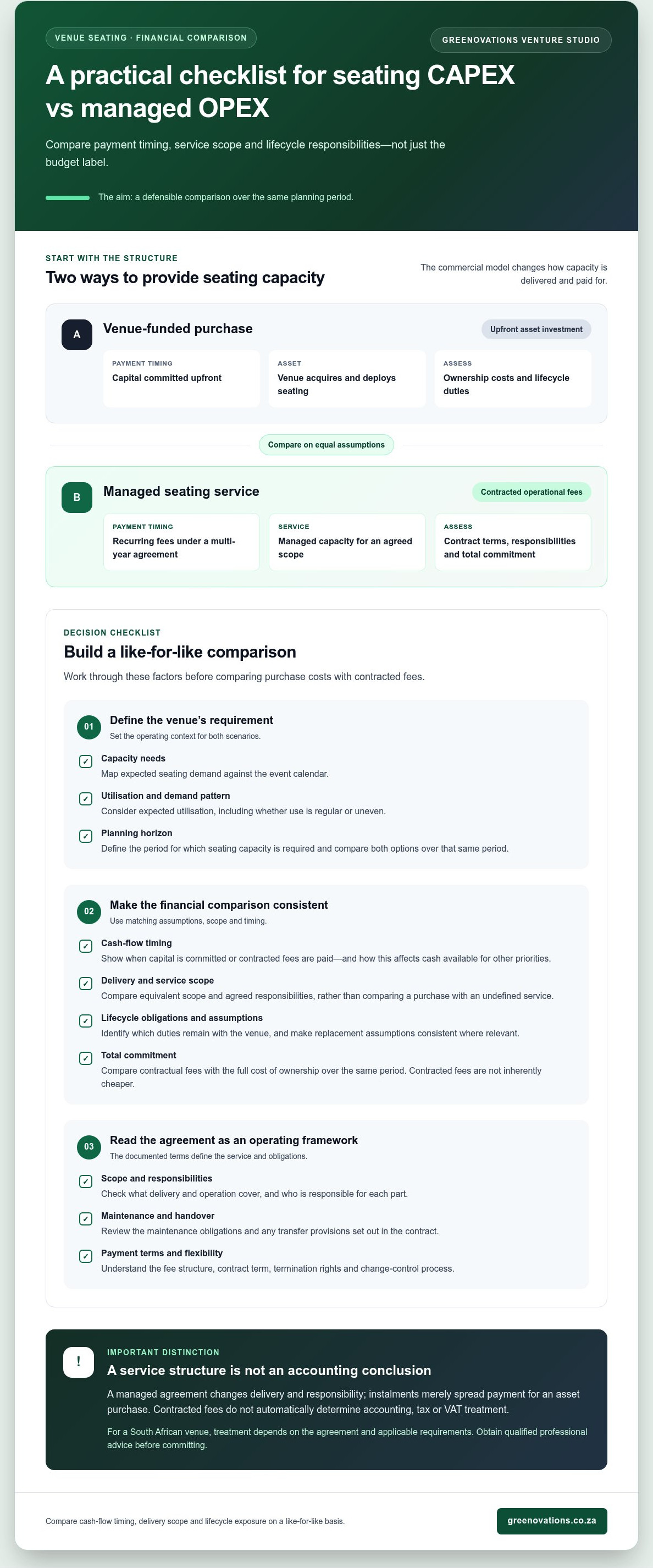
CAPEX is expenditure to acquire or develop a longer-lived asset; OPEX is recurring expenditure incurred in operating an organisation. A venue that buys grandstand seats makes an upfront asset investment, which may be recorded in its asset register and budgets under its applicable accounting policies. Under a managed seating agreement, the venue instead pays recurring contracted fees for an agreed operational scope. Capital expenditure (CAPEX) and operating expense (OPEX) offers a useful foundation for understanding the distinction.
A service model changes the delivery and responsibility structure; instalments merely spread payment for an asset purchase. The commercial form matters, but it does not by itself determine accounting, tax or VAT treatment. South African venues should obtain qualified professional guidance on the agreement before assuming that contracted fees receive OPEX treatment in their accounts.
Why a venue might reconsider upfront seating investment
A large initial seating outlay can constrain the capital available for other approved priorities, such as venue upgrades or essential infrastructure. Contracted operational fees change when cash leaves the organisation and can support more predictable budgeting across an agreement. They are not inherently cheaper: compare the total contractual commitment with the full cost of ownership over the same period.
The right comparison depends on venue scale, expected utilisation and planning horizon. A venue with regular, sustained use may assess ownership differently from one with uneven demand or changing capacity requirements. Lifecycle exposure also matters: identify which responsibilities the purchase option leaves with the venue and what operational scope the managed agreement covers.
Build the decision around the venue’s operating profile. Map expected seating demand against the event calendar, define the period for which capacity is required, and consider how payment timing affects cash available for other commitments. Then compare the contractual fees with ownership costs over that same period, using consistent assumptions for scope and lifecycle obligations. This gives decision-makers a clear basis for evaluating flexibility and total exposure without treating a payment-model change as proof of savings or a particular accounting outcome.
How managed seating infrastructure converts an upfront commitment into contracted fees
A managed seating arrangement changes how capacity is delivered and paid for. Instead of funding an outright installation itself, a venue defines its seating requirement and enters a multi-year agreement for managed capacity, paying contracted operational fees. The fee structure follows the agreed service arrangement; it is not simply an asset purchase renamed as OPEX.
Greenovations’ delivery approach is design-build-finance-operate-transfer. The process brings design, delivery and financing together with operation under a contracted model. The agreement sets out the payment structure and responsibilities throughout the arrangement, including any transfer provisions. Specific obligations depend on the contract, not on the label “Infrastructure-as-a-Service”.
A managed seating service provides capacity through a multi-year agreement and contracted operational fees, rather than asking the venue to fund an upfront seating purchase.
What the managed seating service model changes
With a venue-funded installation, the operator commits capital to acquire and deploy seating, then manages the resulting asset under its own arrangements. In a managed service, Greenovations finances and manages deployment, while the venue pays contracted operational fees for agreed seating capacity. That changes the commercial structure, but not automatically the accounting classification.
The contract is the control point. It defines project scope, responsibilities, payment terms and transfer provisions, allowing decision-makers to distinguish the service being contracted from ownership of the seats. For a venue assessing how to convert seating capex to opex, the documented arrangement matters more than its headline description.
Which responsibilities and obligations belong in the contract
Review the agreement as an operating framework, not only as a fee schedule. It should set out the delivery and operational scope, allocate responsibilities, and explain any maintenance and handover obligations. Do not infer uptime commitments, replacement arrangements or performance guarantees unless the contract expressly states them.
Assess the term, termination rights, change-control process and end-of-term provisions alongside payment terms. These clauses determine how the arrangement responds if capacity needs change, the project scope is amended or the agreement concludes. In South Africa, obtain qualified professional guidance on the accounting, tax and VAT treatment of the specific agreement; recurring fees alone do not settle that analysis.
A disciplined review connects each fee to a defined obligation and identifies where operational or lifecycle exposure remains with the venue. Greenovations’ managed seating infrastructure service provides a delivery framework for venues evaluating contracted seating capacity. Compare the proposed scope and contractual commitment with an equivalent ownership scenario.
Seating CAPEX versus OPEX: compare cash flow, lifecycle exposure, and accounting
A valid comparison holds the seating requirement constant and changes only the delivery and payment structure. Compare the same capacity, service scope, utilisation assumptions and analysis period. Otherwise, a managed service with agreed operational responsibilities may be compared unfairly with a purchase that leaves those responsibilities outside the calculation.
Use the table to separate cash-flow timing from lifecycle exposure. A managed service can make payment timing more predictable, but recurring fees are not automatically cheaper than buying. Compare the total contractual commitment with the equivalent ownership scenario, including relevant deployment, operating, maintenance and replacement assumptions. Show financing costs separately rather than hiding them in a single total.
| Comparison area | Outright purchase | Managed seating service |
|---|---|---|
| Cash timing | Significant initial payment, subject to the purchase and deployment arrangements. | Contracted operational fees paid over the agreement, according to its payment terms. |
| Scope | The venue acquires seating and funds the agreed purchase and deployment. | The agreement defines the managed capacity and the delivery and operational scope. |
| Lifecycle exposure | Assess the venue’s responsibilities for operation, maintenance, replacement and end-of-life decisions. | Assess which responsibilities the contract assigns to the service arrangement and which remain with the venue. |
| Total commitment | Include purchase, deployment, financing where relevant, and lifecycle costs over the period. | Include all contracted fees and any other costs or obligations specified in the agreement. |
What a fair financial comparison should include
Fix the analysis period first, then use consistent assumptions for capacity, utilisation and service scope. For example, compare the seating required for the same operating profile across the same period, rather than comparing an owned installation over its full useful life with only part of a service agreement. State what happens at the end of each scenario and include replacement assumptions only where relevant and supportable.
Present two views: a period-by-period cash-flow schedule and a total lifecycle expenditure comparison. The first shows when funds are committed; the second shows the full financial exposure. Keep financing costs visible and document material assumptions so decision-makers can test how changes affect the result.
Why OPEX wording does not guarantee off-balance-sheet treatment
A contract’s commercial description does not decide its accounting recognition or tax deductibility. The agreement’s substance and the accounting requirements applicable to the venue determine the analysis. Likewise, a recurring payment description alone does not establish its tax or VAT treatment under South African rules administered by the South African Revenue Service (SARS).
Have qualified South African accounting and tax professionals assess the specific contract against applicable requirements, including IFRS where relevant to the venue’s reporting. The financial case should distinguish payment structure from accounting outcome. A decision to convert seating capex to opex may alter cash-flow timing, but it does not by itself establish savings or off-balance-sheet treatment.
A practical financial analysis for converting seating CAPEX to OPEX
A decision to convert seating capex to opex should withstand both financial and operational review. Build two scenarios around the same venue requirement, then test the assumptions that drive the results. Keep the base case transparent and separate sensitivity tests. Do not make a preferred structure appear stronger by changing capacity, scope or timing between scenarios.
- Define the capacity need. Set out the grandstand seating capacity and operational requirements the venue needs to meet. Apply the same requirements to an outright purchase and a managed service.
- Set the comparison horizon. Choose a planning period that makes sense for the venue’s decision. Record what each scenario assumes at the end of that period, including continuing obligations or transfer assumptions.
- Model cash flows. Show purchase and deployment outlays separately from recurring service fees. Include relevant operating, maintenance, replacement and financing assumptions, and identify costs excluded from either scenario. Present payment timing alongside total expenditure.
- Test contractual terms. Map the proposed payment schedule, escalation provisions, scope, change-control process and exit conditions into the model. Distinguish obligations stated in the agreement from assumptions made for analysis.
- Review classification. Have the venue’s finance team and professional advisers assess accounting, tax and VAT treatment against the contract and current South African requirements. Do not infer classification from the words “OPEX” or “service fee”.
Build comparable purchase and service scenarios
Keep capacity, operating requirements, utilisation assumptions and analysis period consistent. For the purchase case, record upfront investment, deployment and lifecycle costs relevant to the venue. For the service case, record contracted fees, included scope and excluded costs. Create a base case using documented assumptions rather than unsupported price or savings estimates, and retain a clear audit trail for each input.
Run sensitivities separately. Lower or higher utilisation, a change in service scope, different contract-length assumptions or an alternative replacement scenario may alter the comparison. Each test shows how the decision responds to a specific change; none produces a universal result.
Stress-test the contract and financial assumptions
Ask the finance team to model both the timing of cash movements and the total commitment over the same period. Check how payment schedules and escalation provisions affect forecast expenditure, and assess the impact of scope changes or termination under the agreement. Keep accounting recognition separate from the cash-flow model, then obtain qualified advice on how the contract applies.
Decision checklist:
- Does each scenario deliver the same defined seating capacity and operational scope?
- Are utilisation, replacement and end-of-term assumptions explicit?
- Are fees, exclusions, escalation and exit provisions reflected in the model?
- Have qualified South African professionals reviewed accounting, tax and VAT implications?
This framework gives decision-makers a disciplined basis for assessing Greenovations’ managed seating infrastructure approach against a venue-funded purchase. Use the completed comparison to identify which delivery structure fits the venue’s capacity plan, cash-flow requirements and contractual risk tolerance.
Greenovations' managed seating model: define the next decision
A managed service merits evaluation when a venue has a defined seating requirement, faces constraints on upfront capital and prefers a contracted delivery structure. It is not automatically the lower-cost choice. The decision is whether the service scope, payment profile and responsibilities fit the venue’s operating plan better than an outright purchase.
Where Greenovations fits in the decision
Greenovations Venture Studio develops infrastructure businesses, and its seating offering is structured as Infrastructure-as-a-Service. Its design-build-finance-operate-transfer approach brings those functions together within a managed seating model. Venue operators access managed seating capacity through multi-year agreements with contracted operational fees, rather than funding the seating through an upfront capital spend.
The agreement, not the model name, defines the commercial arrangement. Project-specific scope and terms determine the capacity provided, the responsibilities assigned to each party, the fee structure and any transfer provisions. Those details also form the basis for comparing the managed service with venue-funded ownership. An operational-fee structure alone does not determine accounting, tax or VAT treatment.
The information needed to progress a venue assessment
Prepare a clear project brief before evaluating whether to convert seating capex to opex. Set out the venue’s seating requirement, operating context and intended analysis horizon. Describe how the capacity will be used across planned activities, then identify the operational requirements to include in the assessment.
Next, define the commercial scope to be assessed. Record the delivery and operation required, the responsibilities the venue expects the agreement to allocate, and the assumptions to test in the financial model. Keep the comparison tied to a consistent capacity and period, and distinguish requested scope from the final contractual commitment.
- Capacity: What seating requirement must the venue address?
- Operating context: How will the seating support the venue’s planned use?
- Analysis horizon: What period will the venue use to compare purchase and managed service?
- Commercial scope: Which delivery, operational and handover responsibilities need to be defined?
- Decision controls: Which contract, cash-flow and professional accounting or tax reviews are needed?
This information gives Greenovations a practical basis for discussing the venue’s seating infrastructure project and the fit of contracted managed capacity. It also helps decision-makers evaluate stadium seating without upfront capital spend as a delivery structure, rather than presume that changing payment timing guarantees savings or a particular accounting result.
Discuss your seating infrastructure project with Greenovations to assess how contracted managed seating aligns with your venue’s requirements and financial priorities.
Make the next seating decision on comparable terms
Turn the financial analysis into a decision brief that procurement, operations and finance can assess using the same assumptions. Set out the capacity requirement, planning horizon, service scope and key contractual exposures, then record which issues still need professional accounting or tax review. This keeps the decision focused on commercial fit, not on whether a payment is labelled CAPEX or OPEX.
For venues considering whether to convert seating capex to opex, the objective is not to favour recurring fees by default. It is to determine whether contracted delivery aligns with the venue’s capital priorities, operational requirements and appetite for defined long-term commitments. A disciplined assessment gives stakeholders a sounder basis for approval and negotiation.
A clear project brief makes the discussion of a managed seating structure more productive and keeps the assessment tied to the venue’s requirements.
Frequently Asked Questions
Can seating CAPEX be converted to OPEX without buying the seats?
Yes. A venue can access managed seating capacity through an Infrastructure-as-a-Service agreement rather than purchasing the seats outright. Greenovations’ model uses contracted operational fees under a multi-year agreement, so the venue does not fund the seating through an upfront capital purchase. The agreement defines the capacity and service arrangement. This differs from buying seats and paying the purchase price in instalments.
Does converting seating CAPEX to OPEX automatically keep it off the balance sheet?
No. A recurring fee or an OPEX description does not by itself determine balance-sheet treatment. The accounting assessment depends on the agreement’s substance and the requirements applicable to the venue’s reporting. Before approving the arrangement, provide the complete contract, including its scope and transfer provisions, to the venue’s qualified accounting advisers. They can assess how the agreement should be recognised rather than relying on commercial labels.
Is a managed seating service cheaper than buying seating outright?
Not necessarily. The outcome depends on project scope, payment terms, responsibilities and the assumptions used in the comparison. For example, a purchase scenario that excludes operating responsibilities is not comparable with a service scenario that includes them. Assess the full commitment over a consistent period, and distinguish cash-flow timing from total expenditure. The right choice depends on the venue’s requirements, not on a general assumption that service fees cost less.
How should a venue compare seating purchase and Infrastructure-as-a-Service?
Define one seating requirement and apply it to both options. Then map the expected event and operating profile, analysis period and responsibilities included in each scenario. For a venue with seasonal demand, test whether the capacity and contracted scope remain appropriate during quieter periods as well as peak use. Record exclusions and end-of-period assumptions so the comparison reflects the venue’s actual operating case.
What contract terms matter when seating is funded through operational fees?
Review the clauses that define capacity, service scope, payment dates and any escalation mechanism. Also examine responsibility allocation, change control, termination rights and end-of-term provisions. These terms determine how the arrangement responds if the venue’s requirements change or the agreement concludes. Confirm that operational expectations are expressed in the contract; do not treat assumptions about maintenance, replacement, uptime or performance as commitments unless the agreement states them.
Can a South African venue deduct seating service fees for tax?
Not automatically. Whether a payment is deductible depends on the facts of the arrangement and the tax rules applicable to the venue, so the fee’s description alone cannot establish the outcome. Have a qualified South African tax professional review the agreement and the venue’s circumstances, including relevant SARS requirements. Treat tax deductibility and accounting recognition as separate assessments, and do not build a financial case on an assumed deduction.
What happens to managed seating infrastructure at the end of the contract?
The agreement’s end-of-term and transfer provisions govern the outcome. Greenovations’ delivery approach is design-build-finance-operate-transfer, but the project contract sets the specific handover arrangements and obligations. Before entering an agreement, establish what the documents provide for at expiry, including any transfer process and each party’s responsibilities. Do not assume that the venue automatically owns the infrastructure, or that it must be removed, without reviewing those provisions.
Visual summary
Planning a project like this?
Talk to the Greenovations venture desk about a No-CAPEX structure.