The seat is only half the decision. Stadium seating solutions South Africa operators assess must suit the venue’s physical requirements and capital plan. An upfront purchase, managed seating and temporary rental each create different budget and operational demands.
Comparing options is difficult when product information focuses on individual features rather than consistent criteria. Durability, maintenance, spectator needs and installation expenditure all matter. A lower initial outlay, for example, does not by itself make an option the best long-term fit.
This comparison covers common seating formats and the trade-offs between outright ownership and managed infrastructure. Greenovations Venture Studio’s Infrastructure-as-a-Service model provides managed seating capacity through contracted operational fees and multi-year agreements, without upfront capital expenditure from the venue partner. The guide also outlines what to gather before evaluating a project, including venue use, capacity requirements and capital constraints. This gives operators a practical basis for comparing options on both operational and commercial grounds, rather than relying on seat specifications alone.
Key Takeaways
- Compare individual spectator seats, upholstered VIP seating, concrete embankments and managed seating by application, site dependency and operational impact.
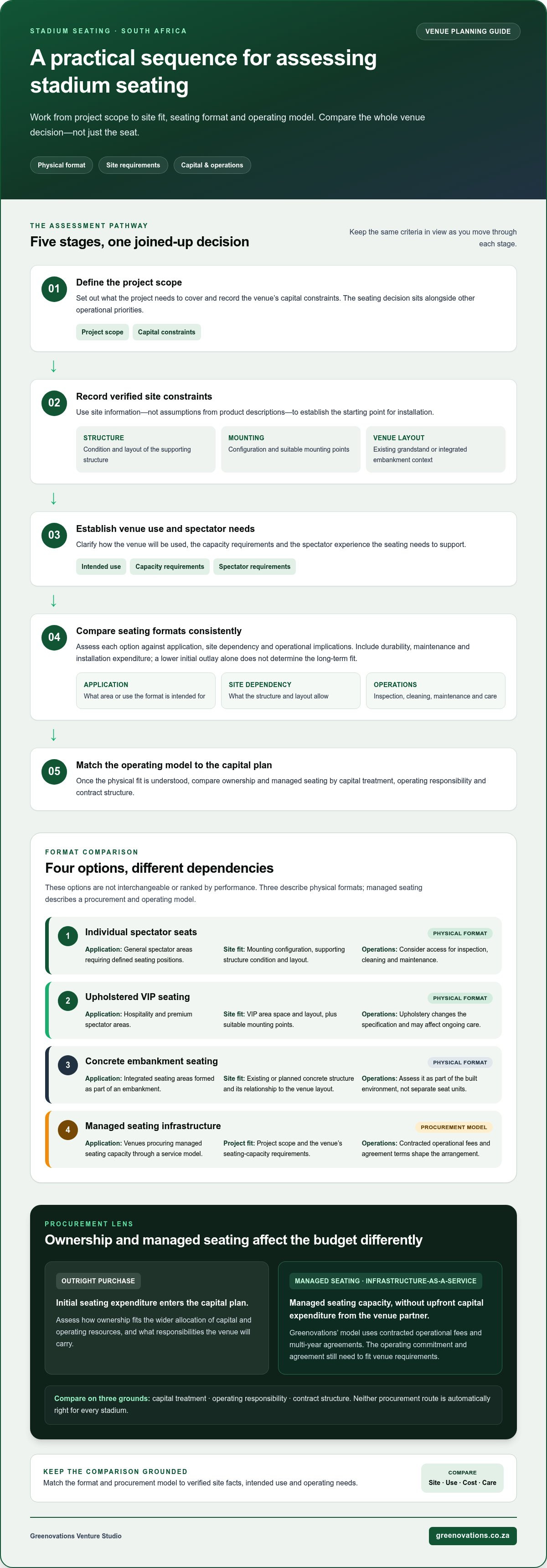
- Follow a consistent assessment sequence: define the project scope, record verified site constraints, establish venue use, compare formats and assess operating needs.
- Evaluate stadium seating solutions South Africa venues can adopt by considering capacity, spectator requirements, maintenance and capital allocation together.
- Compare outright purchase with managed seating across capital treatment, operating responsibility and contract structure, not just physical format.
- Greenovations’ Infrastructure-as-a-Service model provides managed seating capacity through contracted operational fees and multi-year agreements, without upfront capital expenditure from the venue partner.
Stadium seating solutions in South Africa: frame the venue decision
Seating is a venue-wide infrastructure decision, not simply a catalogue choice. It affects usable capacity, spectator experience, maintenance demands and how capital is allocated alongside other operational priorities. A seat that looks suitable on its own may be a poor fit if the existing structure, event use or ongoing operating requirements point elsewhere.
This comparison focuses on permanent stadium and grandstand seating, rather than temporary chairs brought in for a single event. It assesses stadium seating solutions South Africa operators can consider by looking at both physical format and procurement model. For broader context, stadium design and seating are part of planning a venue around its intended use.
What counts as a stadium seating solution?
The term covers several physical arrangements: individual spectator seats fixed to a structure, upholstered seating for VIP areas, and integrated embankment or grandstand systems. These formats differ in how they fit the venue, the spectator experience they support and the operational demands they create.
Mounting configuration and the supporting structure influence what can be installed. An established grandstand presents a different starting point from a project where seating is integrated with an embankment. Use site information to establish these differences instead of relying on assumptions drawn from a product description. The physical system is only one part of the decision: the procurement model determines whether the venue owns the seats or pays for managed seating capacity under an agreement.
Why the procurement decision matters as much as the seat
With an outright purchase, the initial seating expenditure goes into the venue’s capital plan. It may compete with other priorities, so assess how ownership fits the wider allocation of capital and operating resources, not just whether the seats can be acquired.
Operating expenditure follows a different budget and contracting route. Greenovations’ Infrastructure-as-a-Service model provides managed seating capacity through contracted operational fees and multi-year agreements, without upfront capital expenditure from the venue partner. This changes the financial structure, but the operating commitment and agreement still need to fit the venue’s requirements.
Neither procurement route is automatically right for every stadium. Compare whether the physical format suits the site and intended use, then assess whether ownership or a managed-service structure fits the venue’s capital plan and operating responsibilities.
The sections that follow compare four formats, provide a sequence for assessing venue requirements and examine outright purchase against managed seating. Together, they help operators narrow the options before detailed project planning.
Compare four stadium seating formats for South African venues
These options address different needs. Individual seats, upholstered VIP seating and concrete embankments are physical formats; managed seating infrastructure is a procurement and operating model. Comparing them side by side helps clarify what depends on the venue’s structure, intended use and operating approach. They are not interchangeable, and this comparison does not rank them by performance.
| Format | Typical application | Site dependency | Operational implications |
|---|---|---|---|
| Individual spectator seats | General spectator areas requiring defined seating positions | Mounting configuration and the condition and layout of the supporting structure | Consider access for inspection, cleaning and maintenance alongside seat selection |
| Upholstered VIP seating | Hospitality and premium spectator areas | Space and layout allocated to the VIP area, plus suitable mounting points | Upholstery changes the seating specification and may affect ongoing care requirements |
| Concrete embankment seating | Integrated seating areas formed as part of an embankment | Existing or planned concrete structure and its relationship to the venue layout | Assess as part of the built environment, not as a collection of separate seat units |
| Managed seating infrastructure | Venues procuring managed seating capacity through a service model | Project scope and the venue’s requirements for seating capacity | Contracted operational fees and agreement terms shape the procurement arrangement |
Individual spectator seats and VIP seating
Hard-shell individual seats provide defined places for general spectators, while upholstered VIP seats are intended for hospitality areas. The mounting approach matters too. Step-, riser- and beam-mounted configurations are options named by Rodlin Design, and each depends on how the seats relate to the supporting structure. Do not treat these configurations as equivalent installations. Rodlin Design describes UV resistance, flame retardancy and vandal resistance as properties of its products. These are supplier-specific claims, not universal attributes of every seat.
Embankment seating and managed seating infrastructure
Concrete embankment seating integrates seating into a concrete structure. Infraset presents its system for stadiums and other public spaces, positioning it as part of the built environment. Managed seating infrastructure is different: Infrastructure-as-a-Service is a way to procure and manage capacity, not a seat type or a claim about material or mounting system. Greenovations structures its model around contracted operational fees and multi-year agreements, without upfront capital expenditure from the venue partner. Operators assessing stadium seating solutions South Africa can therefore separate two decisions: which physical arrangement suits the site, and how the venue will procure the capacity. For venues considering the procurement model, managed seating infrastructure provides an alternative to outright ownership.
No format is inherently right for every venue. Use verified site information to assess mounting and structural dependencies, then compare operational implications against intended use. This keeps supplier-specific claims separate from project requirements and avoids comparing unlike formats as if they shared the same specification.
How to assess stadium seating solutions against venue requirements
A sound assessment starts with evidence, not a preferred product. For stadium seating solutions South Africa operators are considering, use the same sequence for every option: define the project, record known site conditions, specify venue use, compare suitable formats and assess ongoing operations. This makes information gaps visible before assumptions become part of the procurement decision.
- Establish scope. Define which seating areas are included and whether the project involves new capacity, replacement seating or an upgrade to an existing area.
- Map site constraints. Record available information about the existing structure, mounting locations and layout. Mark unknowns clearly instead of filling them with estimated dimensions or assumed engineering requirements.
- Define use. Identify intended audiences and how each area will be used, including whether it serves general spectators or a VIP function.
- Compare formats. Assess individual seats, upholstered seating and integrated embankment options against the same documented requirements. Treat managed infrastructure as a procurement model, not a physical seat format.
- Assess operations. Consider access, spectator safety, durability, cleaning, inspection, maintenance and replacement planning as project-specific review categories.
Map capacity, site conditions and seating use
Start with the venue’s records. Document the areas in scope, intended audiences and expected patterns of use, then note existing structures and known mounting constraints. Separate measured or documented information from what remains to be established. Include cleaning access, routine maintenance and replacement planning in the brief. These factors affect how a format works in service, not just how it fits on installation day.
Compare technical claims and operational requirements
For each shortlisted option, record the stated material, mounting method and any tested property alongside its source. A claim about one product does not establish that another has the same property. Review spectator safety, access, fire performance and accessibility against the project’s applicable requirements. Do not infer compliance from a general product description. If evidence is missing, flag the gap for resolution rather than treating it as equivalent to a documented result.
A comparison matrix keeps the review consistent and auditable. Give each option a row, with fields for intended area, site dependencies, stated properties and source, operational considerations, and evidence still required. Label each item as documented, assumption or to be verified so decision-makers can distinguish facts from planning inputs. This prevents unverified dimensions, capacity figures or performance claims from quietly becoming procurement criteria.
The result is a project brief grounded in the venue’s conditions. It gives decision-makers a clearer basis for comparing formats and shifts the discussion from broad product claims to requirements, evidence and operating consequences.
Upfront purchase versus managed stadium seating
The procurement model determines how a seating project affects the venue’s capital plan and ongoing budget. Outright purchase treats seating as an asset acquired through upfront capital expenditure. Managed seating uses contracted operational fees for capacity provided under an agreement. These routes change the financial structure, but neither removes the need to assess operational requirements and commitments.
Compare the models across three criteria: how expenditure is budgeted, who owns the seating and how responsibilities are defined in the agreement. For stadium seating solutions South Africa operators are evaluating, the right comparison depends on the project. Do not assume that avoiding upfront expenditure guarantees a lower total cost, or that ownership automatically makes operations simpler.
When outright purchase may fit the capital plan
With an outright purchase, the venue funds the acquisition through capital expenditure and retains ownership of the seating asset. This may suit a capital plan that can accommodate the initial investment and the venue’s longer-term asset responsibilities. Ownership also means including ongoing care and future replacement in venue operations. It does not, by itself, establish that this is the most economical or straightforward route.
How managed seating Infrastructure-as-a-Service works
Greenovations’ Infrastructure-as-a-Service model provides managed seating capacity through contracted operational fees and multi-year agreements. It avoids upfront capital expenditure by the venue partner and turns high seating installation costs into predictable operational expenses. This is an alternative procurement structure, not an absence of ongoing commitment. Assess the agreement period and contracted fees against the venue’s requirements and budget planning.
Use a consistent decision record before selecting a route:
- Capital treatment: determine whether the project can accommodate upfront acquisition expenditure or needs an alternative budget structure.
- Ownership: record whether the venue will own the seating or procure managed capacity.
- Operating responsibility: identify how responsibilities are allocated and documented under the chosen arrangement.
- Contract structure: assess the fee basis and agreement commitments against the venue’s planning horizon, using the terms set out for the project.
Consider this comparison alongside the physical-format assessment. First establish which seating approach suits the site and intended use, then assess whether buying the asset or procuring managed capacity better fits the capital plan. A financial model cannot compensate for a mismatch between the physical solution and venue requirements. Equally, a suitable physical format does not determine how it should be funded.
For venues considering an alternative to upfront purchase, explore Greenovations’ managed seating approach as a project-specific procurement option. Assess the contracted operational commitment alongside capital allocation, operating responsibilities and required seating capacity.
Greenovations’ managed seating solution: define the next project steps
Greenovations’ Sustainable Seating Infrastructure-as-a-Service is the managed option in this comparison. It is a procurement model for venue operators, not a catalogue of individual seat products. The model provides managed seating capacity through contracted operational fees and multi-year agreements, without upfront capital expenditure from the venue partner. This changes how seating is funded; operators still need to define the physical scope, operational requirements and agreement commitments.
What Greenovations’ seating Infrastructure-as-a-Service changes
Instead of funding seating installation through an upfront capital outlay, the venue pays contracted operational fees for managed capacity. The multi-year agreement structure supports predictable operating expense planning, allowing operators to consider seating alongside other capital priorities. The commercial decision remains project-specific: assess the contracted commitment against the venue’s budget objectives and required capacity.
Prepare a decision brief for the venue
A clear project brief makes it easier to compare physical seating formats and procurement routes on a consistent basis. Separate verified site information from assumptions, and record the operational and capital objectives that will shape the decision. For stadium seating solutions South Africa operators are evaluating, useful preparation includes:
- Project scope: identify the seating areas involved and whether the requirement concerns new capacity, replacement or an upgrade.
- Site information: gather available records on existing structures, layout and mounting constraints. Mark unknowns for assessment rather than estimating dimensions or engineering needs.
- Use requirements: describe intended audiences, how each area will be used and the expected patterns of use.
- Operational priorities: record maintenance, cleaning, access and replacement considerations that matter to venue operations.
- Procurement objectives: state whether the priority is asset ownership through upfront capital expenditure or managed capacity with contracted operational fees.
- Comparison evidence: capture the source of stated materials, mounting methods and tested properties, alongside any evidence still required for project-specific review.
This brief gives decision-makers a grounded basis for comparing seat formats with the Infrastructure-as-a-Service model. It helps distinguish site facts from planning assumptions and clarifies how a managed arrangement fits the venue’s capital allocation and operating expense objectives. Evaluate the model against documented project requirements rather than treating it as a universal replacement for ownership.
Venue operators assessing managed capacity can explore Greenovations’ seating infrastructure model and discuss how the Infrastructure-as-a-Service approach fits their project brief.
Set the seating project in motion
Turn the venue’s priorities into a decision brief to guide commercial evaluation. Define the seating scope, record available site information and state the capital objective before comparing procurement routes. This gives stadium seating solutions South Africa operators assess a clear basis for project planning, rather than leaving the decision at the level of product descriptions.
For venues seeking to preserve upfront capital for other priorities, Greenovations’ managed model provides seating capacity through contracted operational fees. Its multi-year agreements convert high seating installation costs into predictable operating expenses. Assess how that structure aligns with your venue’s requirements, budget planning and operating responsibilities.
Explore Greenovations’ managed seating infrastructure model to take the next step towards a seating procurement approach grounded in your project’s needs. A well-defined brief creates a stronger foundation for a confident decision.
Frequently Asked Questions
Can stadium seating be upgraded in phases?
Yes. A stadium can plan seating upgrades in phases when the project scope and interfaces between areas are clearly defined. A venue might, for example, prioritise one stand or section before addressing others. Before committing to a phased approach, map how each stage affects access, spectator routes, ongoing events and connections to existing seating. Record dependencies between phases so early work does not constrain later decisions or create inconsistent requirements across the venue.
What is the difference between spectator seating and VIP stadium seating?
Spectator seating generally serves the venue’s main audience, while VIP seating is intended for designated hospitality areas and may use upholstered seats rather than hard-shell individual seats. The distinction is not just appearance. Area purpose, intended users, layout and operating expectations all inform the specification. A hospitality zone, for example, may have different furniture and maintenance considerations from a general stand. Define each area’s role before comparing seat formats or treating them as one procurement requirement.
Are concrete embankment seats suitable for every stadium?
No. Concrete embankment seating is integrated into a structure, so its suitability depends on the venue’s built environment, layout and project scope. It may suit a project where seating is planned as part of an embankment, but it is not a direct substitute for individual seats mounted to an existing stand. Establish which structures are present and what the project requires before shortlisting this format. Do not assume it will fit every site or suit every seating area.
What does beam-mounted stadium seating mean?
Beam-mounted seating describes seats attached to a supporting beam rather than fixed directly to a step or riser. It is one mounting configuration named for spectator seating applications. The term alone does not establish whether a particular seat is suitable for a venue. Consider the supporting structure, mounting arrangement and available site information together. Record the proposed method and its source in the project comparison, distinguishing verified details from matters that still require assessment.
How should venues assess claims such as UV resistance or flame retardancy?
Establish what evidence supports each stated property and whether it applies to the specific product being assessed. Record the claim, its source and any relevant test documentation instead of treating a supplier description as proof of a universal standard. For example, Rodlin Design lists UV resistance and flame retardancy as product claims. Compare these with evidence for other shortlisted options, and flag missing documentation for project-specific review.
Can a stadium use managed seating without upfront capital expenditure?
Yes. Greenovations’ managed seating Infrastructure-as-a-Service model provides seating capacity without upfront capital expenditure from the venue partner. The venue pays contracted operational fees under a multi-year agreement. This offers an alternative to buying the seats outright, but remains a contractual operating commitment. Assess the arrangement against the venue’s capacity needs, budget planning and operational priorities before choosing a procurement structure.
What information should a venue include in a stadium seating project brief?
Include the project scope, seating areas, intended audiences and expected use. Add available site records, existing structures and known mounting constraints, clearly labelling anything not yet verified. Document operational priorities such as cleaning, maintenance and replacement planning alongside the venue’s capital objectives. To compare stadium seating solutions South Africa venues may consider, record each format’s stated properties and evidence source, as well as the procurement model and any outstanding assessment requirements.
Visual summary
Planning a project like this?
Talk to the Greenovations venture desk about a No-CAPEX structure.