
A DBFOT concession is not a straightforward public works contract: the private partner designs, builds, finances and operates infrastructure before transferring it to government at the end of the concession. The DBFOT model for public infrastructure therefore depends on clear allocation of delivery and operating risks, alongside a revenue structure that can support the investment. In South Africa, PPP agreements require Treasury approval against affordability, value-for-money and substantial risk-transfer requirements.
The commercial case for a DBFOT model for public infrastructure rests on assigning each risk to the party best able to manage it, not simply shifting risk to the private sector. This guide explains how government-pay and user-pay revenues work, what contractual handback involves, and how DBFOT differs from affermage, where government typically retains responsibility for capital expenditure. It also outlines the South African approval context that shapes whether a proposed concession is affordable and bankable.
Key Takeaways
- Allocate each risk to the public or private party best positioned to manage it, rather than transferring risk without regard to control.
- Distinguish government-pay revenue from user-pay revenue to understand who funds the concession and where demand exposure sits.
- Define operating obligations and asset handback requirements in the concession terms before construction begins.
- Separate DBFOT from affermage by identifying who carries capital expenditure responsibility, not just who operates the infrastructure.
Allocation of market, project, political, regulatory and financial risks
Public-private partnerships finance infrastructure through contracts that allocate delivery obligations and risk between government and a private partner. In a DBFOT structure, that allocation must link design, construction, finance, maintenance and operations to measurable contract requirements.
Risk allocation across project stages
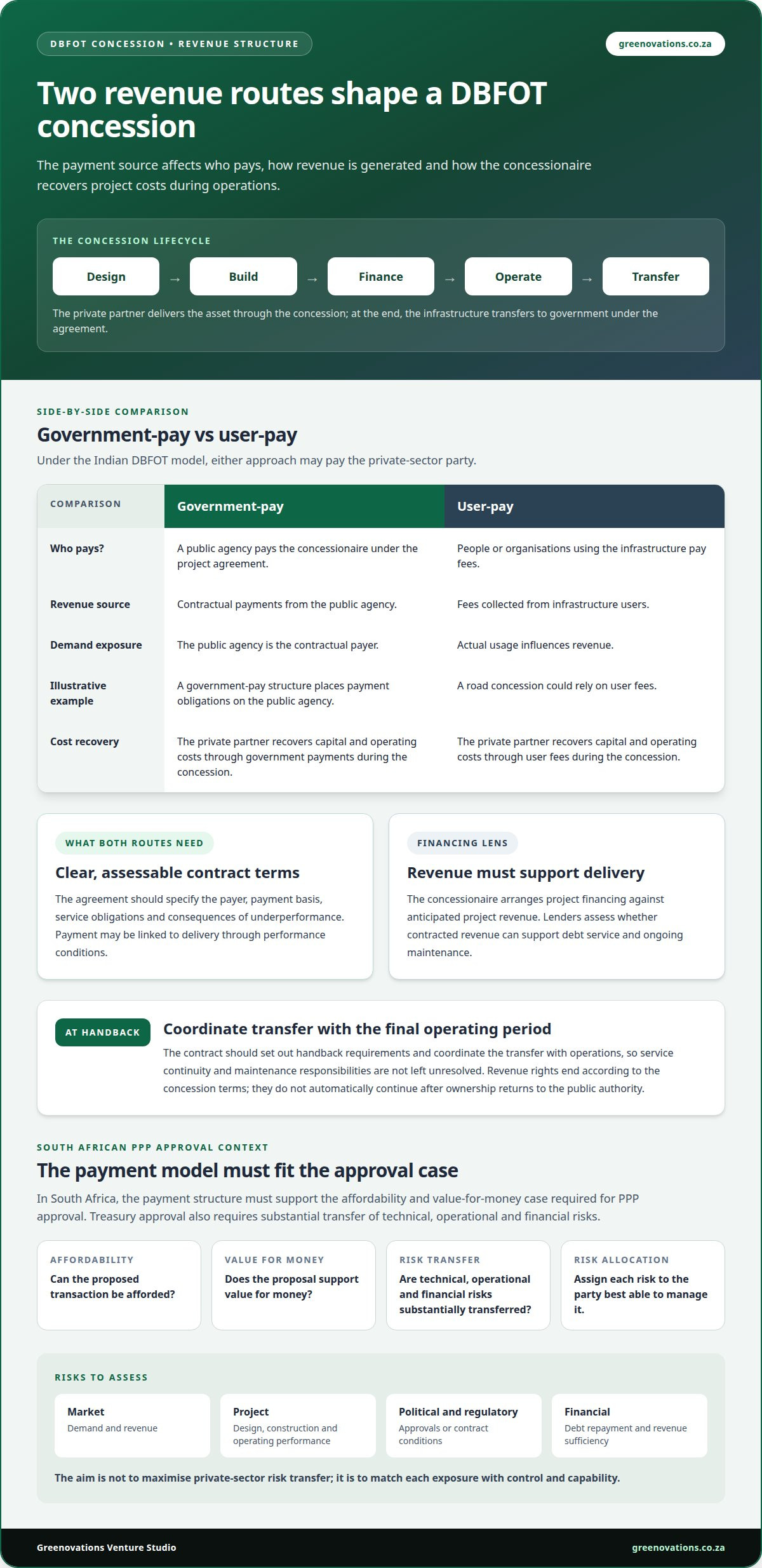
Risk allocation assigns each project exposure to the party best equipped to manage it. Market risk concerns demand and revenue; project risk covers design, construction and operating performance. Political and regulatory risks can affect approvals or contract conditions, while financial risk includes debt repayment and revenue sufficiency. Allocate risks according to control and capability, not simply to maximise private-sector transfer. This supports value for money.
Private-sector delivery responsibilities
Private-sector delivery combines design, construction, financing, maintenance and operations under one concession. The private partner arranges project finance, often using long-term debt and other financing facilities, then relies on contract-backed revenue to meet operating obligations and debt service. A practical allocation links construction milestones to technical requirements and ongoing maintenance and operating duties to performance standards. This makes lifecycle responsibility explicit instead of separating construction from asset upkeep.
South African rules and project examples
South African PPP procurement is governed by Treasury Regulation 16, issued under the Public Finance Management Act (PFMA) 2004. Treasury approval requires affordability, value for money, and substantial transfer of technical, operational and financial risks. These tests apply to the proposed transaction and its allocation of obligations.
DBFOT is a contractual structure, not a designated list of South African projects. Proposals may include roads, railways, electricity generation or distribution, water treatment plants and seaport terminals. Each requires assessment of its demand, delivery and operating risks. The project type alone does not establish whether DBFOT is suitable. Treasury’s affordability and value-for-money tests shape the procurement decision.
Government-pay and user-pay revenue models
A DBFOT concession’s revenue mechanism determines how the private partner recovers project costs during operations. In South Africa, the payment structure must support the affordability and value-for-money case required for PPP approval.
Government and user-fee payments
Government-pay revenue is payment from a public agency to the concessionaire under the project agreement. User-pay revenue comes from fees charged to people or organisations using the infrastructure. Under the Indian DBFOT model, either approach may pay the private-sector party. For example, a road concession could rely on user fees, while a government-pay structure places payment obligations on the public agency. The contract defines the revenue source and the operating obligations it supports.
The distinction affects exposure to demand. With user fees, actual usage influences revenue; with government payments, the public agency is the contractual payer. A public-private partnership can also link payment to delivery through performance conditions. In each case, the revenue model must align with the service, expected demand and financing commitments. The payment source is a central contract term, not a minor detail.
Project financing and cost recovery
Project financing funds design and construction against anticipated project revenue, rather than relying only on the concessionaire’s balance sheet. The private partner arranges financing, then recovers capital and operating costs through government payments or user fees during the concession. Lenders assess whether contracted revenue can support debt service and ongoing maintenance.
Cost recovery depends on the payment mechanism, operating performance and revenue available across the concession. The agreement should specify the payer, payment basis, service obligations and consequences of underperformance. These terms make cash flows assessable for financing and connect payment to delivery.
At the concession’s end, the infrastructure transfers to government under the DBFOT arrangement. The contract should coordinate handback with the final operating period, so the transfer does not leave unresolved responsibilities for service continuity or maintenance. Revenue rights end according to the concession terms; they do not automatically continue after ownership returns to the public authority.
DBFOT concession structure and project handback
A DBFOT concession joins infrastructure design, construction, finance, operation and eventual transfer in one contract. Its structure must define decision rights, delivery obligations, concession duration and handback condition.
Public authority and concessionaire roles
The public authority defines the required infrastructure and oversees the concession contract; the private concessionaire delivers the agreed project. The authority sets service requirements, procurement terms and performance measures, then monitors compliance. The concessionaire designs, builds, finances, maintains and operates the asset to those requirements throughout the concession. For a water treatment project, the agreement should distinguish public oversight from the concessionaire’s operating duties.
Concession periods and project prices
The concession period is the contract term during which the private partner operates the asset before transfer. Its duration depends on construction requirements, operating obligations, expected revenue and the time needed to recover financing. There is no single term for every South African project. Project price reflects the defined scope, design and construction requirements, financing structure, maintenance commitments and allocated risks. These inputs shape comparable tender bids.
Project structuring and tendering steps
Project structuring turns a public infrastructure requirement into a defined, tenderable concession. First, the authority specifies the asset, service outputs and operating standards. It then sets the proposed risk allocation, revenue mechanism, concession term and handback requirements. Tender documents translate these decisions into obligations bidders can price and finance. Evaluation should compare proposed delivery and financing with the stated requirements, rather than treating the lowest initial price as the only measure.
Project handback
Project handback is the contractual transfer of infrastructure to government when the concession ends. The agreement should identify the assets being transferred and the condition they must meet. It should also explain how inspections, records and outstanding maintenance obligations are handled before transfer. These provisions make the concession’s endpoint operationally clear. In a transport project, for example, handback terms should cover the infrastructure and relevant operating records, not merely state that ownership returns.
What are the roles of the public authority and private concessionaire in DBFOT?
A DBFOT contract separates public authority oversight from private delivery. This distinction matters throughout procurement, construction, operations and transfer, because each decision needs an accountable party.
Public authority: contract owner and oversight body
The public authority defines the required service and governs the concession through its contract. It sets measurable outputs, approves the project framework and monitors delivery against those outputs. During construction, it tracks milestones and manages formal decisions through the agreed contract process. During operations, it reviews performance information and applies contractual remedies when standards are missed. For a South African water treatment project, the authority oversees the contracted service rather than directing every daily operating task.
Private concessionaire: delivery and performance lead
The private concessionaire is contractually responsible for delivering the agreed infrastructure and service. It coordinates design, construction, financing, maintenance and operations, then manages subcontractors against concession requirements. A clear internal chain of responsibility helps the concessionaire address construction delays or operating failures without leaving the public authority to manage its delivery team. The contract should identify reporting duties, performance measures and the escalation route for unresolved issues.
Managing the public-private interface
The interface comprises the contract processes through which the authority and concessionaire manage decisions, performance and change. A workable sequence begins with agreed reporting, reviews results against service measures, and records corrective action and deadlines. Changes to scope or operating requirements should follow the contract’s change-control process, so neither party relies on informal instructions. Define dispute escalation before delivery starts to preserve an auditable record of decisions across the project lifecycle.
These roles are distinct, but they must connect at approval points, performance reviews and handback. A concession succeeds operationally when public oversight tests outcomes and the private party remains accountable for delivery. For infrastructure initiatives requiring a structured delivery model, explore infrastructure delivery options.
Greenovations Venture Studio: Sustainable Seating Infrastructure-as-a-Service
Greenovations Venture Studio offers Sustainable Seating Infrastructure-as-a-Service for organisations planning seating as an infrastructure requirement. It suits projects that need a defined approach to seating provision rather than an isolated purchase. Consider it alongside DBFOT planning when defining the required asset, service scope and responsibilities. This is a distinct seating infrastructure offering, not a claim that every project uses the same procurement or payment structure. Clear project requirements help establish how it fits into a broader infrastructure plan. Discuss Sustainable Seating Infrastructure-as-a-Service with Greenovations Venture Studio.
Move from concession design to project priorities
The next step is to turn the proposed infrastructure scope into a decision-ready project brief. Define the service requirement, delivery model and commercial outcomes before committing to a concession structure. The DBFOT model for public infrastructure is one mechanism, not the default answer for every asset. A disciplined brief lets public and private stakeholders assess whether its obligations and revenue logic fit the project.
Where the priority is a related infrastructure solution rather than concession structuring, Greenovations Venture Studio offers Drone-Powered Industrial Intelligence (GII), an Electric Vehicle Ecosystem, and Sustainable Seating Infrastructure-as-a-Service. These distinct offerings address different operational requirements. Start with the project need, not the financing label.
Set out the infrastructure challenge and intended outcome, then contact Greenovations Venture Studio to discuss a relevant offering. A clear project brief is a practical foundation for the next decision.
Frequently Asked Questions
What does DBFOT mean in public infrastructure projects?
DBFOT means design, build, finance, operate and transfer. In the DBFOT model for public infrastructure, a private concessionaire undertakes these linked project stages under an agreement with a public authority. The arrangement is more than a construction contract: it connects delivery and operation to a later transfer. The contract defines the asset, service obligations and conditions governing that transfer.
How does the DBFOT model work from design through transfer?
A DBFOT project moves from design and construction into financing and operations, followed by transfer to government. For example, a hypothetical water-treatment concession would first define the facility and required service, then build and operate it under contract. The agreement should connect design requirements to operating performance and explain how asset records, maintenance status and outstanding obligations are addressed before handback.
How does DBFOT compare with BOT, BOOT, and other public-private partnership models?
DBFOT expressly identifies financing and transfer alongside design, construction and operations; BOT is often used interchangeably with BOOT. Under a BTO contract, ownership transfers to government once construction is complete, rather than at the end of operations. Affermage differs because government typically retains responsibility for capital expenditure. Compare the contract’s actual ownership, funding and operating clauses rather than relying on its label alone.
What are the main risks and benefits of the DBFOT model for governments and investors?
DBFOT can integrate delivery and operating responsibility, giving government a contractual basis for assessing service performance. Investors gain a defined concession and revenue framework, but remain exposed to risks assigned to them, including construction, operations, demand or finance. Government retains obligations controlled by the contract or public sector, including affordability and oversight. The model’s value depends on disciplined risk allocation, not transfer alone.
Which South African public infrastructure projects use or have considered DBFOT?
Possible DBFOT proposals in South Africa include roads, railways, electricity generation or distribution, water treatment plants and seaport terminals. The article does not identify specific projects that have used or considered the model.
Visual summary
Planning a project like this?
Talk to the Greenovations venture desk about a No-CAPEX structure.