South Africa’s draft Green Finance Taxonomy puts project classification at the centre of the sustainable finance discussion. Published for consultation on 7 June 2021, it identifies six environmental objectives, giving project teams a local framework to consider alongside climate resilience, ESG due diligence and financing requirements. For ESG project finance in South Africa, alignment matters, but a sustainability case alone doesn’t make a project bankable.
Capital providers need to understand how climate exposure, environmental and social risks, governance, and commercial assumptions affect a project’s performance over time. This article explains how these factors interact, what global frameworks contribute, and why South Africa’s draft taxonomy matters in financing decisions. It also explores how project teams can turn resilience and measurable impact into credible risk management, stronger financial models, and structures that can withstand investor scrutiny.
Key Takeaways
- Stress-test project returns against climate scenarios to see how exposure could affect long-term financial performance.
- Map environmental and social risks, governance, and measurable impact into the investment case from the outset.
- Align global ESG expectations with South African market conditions to reduce reporting friction and strengthen investor confidence.
- Assess how Greenovations Venture Studio’s infrastructure and circular-economy offerings could address specific project requirements.
Climate resilience and infrastructure needs
Climate resilience affects whether South African infrastructure can keep operating as physical conditions change. Financing decisions should account for exposure, transition policy, and project-level cash flows.
Climate change and sustainable finance
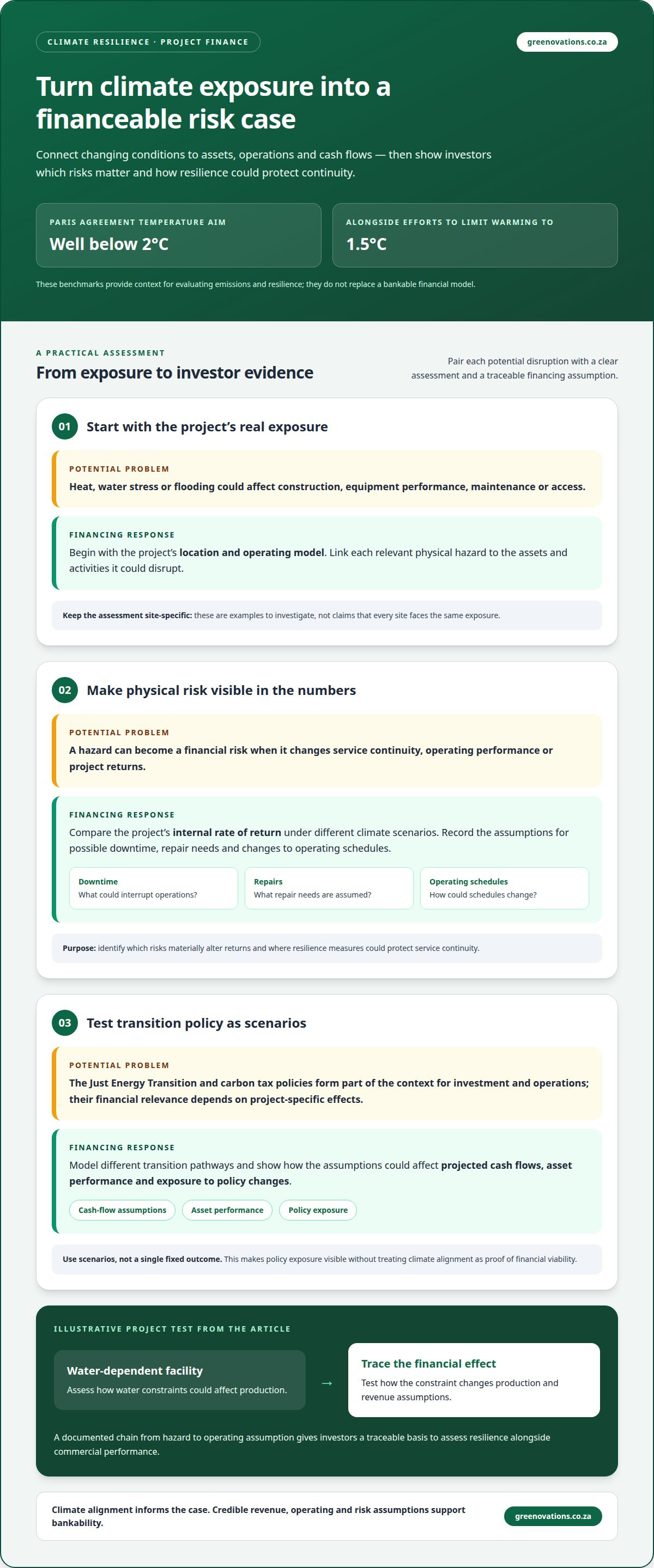
Sustainable finance directs capital towards projects whose environmental performance and financial assumptions can be assessed together. The Paris Agreement sets a global temperature aim of well below 2°C, alongside efforts to limit warming to 1.5°C. For South African project developers, those benchmarks provide context for evaluating emissions and resilience. They do not replace a bankable model: lenders still need credible revenue, operating and risk assumptions.
Transition policies and project finance
The Just Energy Transition and carbon tax policies shape the context in which South African projects plan investment and operations. Their financial relevance depends on how transition assumptions affect projected cash flows, asset performance, and exposure to policy changes. Model these effects as scenarios rather than a single fixed outcome. For example, an energy infrastructure project should test how different transition pathways affect operating assumptions and its investment case. This makes policy exposure visible to capital providers without treating climate alignment as proof of financial viability.
Climate risk and resilience assessment
A climate risk assessment identifies physical hazards that could disrupt a project and links each one to assets, operations, and financial consequences. Start with the project’s location and operating model. Assess how heat, water stress, or flooding could affect construction, equipment performance, maintenance, and access. These are examples to assess, not claims that every site faces the same exposure.
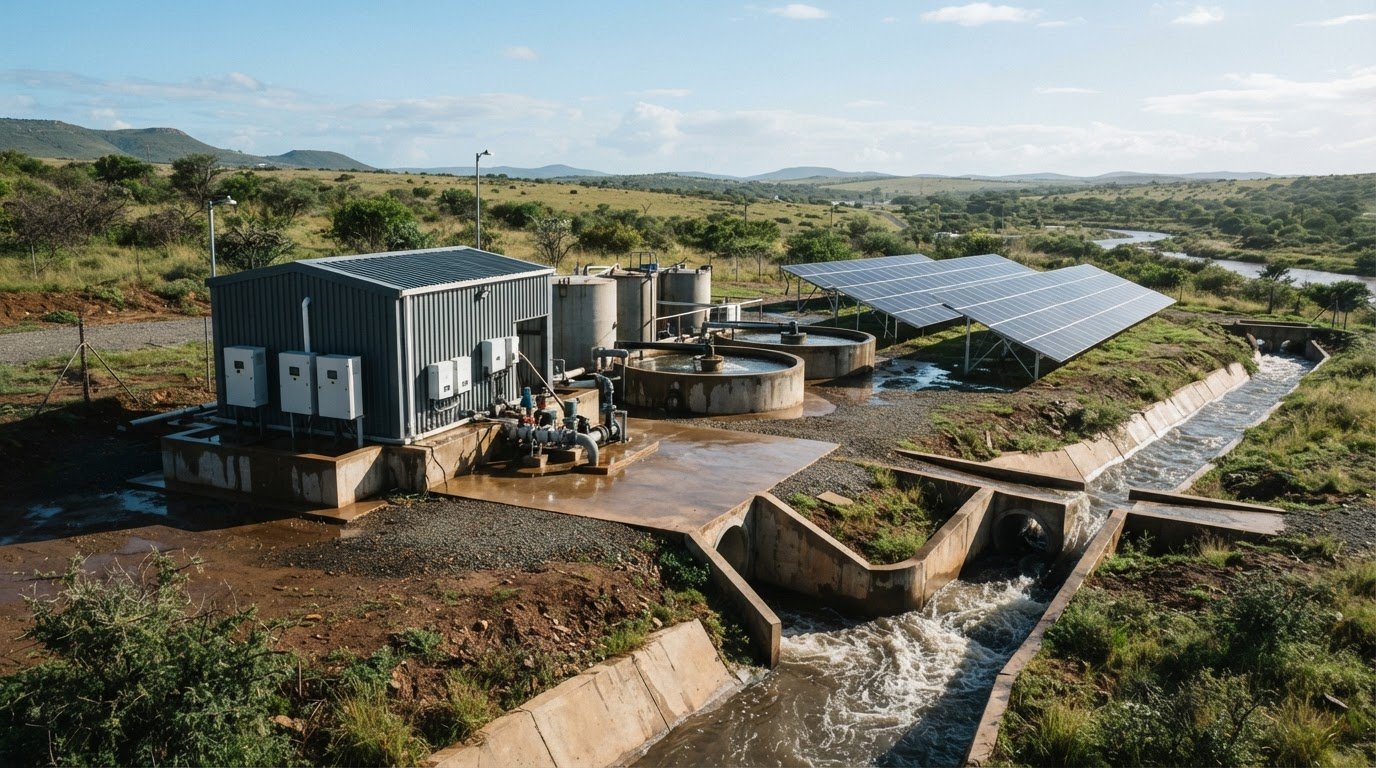
Next, compare the project’s internal rate of return under different climate scenarios. Record the assumptions behind each case, including possible downtime, repair needs and changes to operating schedules. This shows which risks materially alter returns and where resilience measures could protect service continuity. A South African water-dependent facility, for example, should test how water constraints affect production and revenue assumptions. The resulting analysis gives investors a traceable basis for assessing resilience alongside commercial performance.
Environmental and social due diligence for project finance
Due diligence tests whether environmental, social, and governance risks are identified, managed, and reflected in financing assumptions. It can also surface material risks before they affect delivery, revenue, or investor confidence.
NEMA, environmental authorisations, and water-use licences inform project readiness, conditions, and operating constraints. Lenders assess relevant approvals and permissions alongside the project schedule, risks, and funding structure.
After financial close, financing documents, approval conditions, and project management plans shape reporting, monitoring, and community engagement requirements. These frameworks establish what information is tracked, how performance is reported, and how community concerns are addressed.
South African funding support can include blended finance, guarantees, and concessional capital. These mechanisms may help allocate risk among participants, with their role shaped by the project’s financial model and risk profile.
Material risks can include climate exposure, water availability, land impacts, and community relationships. Water constraints, for example, can disrupt operations, while unresolved land or community issues can affect delivery and investor confidence.
Environmental and social management systems turn due diligence into operational controls. They assign responsibilities, record risks, track mitigation, and provide monitoring evidence. Relevant frameworks include the Development Bank of Southern Africa’s environmental and social safeguards and IFC environmental and social standards. Job creation, financial inclusion, and governance structures can also influence project value.
Green, social, sustainability and blue bonds connect capital use to defined outcomes and reporting. South Africa issued its first green bond in 2012. Bond preparation therefore requires a clear rationale for how proceeds support the stated purpose, with credible records for investors.
For municipal waste projects, municipal waste management PPPs offer an infrastructure model to assess against environmental controls, community impacts and delivery responsibilities. Strong due diligence converts these issues into managed project risks, not unexamined assumptions.
Global ESG frameworks and South African market realities
Global ESG frameworks give investors a shared structure for assessing environmental and social risks, governance, and outcomes. South African projects still need to translate those expectations into local operating conditions, development priorities, and auditable investment decisions.
For JSE sustainability disclosures, distinguish a listed sponsor’s reporting from the project company’s financing obligations. Relevant disclosures depend on the sponsor’s applicable reporting framework and listing requirements, as well as any ESG covenants in the project’s finance documents. Project finance does not prescribe one reporting format for every asset.
The Equator Principles and IFC Performance Standards provide environmental and social risk frameworks used in development finance. Lenders applying these frameworks assess material project risks, expect mitigation measures, and use monitoring evidence to track performance. Financing documents and the lender’s adopted standards determine project-specific obligations. These frameworks are not interchangeable with South African law.
Investor use of ESG information is commercially material: 88% of institutional investors reported increasing its use in decision-making in 2024. Different institutions may request similar information in varying formats, increasing reporting effort. A project can reduce duplication by maintaining consistent records for governance, risk controls, emissions and social outcomes, then mapping those records to each investor’s framework.
South Africa’s domestic context adds established governance reference points. CRISA was released in 2011 and revised in 2022, while the King IV Report, dated 2016, urges local institutional investor organisations to practise responsible investment. These frameworks connect assurance and governance to investment decisions, rather than treating ESG as a separate narrative.
European capital continues to apply ESG requirements across emerging markets, while South African businesses also prioritise job creation and community development. Aligning global standards with local conditions helps present transition plans credibly. It does not replace commercial analysis: investors still assess financial assumptions, risk management, governance, and measurable project outcomes.
In South Africa, applying these frameworks means identifying significant environmental and social risks, putting measures in place to address them, and tracking results with monitoring evidence. The project’s precise obligations are set by its financing documents and the lender’s chosen standards, alongside South African law, not instead of it.
South Africa’s draft Green Finance Taxonomy
South Africa’s draft Green Finance Taxonomy offers a local classification framework for green finance. It helps clarify environmental objectives but does not replace project-level diligence or commercial analysis.
Laws and regulations governing ESG
South African ESG obligations arise through applicable laws and regulations, while the draft taxonomy guides classification rather than acting as a standalone financing approval. Regulation 28 is an amended regulation under the Pension Funds Act, No 24 of 1956. It is relevant to investment decision-making by pension funds, but does not replace project-specific legal requirements. Developers should distinguish binding obligations from voluntary frameworks and taxonomy alignment when presenting an investment case.
This distinction matters: classifying a project does not establish legal compliance or guarantee access to finance.
A South African working group published the draft Green Finance Taxonomy for consultation on 7 June 2021. It identifies six environmental objectives, giving investors and project teams a locally grounded reference for assessing eligible activities. The draft’s objectives can help structure evidence around a project’s environmental contribution. They should be considered alongside the project’s broader impacts, operating context and financial model.
For project teams, the practical step is to map activities and supporting evidence to the relevant objective, then document the rationale. International frameworks may inform investor requirements, while local classification helps explain how the project fits South Africa’s context. A credible assessment distinguishes measurable environmental benefits from unsupported claims and records material trade-offs.
ESG criteria and loan terms
ESG criteria influence loan terms by shaping lenders’ assessment of risk, governance, and project controls. Strong evidence can support clearer credit decisions, while material unmanaged risks may affect pricing, fees, covenants, or other conditions. Taxonomy alignment does not automatically reduce rates. Lenders assess the full transaction, including repayment capacity, security, risk allocation, and monitoring requirements.
Project teams should link each material ESG measure to its supporting evidence, accountable owner, and reporting process. This gives financing discussions a verifiable basis.
For projects assessing material alternatives, explore biocomposite materials as part of the project’s environmental considerations and investment case.
Greenovations Venture Studio
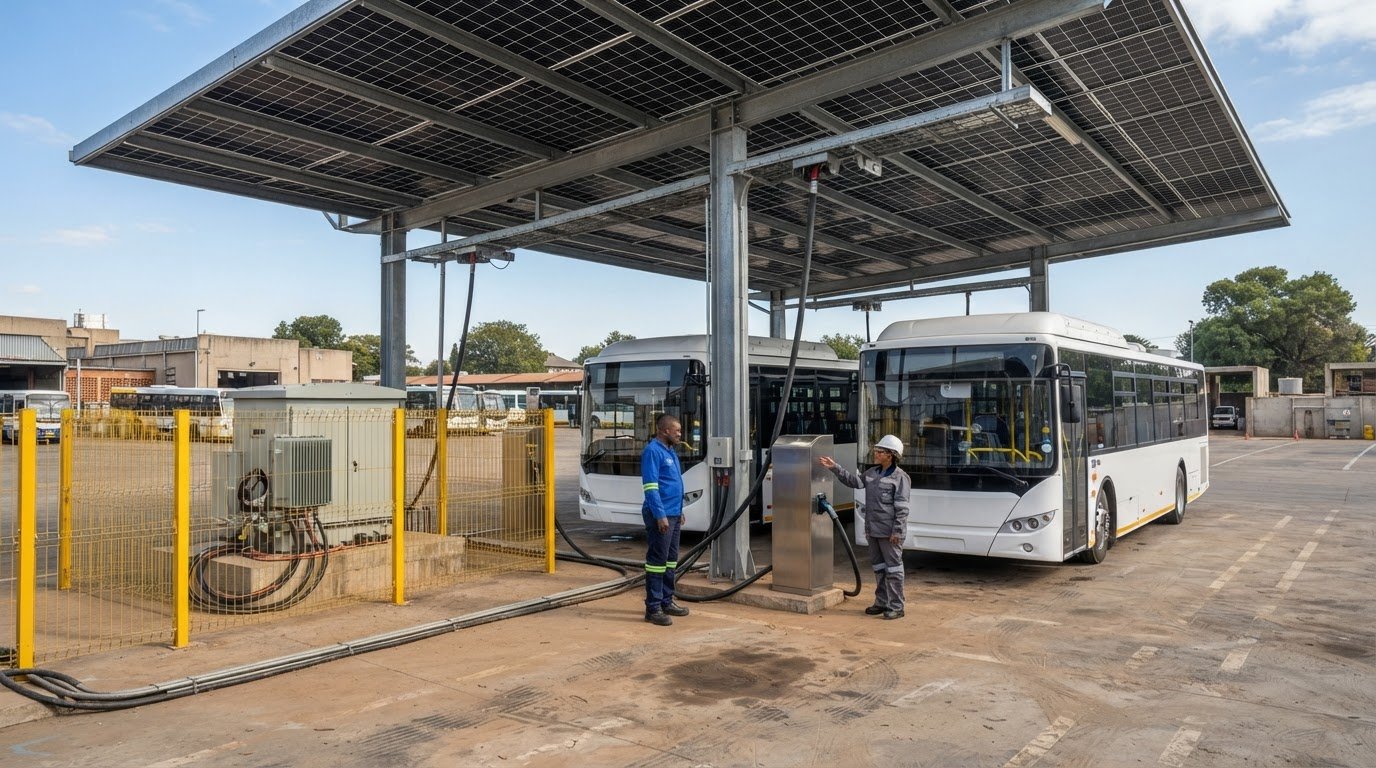
Greenovations Venture Studio can support projects that need infrastructure solutions aligned with operational and environmental priorities. Its offerings include Drone-Powered Industrial Intelligence (GII), an Electric Vehicle Ecosystem, Sustainable Seating Infrastructure-as-a-Service, and Solar PV Recycling.
Each offering addresses a distinct execution need. GII provides industrial intelligence; the Electric Vehicle Ecosystem supports mobility infrastructure; Sustainable Seating Infrastructure-as-a-Service provides managed seating capacity; and Solar PV Recycling processes end-of-life panels. These operational solutions do not replace project due diligence, legal compliance, or a bankable financing structure. Their fit depends on the project’s scope, delivery model, and measurable objectives.
Involve Greenovations Venture Studio when you are turning an infrastructure requirement into a defined project opportunity. Contact Greenovations to discuss how its solutions could support your project’s operational objectives.
Turn ESG priorities into an executable project
The next step is practical: define which operational requirements need a delivery model, then connect them to the project’s financing case. Effective ESG project finance in South Africa depends on more than classification. It requires alignment among capital structure, risk controls, and the asset’s operating objectives.
Greenovations Venture Studio offers Drone-Powered Industrial Intelligence (GII), an Electric Vehicle Ecosystem, and Sustainable Seating Infrastructure-as-a-Service. These offerings address distinct project needs, from industrial intelligence to mobility and managed infrastructure. Their relevance depends on the project’s scope and the role each solution can play in its operating model.
Bring a defined infrastructure requirement into the next planning discussion. Contact Greenovations Venture Studio to discuss how an offering may fit your project’s objectives and delivery structure. A clear starting point helps keep the conversation focused on execution.
Frequently Asked Questions
What is ESG project finance in South Africa?
ESG project finance in South Africa funds an identifiable asset or project while assessing its environmental, social, and governance risks alongside its repayment prospects. Expected cash flows, risk allocation, and controls remain central to credit decisions. For example, a renewable energy project’s financing case can connect revenue assumptions with documented environmental impacts, community considerations, and governance responsibilities.
How do South African banks assess environmental and social risks in project finance?
South African banks assess whether material environmental and social risks could disrupt construction, operations, revenue, or repayment. Their review may consider project documents, risk controls, governance, stakeholder impacts, and evidence supporting management plans. For a renewable energy asset, lenders may examine how site-related impacts are monitored and who is accountable for corrective action. Financing terms reflect the transaction’s overall risk profile.
What ESG due diligence steps are required for renewable energy project finance in South Africa?
Due diligence should establish site-specific risks, applicable approvals, mitigation measures, and ongoing monitoring arrangements. For a solar or wind project, assess land and community impacts, water considerations, climate exposure, operational controls, and the responsibilities assigned to project partners. Then link the findings to financial assumptions and reporting processes so lenders can trace how identified risks are managed before and after financial close.
Visual summary
Planning a project like this?
Talk to the Greenovations venture desk about a No-CAPEX structure.