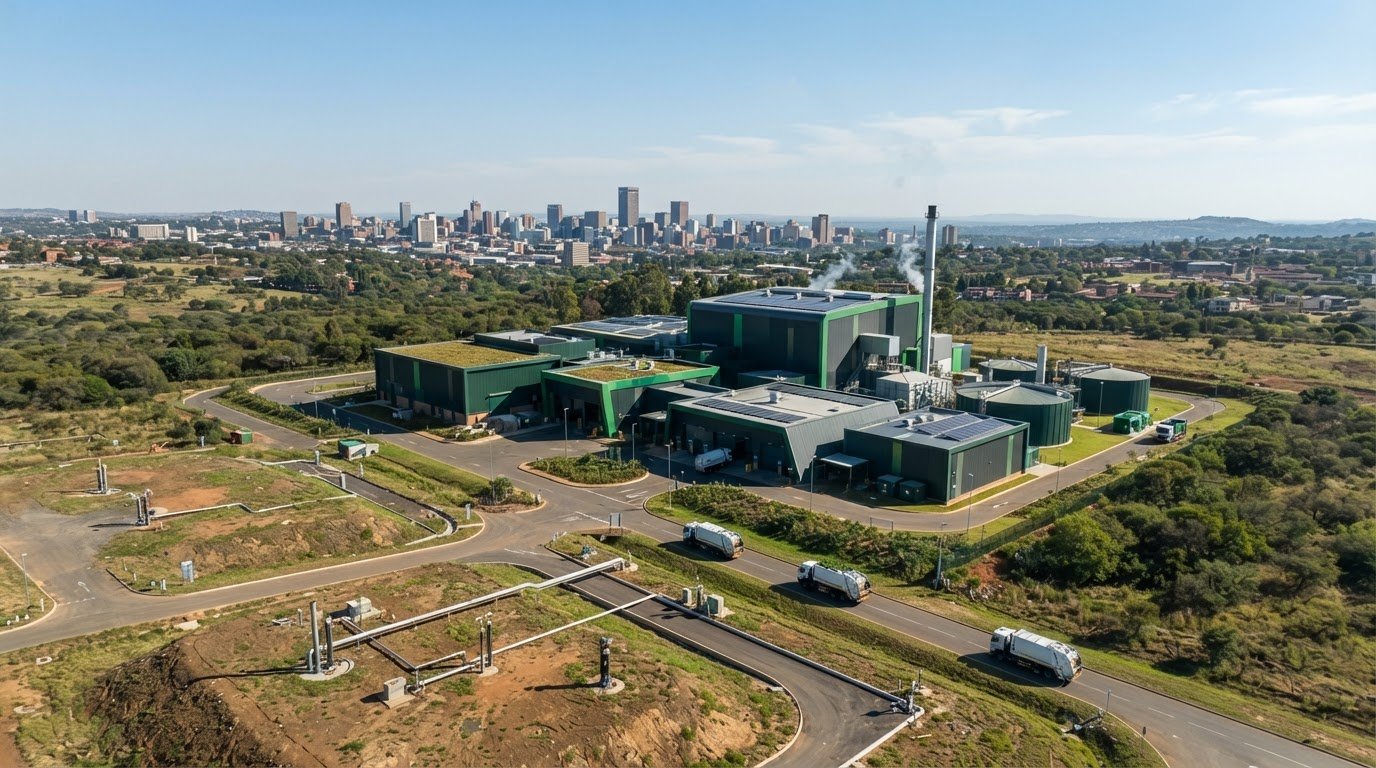
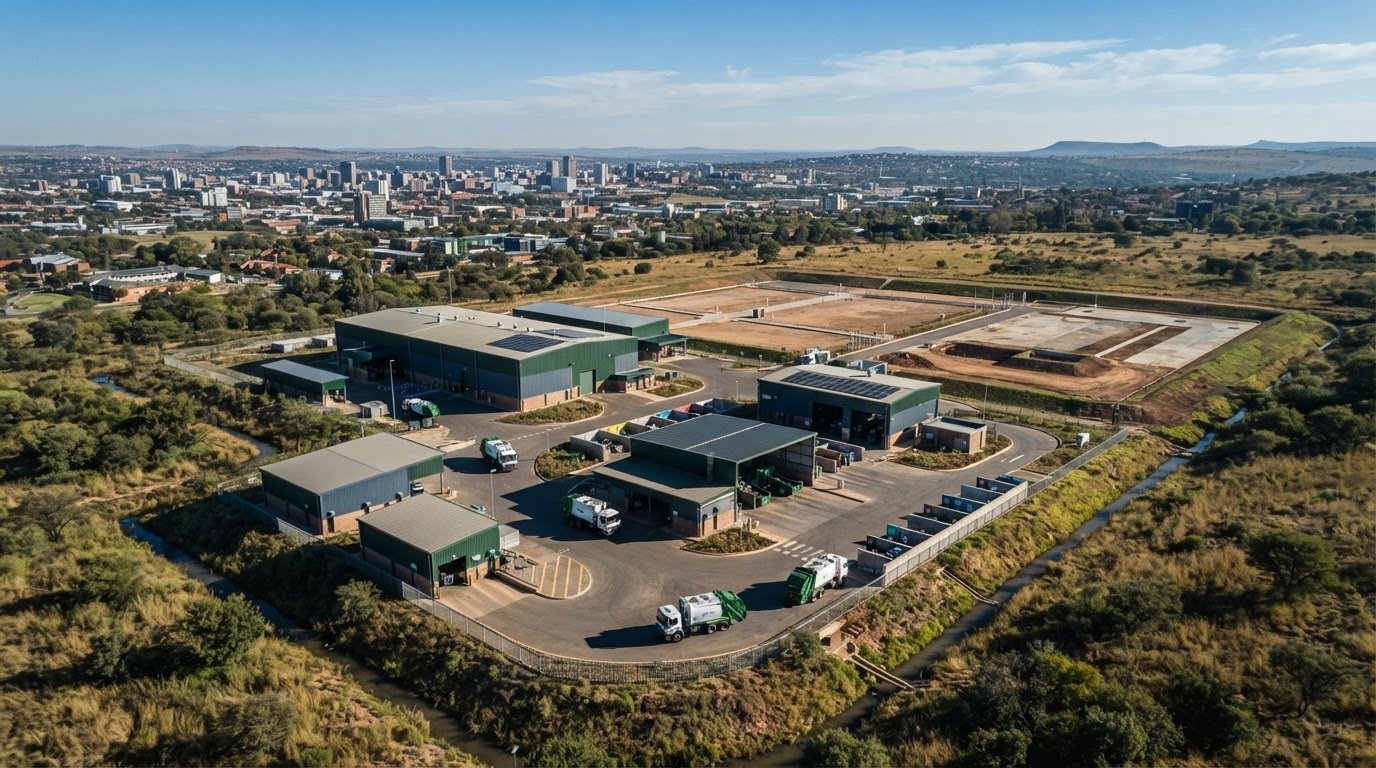
Affordability, not technology, determines whether a DBFOT concession for municipal solid waste in South Africa is bankable. Begin with a credible cost-recovery model and clear performance oversight. Phase in capital-intensive treatment or resource-recovery infrastructure only as institutional and financial foundations become workable. DBFOT means design-build-finance-operate-transfer.
Reliable municipal waste services require more than a treatment plant. The contract must align public obligations, private delivery and a revenue model that can sustain operations. Strong monitoring can add administrative burden and strain public budgets if cost recovery remains weak.
This guide explains how to build affordability into a concession, assign risks to the parties best placed to manage them, and define governance, delivery and safeguards that support measurable performance. It also shows how municipal solid waste partnerships fit together, helping decision-makers assess the full arrangement rather than treating financing, operations and accountability as separate issues.
Key Takeaways
- Build affordability around realistic cost recovery and public support, rather than relying on monitoring or advanced technology alone.
- Define decision rights, reporting duties and handback requirements in the contract so responsibilities remain auditable throughout the concession.
- Link payment deductions to measurable construction and operating performance, with clear evidence and procedures for resolving disputes.
- Translate environmental and social safeguards into delivery obligations, monitoring processes and corrective actions within the concession structure.
- Coordinate municipal, private-sector and service-delivery partners around shared responsibilities, dependable revenue flows and operational interfaces.
Affordability, public support and value for money
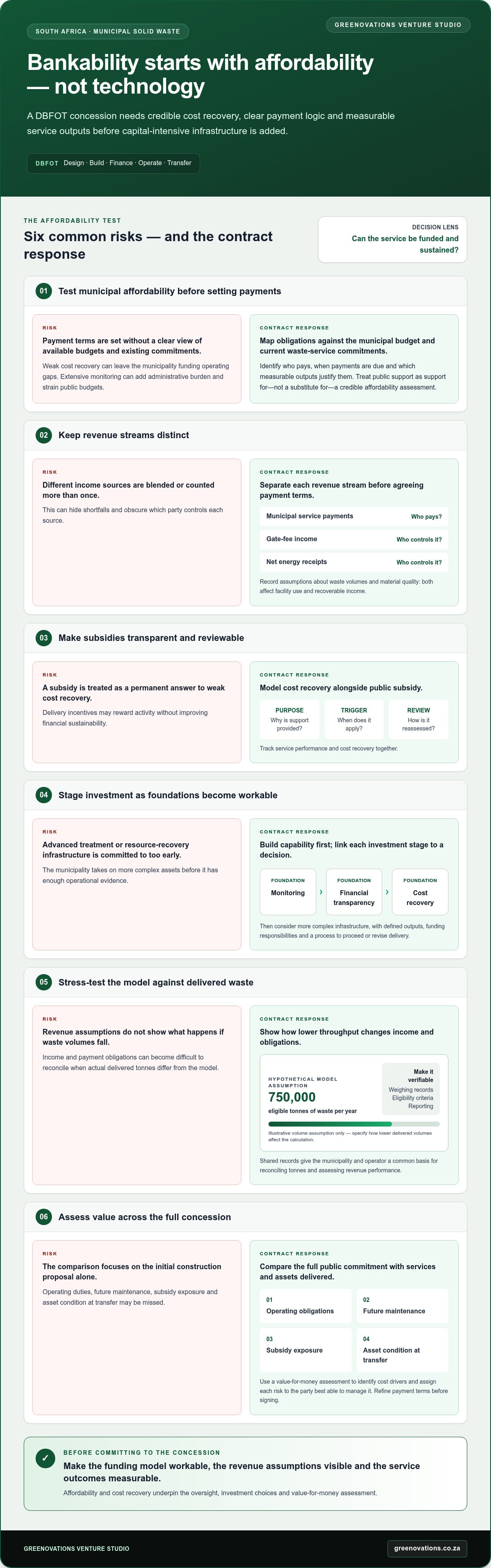
Set payment terms against municipal affordability, recoverable revenue and measurable service outputs. A DBFOT concession for municipal solid waste needs a funding model that remains workable as costs, waste volumes or revenues change.
-
Assess affordability and public support
Map the municipality’s payment obligations against its available budget and existing waste-service commitments. Test the proposed structure against a practical service example, such as collection, transfer and treatment delivered under one concession. Identify who pays, when payments are due and which service outputs justify them. Do not treat public support as a substitute for a credible affordability assessment.
-
Separate revenue streams before setting payment terms. Distinguish municipal service payments from gate-fee income and net energy receipts, for example, and identify which party controls each source. This makes shortfalls visible and prevents the same expected revenue from being counted against several obligations. Record assumptions about waste volumes and material quality, since both affect facility use and recoverable income.
-
Plan cost recovery and subsidies
Model cost recovery alongside any public subsidy, rather than presenting subsidy as a permanent revenue solution. Weak recovery can leave a municipality funding operating gaps, even with extensive monitoring. Define the subsidy’s purpose, trigger and review process, then track service performance and cost recovery together. Avoid incentives that reward activity without improving the financial sustainability of delivery.
-
Use a staged investment sequence to protect value for money. Establish sound monitoring, financial transparency and cost recovery before committing to advanced treatment or resource-recovery technologies. This gives the municipality operational evidence before it takes on more complex assets. Link each investment stage to defined outputs, funding responsibilities and a decision process for proceeding or revising delivery.
-
Stress-test the revenue model against a realistic waste-throughput case. A hypothetical concession may assume 750,000 eligible tonnes of waste per year, but the contract should show how lower delivered volumes affect income and payment obligations. Specify how weighing records, eligibility criteria and reporting support the calculation. This gives the municipality and operator a shared basis for reconciling tonnes and assessing revenue performance.
-
Compare the full public commitment with the services and assets delivered, not just the initial construction proposal. Include operating obligations, future maintenance, subsidy exposure and asset condition at transfer. Present the comparison in a value-for-money assessment that identifies key cost drivers and assigns each risk to the party best able to manage it. Use the assessment to refine payment terms before signing.
Contract governance, handback and implementation
Turn the concession concept into enforceable decision rights, reporting duties and transfer conditions. Define these controls before tender, not after construction begins.
In South Africa, assess municipal finance and public-private partnership requirements alongside procurement, waste and environmental obligations. The applicable route depends on the municipality’s role, payment commitments, asset ownership and risk transfer. Classify the arrangement before choosing the procurement process.
- Map approval and accountability routes before drafting the tender. Identify which municipal function owns the contract, who approves material changes and how performance information reaches decision-makers. For example, separate operational reporting from approval of payment variations. Record escalation steps and dispute procedures so issues such as a weighbridge or service failure have a defined resolution path.
- Choose the PPP structure by matching responsibilities to the project’s delivery needs. DBFOT means design-build-finance-operate-transfer, with the private partner financing and operating assets before transfer. Compare this allocation with BOT or DBO structures, where financing or operating responsibilities differ. Specify ownership, financing, maintenance and transfer duties rather than relying on model labels.
- Set the concession term according to the asset lifecycle, financing profile and implementation sequence. It must allow for construction, commissioning and operation before handback, while preserving municipal oversight throughout. Define milestones for design approval, construction completion and operational readiness. Avoid an unexplained fixed term that leaves the municipality carrying substantial asset or service risk near expiry.
- Build change control into the contract for changes to scope, law, interfaces or services. Require written reasons, an impact assessment and authorised approval before obligations change. For example, a change to accepted waste streams can affect facility processes, reporting and payment calculations. Tie each variation to documented costs, performance consequences and updated responsibilities.
- Specify handback through measurable asset-condition and records requirements. List the facilities, equipment, operating manuals, maintenance history and environmental records to be transferred. Set inspection stages and remediation responsibilities before expiry. The transfer plan should also define staff knowledge transfer and treatment of outstanding defects, so the municipality receives usable assets rather than an unresolved maintenance liability.
- Schedule implementation gates so construction does not outpace governance. Require approved designs, permits, financing close, site access and interface plans before relevant work proceeds. Assign an evidence owner and acceptance authority to each gate. This creates a traceable record when milestones slip and distinguishes contractor delays from municipal or third-party dependencies.
- Align the governance framework with municipal waste partnership structures by making public and private responsibilities explicit. Record meeting cadence, data access, audit rights and corrective-action ownership in the contract. These controls turn collaboration into an operating mechanism, not an informal expectation, and keep the concession’s implementation record auditable.
Construction, operations and performance deductions
Turn design, construction and operating requirements into measurable acceptance tests. A DBFOT concession should link payment deductions to evidence, not subjective assessments.
- Define construction milestones around deliverables that can be inspected and accepted. Specify design approval, completed civil works, installed equipment, commissioning records and operational readiness. For example, a weighbridge should pass calibration and data-transfer tests before its readings are used in payment calculations. Assign an acceptance authority and require a documented response to defects, incomplete work or failed tests.
- Separate construction completion from service commencement. Require evidence that the facility can safely receive, process and record waste before routine operations begin. Set out commissioning procedures, test loads, staff training records and treatment of outstanding defects. A physically complete plant that cannot demonstrate reliable weighbridge records is not ready to support auditable service payments.
- Translate operating obligations into observable service measures. Track eligible tonnes received, operating availability, rejected loads, weighbridge records and required reporting. A hypothetical municipal waste concession assumes 750,000 eligible tonnes of waste per year (annual), making eligibility definitions and verified weighing central to performance assessment. State how each measure is recorded and who can access supporting evidence.
- Design deductions around the operational impact of each failure. A missed reporting deadline should not be treated like a facility outage that prevents waste processing. For each event, define the affected service, evidence threshold, calculation method and correction period. Exclude failures outside the operator’s control only through clearly defined contractual tests and records.
- Use a transparent monthly assessment process rather than inventing one score for every service. Reconcile weighbridge data, facility logs, incident reports and operator submissions against the contract’s performance schedule. Give both parties a defined period to identify errors and submit evidence. Record accepted adjustments and unresolved disputes separately, maintaining a clear audit trail for each payment decision.
- Require operational reporting to reveal causes, not just outcomes. Have the operator classify downtime, maintenance, equipment failure and inbound waste constraints separately. A sorting-line interruption and a municipal delivery shortfall, for example, need different corrective actions. Link each reported cause to an accountable party, a remedy and a follow-up record, so recurring failures do not disappear into aggregate performance data.
- Prevent deductions from becoming an unworkable substitute for operational control. Define escalation from notice to corrective action, repeat-failure review and formal dispute resolution. Specify the evidence required at each stage, including timestamps, inspection records and relevant correspondence. Review deduction patterns against service delivery and maintenance obligations, then use the findings to improve contract management rather than merely reduce payments.
Environmental and social safeguards
Make safeguards contractual controls, not broad policy statements. For a South African waste hub, identify site-specific impacts, responsible parties, monitoring evidence and corrective actions before construction starts.
- Map environmental risks to each facility and operating activity. At a landfill, assess leachate, stormwater and gas management. At a sorting plant, assess dust, noise and vehicle movements. For every material risk, record the control, monitoring method and accountable party. Link each commitment to design approval, operating procedures and contract reporting, rather than leaving it as an unsupported project aspiration.
- Set site-specific monitoring and response procedures before construction. Define where runoff samples are taken, how odour complaints are logged and who investigates abnormal results. For example, a leachate-control failure should trigger containment, notification and documented corrective action. Keep dated inspection records with findings and evidence of closure, allowing the municipality to compare performance during construction and operations.
- Translate environmental controls into design and acceptance criteria. Require drainage plans to show clean-water diversion and contaminated-water containment, with inspection access built into the layout. Specify how dust suppression, noise management and equipment maintenance will work during construction. Commissioning should demonstrate that controls function under operating conditions, not merely that equipment is installed or procedures filed.
- Identify workers and nearby communities affected by construction traffic, site access or facility operations. Set out safe vehicle routes, access controls, incident reporting and a process for recording and resolving complaints. A traffic-management plan should identify delivery routes and loading areas, while operating rules should address reversing movements and pedestrian separation. Assign an owner to each control and retain evidence that it was implemented.
- Define labour and occupational safeguards as operational duties. Specify induction, task-specific training, personal protective equipment and incident escalation for waste sorting, vehicle movement and equipment maintenance. Separate contractor and operator responsibilities at interfaces, so every site incident has an accountable investigator. Review incident records and corrective actions through the contract’s governance process.
- Set an engagement and grievance process that produces auditable outcomes. Record the issue, date received, responsible responder, action taken and closure status. A recurring odour complaint, for example, should prompt a documented operational investigation, not just an acknowledgement. Report complaint trends alongside monitoring findings so the municipality can identify control failures or recurring interface problems.
- Make corrective action enforceable through clear triggers and evidence. Define who can require an investigation, approve remediation and confirm completion after an environmental incident or safeguard breach. Require root-cause analysis for repeated failures and retain inspection photographs, monitoring results and close-out records. At handback, transfer environmental and social records with the asset documentation so outstanding actions remain visible.
Municipal solid waste management partnerships
Structure the partnership around connected services, clear interfaces and measurable delivery obligations. In South Africa, a concession works only when municipal responsibilities and private delivery are aligned by contract.
-
Define how the DBFOT concession works
Set out the concession lifecycle and responsibilities in the contract. The municipality defines required services and oversight; the private partner designs, builds, finances and operates the agreed facilities before transferring them at the end of the term. Specify who supplies waste, controls each asset and pays for services. Do not leave the public-private interface to informal operating arrangements.
-
Identify included services and facilities
List every service and asset in the scope schedule. A municipal solid waste concession may combine transfer, logistics and weighbridges with sorting, organics processing, energy recovery and residual landfill cells. State whether collection, transport, treatment or disposal is included, and identify the facility responsible for each waste stream. Define interfaces clearly so loads are not left unprocessed and costs are not disputed.
-
Map the full service chain from collection to final destination. Show where municipal collection ends, where the concessionaire accepts custody and how rejected loads are handled. For example, define the weighbridge record that confirms receipt, who is responsible for contamination and the route for unsuitable material. This operating map helps prevent gaps between municipal fleets, transfer stations and treatment facilities.
-
Allocate roles across the municipality, operator, lenders and service contractors. The municipality oversees the contract; the operator coordinates design, construction and operations; specialist contractors deliver defined work packages. Identify who controls site access, waste acceptance, maintenance and operational data. World Bank PPP guidance recommends assigning each risk to the party best able to manage or absorb it at the lowest cost.
-
Make interfaces enforceable through protocols, not general cooperation clauses. Set out delivery schedules, waste acceptance criteria, data formats, incident escalation and decision rights. A missed municipal delivery and an operator plant outage, for example, require separate evidence and remedies. Define the shared operating record used to distinguish these events, then link it to reporting and payment assessment.
-
Coordinate revenue and material flows across partners. Identify which party receives gate fees, energy receipts or proceeds from recovered materials, and specify how each stream affects contractual payments. Make responsibilities for weighing, invoicing and reconciliation explicit. With multiple revenue sources, one auditable accounting process helps prevent disputes over volumes and receipts from displacing service issues.
-
Use evidence from partnership performance to shape the operating model. A systematic review of municipal solid waste public-private partnerships analysed 33 empirical studies, underscoring the value of examining delivery arrangements rather than relying on labels alone. Compare responsibilities, incentives and oversight mechanisms when developing the concession. For South African projects, discuss municipal waste partnership structuring as the next step in aligning delivery interfaces.
Greenovations Venture Studio: Drone-Powered Industrial Intelligence (GII)
Greenovations Venture Studio offers Drone-Powered Industrial Intelligence (GII), an intelligence-as-a-service platform using autonomous LiDAR and thermal imaging. For municipal waste partnerships, it can support operational planning and oversight with precision industrial intelligence. Define the information the project needs, who will use it and how it informs decisions before determining its role.
GII supports the broader work of structuring municipal waste partnerships, but does not replace concession design, affordability analysis or contract governance. First establish the project’s responsibilities and performance framework, then assess how industrial intelligence can support those requirements. This keeps the technology tied to an operational need rather than treating it as a standalone objective.
To discuss Drone-Powered Industrial Intelligence (GII) in the context of your project, contact Greenovations Venture Studio.
Move from concession design to project readiness
The next decision is whether the proposed structure can become a bankable project brief. For a DBFOT concession for municipal solid waste, turn the preferred delivery model into a defined scope, risk allocation and evidence plan that decision-makers can assess. Resolve gaps between municipal responsibilities and private delivery before they become tender or implementation disputes.
Greenovations Venture Studio offers Drone-Powered Industrial Intelligence (GII), an Electric Vehicle Ecosystem and Sustainable Seating Infrastructure-as-a-Service. These are distinct infrastructure solutions, not substitutes for concession governance. Consider them when they align with a separate project requirement and its operating case.
For a discussion about structuring municipal waste partnerships and related infrastructure opportunities, contact Greenovations Venture Studio. A disciplined next step can turn a viable concept into a clearer basis for project decisions.
Frequently Asked Questions
What does DBFOT mean in a municipal solid waste concession?
DBFOT means design-build-finance-operate-transfer. A DBFOT concession for municipal solid waste assigns the private partner responsibility for designing and building specified assets, arranging their financing and operating them under contract before transferring them. The municipality defines the required service and retains its contractual oversight role. For example, a facility’s transfer conditions can cover its equipment, operating records and maintenance history.
What are the typical concession term and project costs for South African waste DBFOT projects?
Set the term and project budget according to the facility lifecycle and service scope, not a universal duration or cost figure. The term must accommodate financing, design, construction, commissioning, operations and handback. The budget depends on the assets, site conditions, logistics, treatment processes, maintenance obligations and safeguards included. Assess these factors together, since a cheaper build can create higher operating or transfer obligations.
How are DBFOT concession fees, tariffs, and revenue sharing structured?
Structure revenue around clearly defined payment sources and allocation rules. A concession may combine municipal service payments, waste tipping fees, and income from recovered materials or energy. Specify how each source is measured, invoiced and reconciled, and which party bears the effects of volume or market changes. For example, terms can explain how verified tonnes received inform a tipping-fee calculation and its supporting records.
What are the municipality's and private concessionaire's responsibilities under a DBFOT contract?
The municipality defines service requirements, provides the contractual oversight framework and fulfils its stated payment and interface obligations. The concessionaire delivers the contracted design, financing, construction and operating duties, then transfers the assets under agreed handback conditions. A practical responsibility schedule identifies who controls site access, supplies waste, maintains equipment and records performance. Assigning each decision to a named role reduces delays where responsibilities intersect.
How are waste volumes, service standards, and concessionaire performance measured?
Measure volumes using agreed eligibility rules and reconciled weighbridge records, then assess service standards against defined operational evidence. For example, compare incoming load records with facility logs, rejected-load reports and downtime records. The contract should identify the data owner, reporting frequency, audit access and error-correction procedure. Base performance deductions on the documented impact of a failure, not a broad rating that obscures its cause.
What are the key risks and benefits of DBFOT compared with municipal delivery, BOT, or PPP models?
DBFOT can integrate design, financing, construction and operations under one concession, but concentrates long-term delivery interfaces in a contract that requires strong oversight. Municipal delivery retains direct public control but leaves the municipality responsible for delivery capacity and asset funding. BOT assigns build, operate and transfer duties, while PPP is the broader partnership category. Compare financing exposure, operational control, waste-volume risk, contract-management demands and handback obligations.
What steps are involved in planning, tendering, awarding, and monitoring a municipal waste DBFOT concession in South Africa?
Start by defining the service scope, waste streams, site interfaces and affordability model. Develop the business case, risk allocation, output requirements and procurement documents before inviting bids. Evaluate proposals against published criteria, document the award decision, then finalise contractual obligations and implementation milestones. During delivery, monitor reported volumes, construction evidence, operating performance, safeguards and corrective actions. Keep an auditable record of decisions, variations, payments and unresolved issues.
What South African laws and procurement rules govern municipal DBFOT waste concessions?
Municipal DBFOT concessions must be assessed against municipal finance and public-private partnership requirements, as well as procurement, waste and environmental obligations. The applicable route depends on the municipality’s role, payment commitments, asset ownership and risk transfer.
Visual summary
Planning a project like this?
Talk to the Greenovations venture desk about a No-CAPEX structure.