

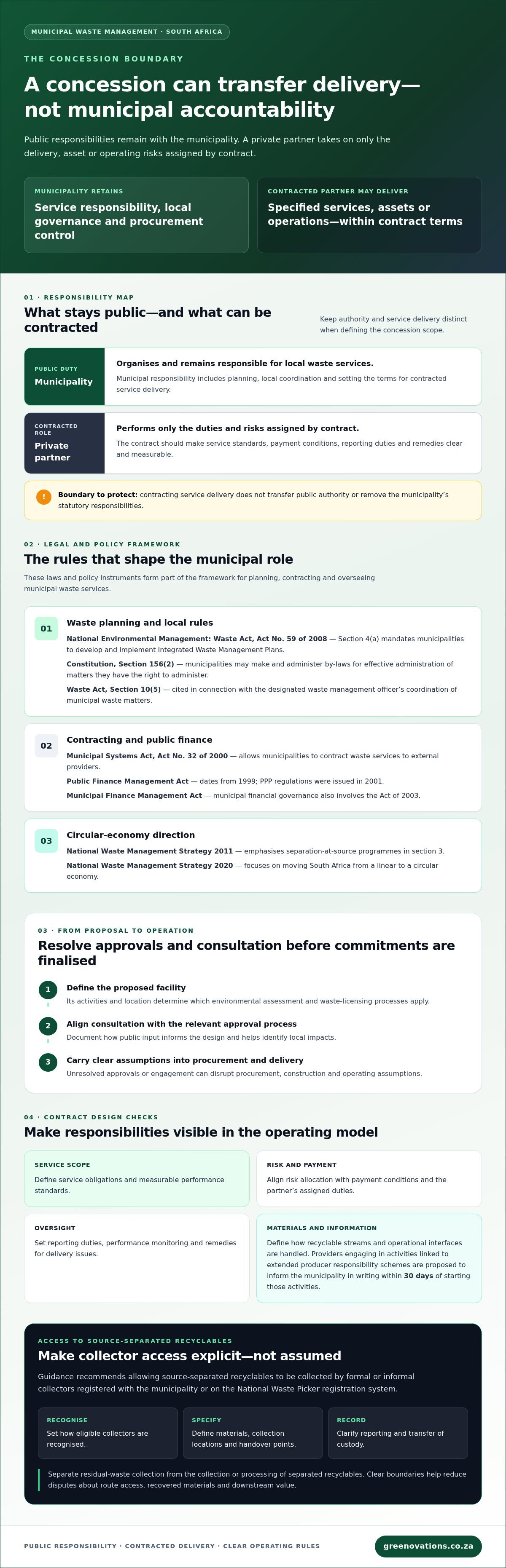
A concession can transfer delivery, not the municipality’s responsibility for waste services. A municipal waste management PPP in South Africa operates within that boundary: municipalities are responsible for providing waste services under the Waste Act, while the Municipal Systems Act, Act No. 32 of 2000, allows them to contract those services to external providers. The commercial test is therefore not simply whether a private operator can run assets, but whether the contract defines municipal control, service obligations and access to recyclable materials clearly enough to support delivery.
That distinction matters to municipalities and investors assessing a concession. A bankable arrangement allocates operational and financial risks clearly, preserves public responsibilities and avoids treating recyclables as an unrestricted private revenue stream.
This article explains how government responsibilities and municipal by-laws shape the framework, how registered formal and informal collectors can access source-separated recyclables, and why community input belongs in system design. It also explains what these conditions mean for concession structure, risk allocation and long-term service performance.
Key Takeaways
- Separate municipal accountability from contracted service delivery when defining a concession’s scope and performance obligations.
- Make access to source-separated recyclables explicit, including the role of collectors registered with the municipality or on the National Waste Picker registration system.
- Assess a PPP against risk transfer, affordability and value for money, not simply the assets or services a private operator can provide.
- Co-design service arrangements with local communities so operational models reflect local access needs and collection realities.
Municipal waste management responsibilities across government
A concession can transfer delivery duties, but it does not remove municipal accountability for waste services. South African law places municipal control, planning and contracting within a broader environmental and public-finance framework.
Municipal waste service duties
Municipal waste service duties are the public responsibilities for organising and providing local waste services. The National Environmental Management: Waste Act is Act No. 59 of 2008, according to the South African Government. Section 4(a) mandates municipalities to develop and implement Integrated Waste Management Plans. Those plans matter to concession design because they connect service scope, infrastructure decisions and municipal priorities in one planning framework.
Section 156(2) of the Constitution provides that a municipality may make and administer by-laws for effective administration of matters it has the right to administer. Section 10 (5) of the Waste Act is cited in connection with the designated waste management officer’s coordination of municipal waste matters. These provisions place local governance and coordination alongside service delivery, rather than transferring public authority to an operator.
The governing framework includes the Constitution, the Waste Act, the Municipal Systems Act, the Municipal Finance Management Act and public-private partnership rules. The Municipal Systems Act, Act No. 32 of 2000, allows municipalities to contract waste services to external providers. South Africa’s Public Finance Management Act dates from 1999, with PPP regulations issued in 2001; municipal financial governance also involves the Municipal Finance Management Act of 2003.
Environmental approvals and public consultation
Environmental approvals and public consultation establish the project’s lawful operating scope and help identify local impacts before commitments are finalised. For a proposed facility, its activities and location determine which environmental assessment and waste-licensing processes apply. Align consultation with the relevant approval process, and document how public input informs the design. Unresolved approvals or engagement can disrupt procurement, construction and operating assumptions.
Risk allocation must distinguish public authority from contracted performance. The municipality retains its statutory service responsibilities and controls procurement terms; a private partner assumes only the delivery, asset or operating risks assigned by contract. A municipal waste management PPP in South Africa therefore needs measurable service standards, clear payment conditions, reporting duties and remedies. Common risks include an unclear scope, weak performance monitoring, misaligned payment mechanisms and plans that exceed operational capacity.
Circular-economy policy adds another interface: waste streams can carry both service obligations and recoverable material value. The National Waste Management Strategy 2020 focuses on moving South Africa from a linear to a circular economy, while the National Waste Management Strategy 2011 emphasises separation-at-source programmes in section 3. Service providers engaging in activities linked to extended producer responsibility schemes are proposed to inform the municipality in writing within 30 days of starting those activities. Contracts should therefore define information flows and operational interfaces clearly.
Municipal ownership of waste and access to recyclables
A waste concession must distinguish municipal control of the service from rights to recover and sell materials. Treating all collected waste as the operator’s unrestricted resource can create conflict with existing collectors and limit the municipality’s ability to shape local recovery arrangements. Define each party’s role before setting collection routes, processing facilities or revenue assumptions.
South African waste-management guidance recommends allowing source-separated recyclables to be collected by formal or informal collectors registered with the municipality or on the National Waste Picker registration system. This offers a practical basis for designing access: establish how eligible collectors are recognised, which materials they may collect and how their activities fit alongside the contracted service. Registration makes participation easier to define within the operating model.
Not all recyclables have the same value or collection route. A municipality can specify where separation takes place, how materials are presented and which handover points apply. The concession can then distinguish residual-waste collection from the collection or processing of separated recyclables. Clear boundaries reduce disputes over route access, materials recovered before collection and the value captured downstream.
For example, tender documents can specify collection zones, approved handover locations, material categories and reporting responsibilities. The operating contract can record the weights or volumes received, rejected loads, destination and transfer of custody. These records support performance oversight and help reconcile service payments with material revenue. They also show whether recyclable streams reach a recovery channel or are mixed with residual waste.
Express municipal control through enforceable operating rules, not vague claims of ownership. Define who can access each stream, how the municipality authorises access and how arrangements change when routes or facilities change. If informal collectors already recover materials locally, mapping those practices before procurement can reveal operational interfaces that might otherwise become disputes after the contract is awarded.
For a municipal waste management PPP in South Africa, bankability depends on separating public-service obligations from material-recovery rights. Investors need a credible account of the feedstock available to contracted facilities; municipalities need a way to retain oversight and accommodate authorised collectors. These requirements can work together when the concession consistently defines access, measurement, custody and revenue treatment.
Where a municipality is structuring a concession around collection, recovery and material flows, municipal waste management PPPs provide a relevant point of departure for developing the operating model.
The service baseline and the rules governing materials remain outside the concession. Across urban municipalities nationally, millions of households rely on weekly access to solid-waste-management services, providing vital context for public service delivery. Such figures provide context for distinguishing the reach of collection obligations from the volume of material available for recovery.
These arrangements do not establish how much recyclable material was collected or who collected it. Assess those questions separately when planning the concession. A sound operating and revenue model can define expected service coverage, access to separated materials and the information needed to verify each. This keeps public-service commitments clear without assuming that the operator controls every household waste stream.
Privatisation and the commodification of waste
Private participation changes who delivers services and captures material value, not the public purpose of municipal waste management. The distinction between a long-term partnership, a short outsourced contract and in-house delivery affects investment, control and risk.
PPP and other service delivery models
A PPP allocates service, financing and operating responsibilities between a municipality and a private partner. In-house delivery keeps operations within municipal structures; conventional outsourcing contracts specific tasks, such as collection, for an agreed period. The distinction matters: a PPP can combine investment with long-term performance obligations, while outsourcing may cover a narrower service scope.
Neither model transfers municipal accountability. Before choosing a structure, compare asset control, performance monitoring, payment exposure and the operator’s responsibility for service continuity.
Costs, tariffs and financing models
PPP costs and tariffs depend on the contracted assets, operating scope, service standards, payment mechanism and allocation of financial risk. A municipality may base payments on availability or measured service delivery; the chosen mechanism determines how revenue responds to performance.
Financing may combine private capital with contract-backed payments, while tariff revenue can contribute to the municipal funding model. Affordability analysis should test the full contract commitment, not just initial capital requirements. No single tariff or project cost applies across South African municipalities.
The meaning of a municipal waste PPP
A municipal waste PPP is a contract under which a private partner delivers defined waste infrastructure or services under public oversight. It is not simply privatisation: the agreement allocates specific responsibilities while the municipality retains its public role.
Recovered materials become commodities when they generate value, but that value does not automatically belong to the operator. Contract terms should identify who bears processing costs, controls material flows and receives revenue from recovered products. Municipalities procure individually, so assess each project against its contract scope and performance obligations rather than assuming outcomes from the PPP label.
Procurement and approval processes
Procurement and approval processes establish whether a proposed partnership transfers risk, remains affordable and delivers value for money. South African PPP projects are assessed using a three-point test covering those criteria. The Public Finance Management Act dates from 1999, and PPP regulations under it were issued in 2001; the Municipal Finance Management Act dates from 2003.
For a proposed waste concession, the municipality should align the business case, service specification and payment design. Its approval analysis must account for contract commitments and risks retained by the public authority. The question is not simply whether private participation is possible, but whether the proposed structure justifies its obligations over the contract term.
Co-designing waste systems with local communities
Community input helps design collection systems that work across distinct neighbourhoods. In South Africa, co-design uses local knowledge to shape service arrangements before procurement fixes routes, collection points and performance measures. It does not replace municipal accountability. Instead, it helps identify practical constraints early and translate them into clear contract specifications.
The scale and form of settlement make that work material. The 2022 Census recorded 4297 informal areas in South Africa, housing over 2 million households. A standard kerbside collection model may not fit every access route, road condition or settlement layout. Local discussions can identify where vehicles cannot enter, where shared collection points may work, and how residents currently move waste to collection locations.
Co-design should produce operational evidence, not just meeting records. Municipal teams can map access routes with residents, test collection-point locations and record areas with missed service before finalising service boundaries. For example, a route walk can identify narrow passages that require hand collection or a transfer point. The resulting specification can set responsibilities, collection frequency and reporting procedures for each service area.
Community participation also affects separation and recovery. The National Waste Management Strategy 2011 emphasises separation-at-source programmes in section 3. A municipality can use local sessions to establish how households will separate materials, where containers or handover points belong, and how information reaches residents. These choices influence contamination, collection logistics and the quality of recoverable streams. They should be reflected in operator performance measures.
Nationally, access to waste collection services is estimated to average 70% across the country. That aggregate figure cannot identify which streets, settlement layouts or collection points are underserved. A concession design should therefore disaggregate service coverage by locality and use resident input to test whether low access reflects route constraints, unsuitable collection points or missed services. This turns a national measure into actionable service specifications without assuming every community faces the same barrier.
For a bankable arrangement, municipalities should turn community findings into defined contract inputs. These might include mapped access limitations, agreed collection locations, escalation channels and indicators for missed pickups. Review those inputs with residents and operational teams before finalising tender documents. This makes local requirements clear to bidders and gives municipal contract managers measurable standards after mobilisation.
Co-design also needs a feedback mechanism during operations, not just consultation before the contract is awarded. A municipal forum or structured reporting process can log recurring service issues, identify affected locations and refer them to the responsible operator. If service patterns change, the municipality can assess whether an operational adjustment is needed. The commercial benefit is clarity: community knowledge becomes a managed input to service design and performance oversight.
The authors recommend co-designing new waste-management arrangements with local communities. This reinforces the value of local participation in system design alongside the operational inputs described above. It grounds arrangements in community perspectives while leaving municipalities responsible for translating agreed needs into workable service requirements.
What is a public-private partnership (PPP) in municipal waste management in South Africa?
A public-private partnership is a long-term contract that assigns defined waste services, assets and risks to a private partner under municipal oversight. In a municipal waste management PPP in South Africa, the municipality remains responsible for public services while the agreement defines the operator’s delivery obligations. The arrangement is neither a transfer of municipal authority nor simply a purchase of equipment.
The contract links operational responsibilities to measurable outputs. For example, a municipality might define collection coverage, facility availability, processing standards and reporting duties. The private partner performs its assigned work and reports against agreed measures. Municipal oversight tests delivery against those measures rather than relying on broad assurances or general activity reports.
Project structure determines what the partnership actually covers. One agreement may include the design, financing, construction and operation of a waste facility. Another may focus on collection, transfer or processing using existing municipal infrastructure. Define asset ownership, maintenance obligations, service boundaries and handover conditions. These terms shape capital requirements and determine who carries each operational risk.
Payment design links performance to revenue. A contract can specify the payment basis, service deductions, supporting evidence and procedures for disputed measurements. If the operator is responsible for processing, the agreement should also define material flows and how recovered-material revenue is treated. This gives lenders and municipal decision-makers a clearer view of cash-flow dependencies without treating projected recycling income as guaranteed.
South African PPP assessment uses a three-point test covering risk transfer, affordability and value for money. These criteria require more than a technically viable facility. A municipality must assess whether risks are assigned to the party best able to manage them, whether payment commitments fit its financial position and whether the partnership offers value against its requirements.
The Municipal Finance Management Act of 2003 forms part of the municipal financial framework, while South Africa’s PPP regulations were issued in 2001 under the Public Finance Management Act. These frameworks make procurement and accountability central to project design. A bankable proposal therefore needs a coherent business case, transparent performance measures and an approval path that reflects municipal commitments throughout the contract.
A PPP is best suited to a defined service or infrastructure need where long-term performance can be specified and monitored. It is less suitable when the municipality cannot define outputs, manage contract oversight or assess affordability. Align scope, payment conditions and retained public responsibilities before procurement, because ambiguity creates execution risks for both parties.
For municipalities assessing a waste concession, discuss structuring a municipal waste PPP around defined services, measurable performance and allocated risk.
Greenovations Venture Studio: Drone-Powered Industrial Intelligence (GII)
Greenovations offers Drone-Powered Industrial Intelligence (GII) and Municipal Waste Management PPPs for infrastructure projects that need disciplined operational design. Consider GII when industrial intelligence can support waste-asset planning or management; its role depends on the project’s requirements. For municipalities assessing a concession, Greenovations’ Municipal Waste Management PPP offering is a direct next step for structuring private participation in waste services and delivery.
The wider portfolio also includes an Electric Vehicle Ecosystem, Sustainable Seating Infrastructure-as-a-Service and Solar PV Recycling. These are distinct offerings, not substitutes for a waste concession. To discuss a municipal waste partnership or industrial intelligence requirements, contact Greenovations Venture Studio.
Move from concept to a defined project
The next decision is whether the proposed service can be translated into a precise, investable scope. Before procurement, align intended outcomes with operating boundaries, measurable performance requirements and a credible approach to risk. This gives public decision-makers and private partners a shared basis for assessing a municipal waste management PPP in South Africa.
Greenovations Venture Studio works on Municipal Waste Management PPPs. Bring forward the service challenge, infrastructure requirement or project concept that needs structuring, and use the discussion to identify the next commercial questions. A well-defined starting point can turn a broad waste-management objective into a workable project pathway.
Contact Greenovations Venture Studio to discuss your project and its requirements. Clear scope creates a stronger foundation for action.
Frequently Asked Questions
What waste services can a municipal PPP cover, including collection, recycling, landfill, and waste-to-energy?
A municipal PPP can cover one service or an integrated chain, including household collection, sorting, recycling, landfill operations and waste-to-energy processing. The municipality defines the scope in the project documents. For example, a contract might include collection and transfer but exclude landfill operations, or combine processing with energy recovery. Specify waste streams, facility interfaces, output standards and responsibility for residual material so each service has a clear operational boundary.
Visual summary
Planning a project like this?
Talk to the Greenovations venture desk about a No-CAPEX structure.