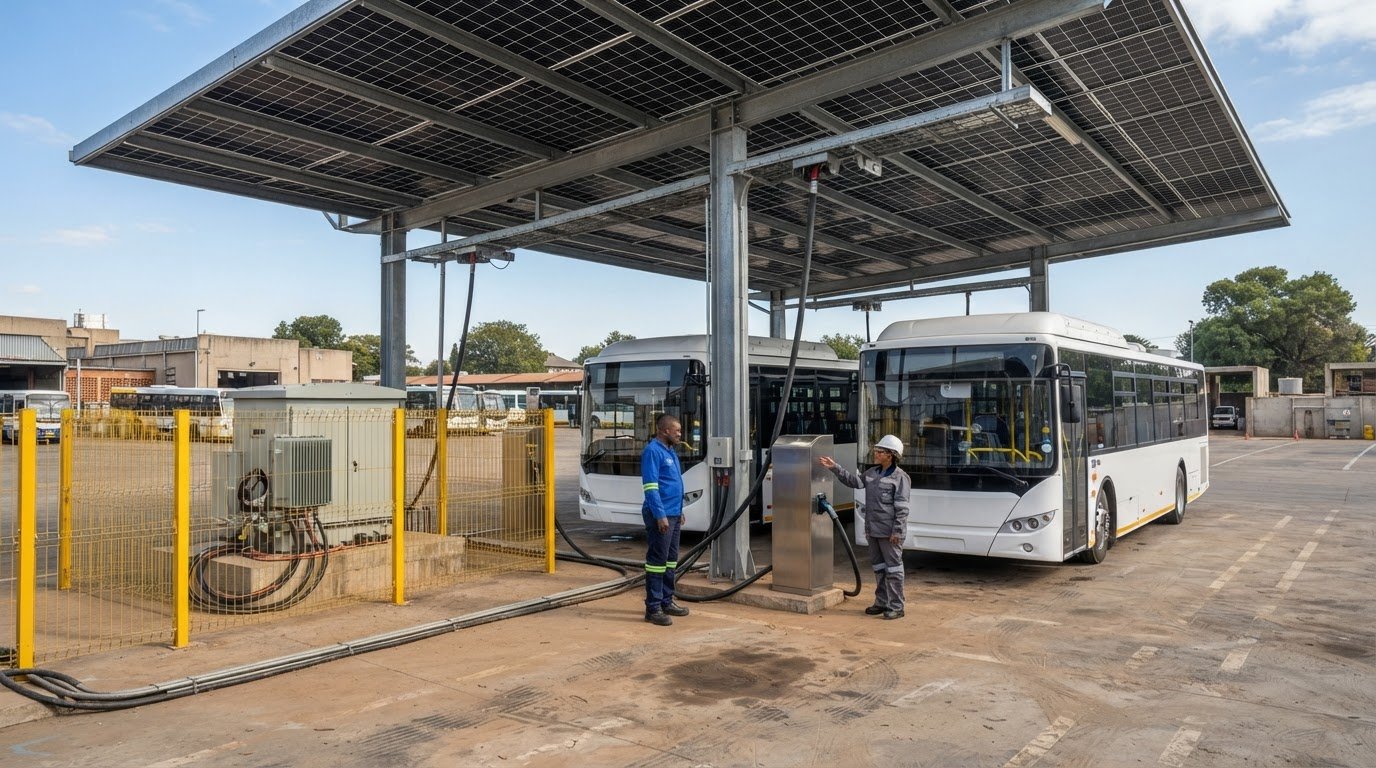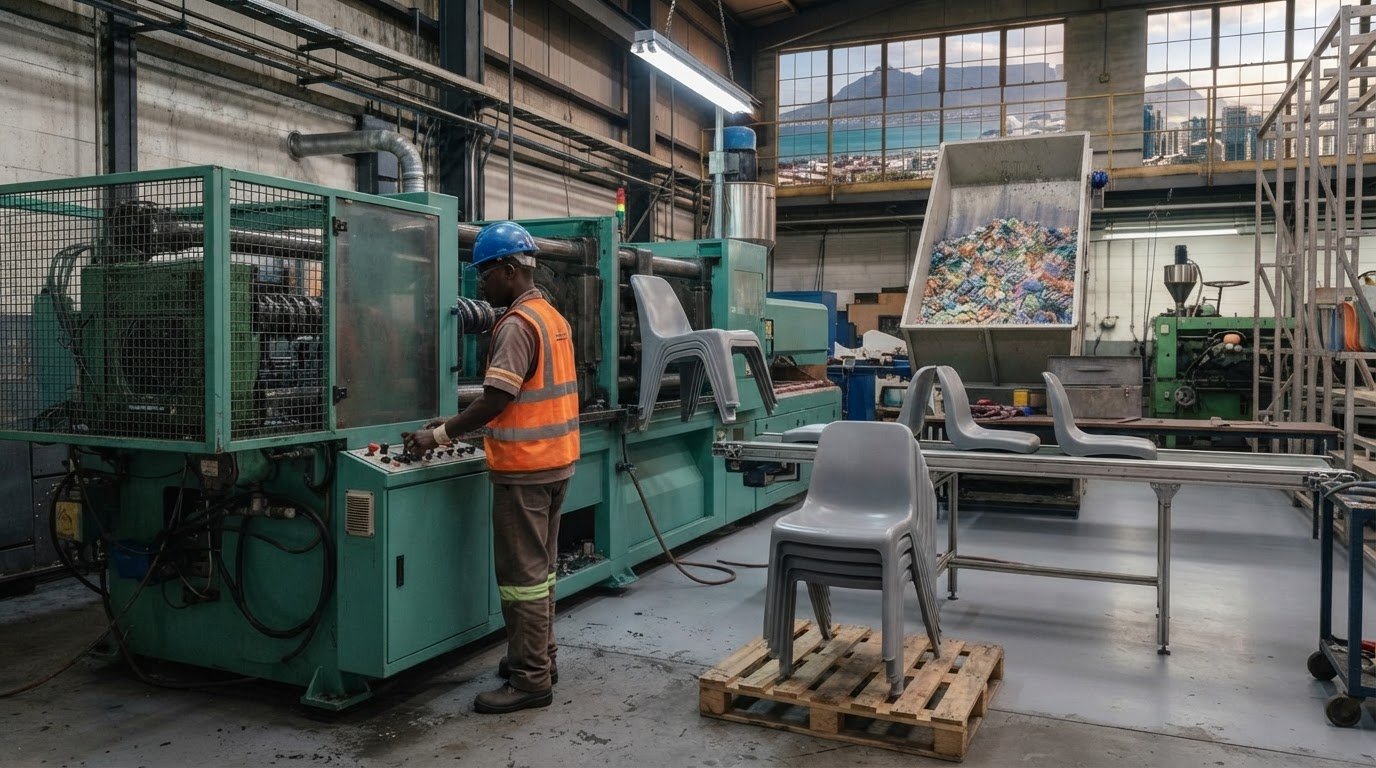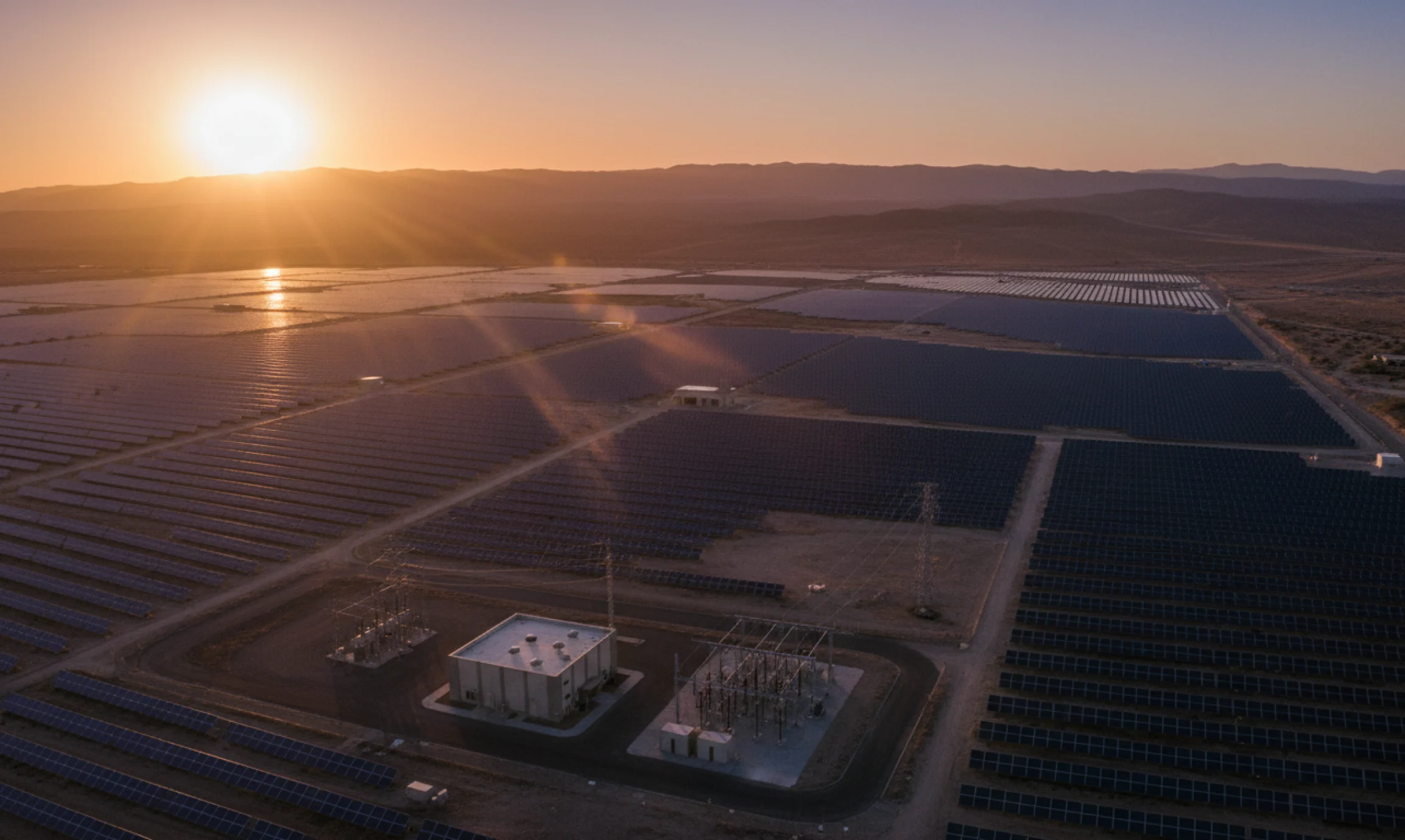

No-CAPEX removes the upfront asset purchase, not the cost of infrastructure. When no-CAPEX business models are explained, the distinction is decisive: a business avoids paying the full capital cost at the outset, but enters a commercial arrangement that funds delivery and allocates ownership and operating responsibilities. For South African organisations balancing infrastructure needs against other investment priorities, this can preserve upfront capital without making the asset free.
The cost is recovered over time through agreed service fees, energy tariffs or concession revenue. The contract determines who finances, owns, operates and maintains the infrastructure, and how performance and risk are allocated. No-CAPEX also does not guarantee off-balance-sheet treatment. Accounting depends on the contract and applicable standards.
This guide explains how the models work, where costs and risks sit, and what decision-makers should assess before committing. It compares conventional ownership with power purchase agreements, managed infrastructure services and design-build-finance-operate-transfer concessions, including examples from Greenovations Venture Studio’s solar utility hubs, seating infrastructure and municipal waste projects.
Key Takeaways
- Understand how funding, ownership and operating duties are allocated across no-CAPEX infrastructure arrangements.
- Map the project lifecycle and each party’s responsibilities before comparing commercial structures.
- Assess energy tariffs, service fees and concession payments against the specific use case and contract terms.
- Test demand stability, utilisation, operational importance and the ability to meet contracted payments before committing.
- See how Greenovations structures infrastructure through design-build-finance-operate-transfer concessions and contracted arrangements.
What does a no-CAPEX business model actually mean?
A no-CAPEX arrangement changes who funds infrastructure at the point of delivery. Instead of buying an asset outright with its own capital, the customer enters a contract through which a provider or project company arranges funding, delivers the asset and recovers its investment over time. The customer still pays to use or operate the infrastructure, but through agreed contractual payments rather than an upfront purchase price.
A no-CAPEX model is a funded infrastructure arrangement that avoids an upfront customer-funded asset purchase. It is not free infrastructure. The commercial exchange is straightforward: the customer deploys less capital at the outset in return for defined payment obligations over the contract period. Payments may be linked to energy consumed, operational services delivered or a concession arrangement.
No-CAPEX versus CapEx and OpEx
Capital expenditure, or CapEx, is spending to acquire or improve a long-term asset. Operating expenditure, or OpEx, is recurring spending on services and day-to-day operations. This distinction is useful, but it does not explain by itself how a customer can access an asset without funding its capital cost upfront. A concise foundation is available in What is Capital Expenditure (CAPEX)?
A no-CAPEX structure can change the timing and form of payment. A business that might otherwise fund infrastructure directly may instead make recurring service payments or pay a tariff under a contracted arrangement. That payment may be treated as an operating expense for management or budgeting purposes, but its label alone does not determine its accounting treatment. The underlying agreement matters.
For decision-makers researching no-capex business models explained, the key distinction is between cash flow and accounting classification. Avoiding an upfront cash purchase may support a liquidity or capital-allocation priority. It does not establish who legally owns the asset, whether the arrangement contains a lease, or how it must be reported. Those questions depend on the contract’s substance and the accounting standards applicable to the organisation.
What a no-CAPEX arrangement is not
No-CAPEX does not mean cost-free, risk-free or automatically off-balance-sheet. The provider or project company funds delivery, and the commercial structure sets out how that investment is recovered. The customer’s exposure may include contracted payments and obligations tied to use, service delivery or concession terms. The agreement also allocates operating responsibilities and sets out what happens if circumstances change.
This differs from a grant or donation, where funding is not ordinarily recovered through a commercial service contract. It also differs from an ordinary unsecured loan: under a loan, the borrower takes on a repayment obligation and typically funds an asset purchase itself. In a no-CAPEX arrangement, funding, delivery, ownership and operation may sit with different parties.
Read the agreement as an allocation of rights and obligations, not as a marketing label. Payment triggers, asset ownership, maintenance duties and transfer conditions determine how the arrangement works in practice. The model exchanges upfront funding for contractual commitments over time, so its suitability depends on whether those commitments fit the project’s demand and financial priorities.
How no-CAPEX models fund, deliver, and operate infrastructure
A no-CAPEX project is a delivery system, not simply a different way to label an invoice. It connects an infrastructure need to a funding structure, a build programme, an operating plan and a contract-backed way to recover investment. In these models, the customer or off-taker defines the demand, while a project company or funder arranges capital and coordinates delivery.
The operating structure must support the commercial one. A delivery team designs and builds the asset, then an operator manages it under agreed responsibilities. These functions can sit with separate parties or be integrated, but the contract needs to make accountability clear. Contracted demand gives funders a clearer basis for assessing expected project revenue.
The project lifecycle and allocation of responsibilities
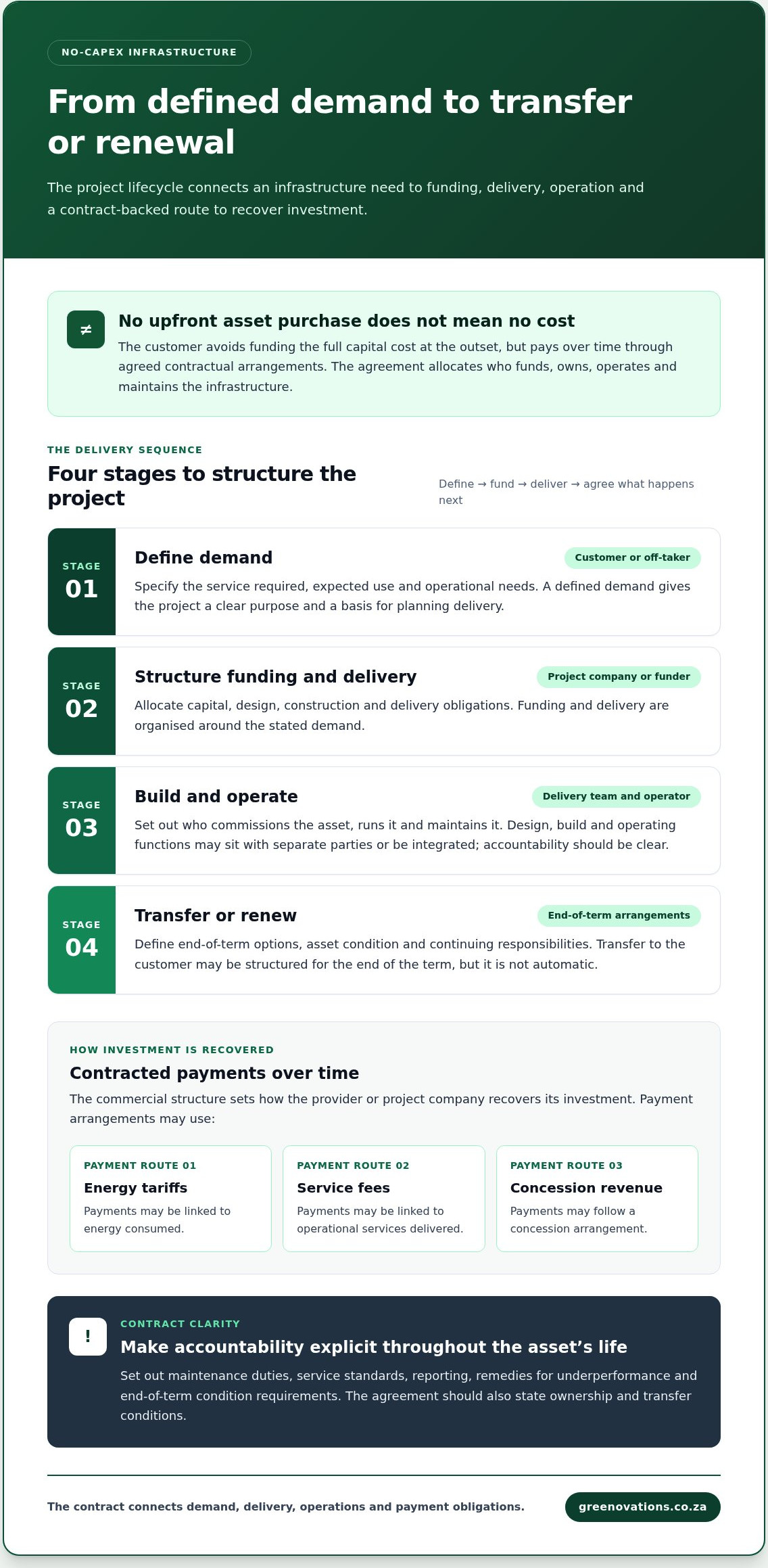
The sequence is deliberate: define demand, structure funding, build the asset, operate it, then transfer it or renew the arrangement. At the outset, the parties establish what infrastructure is required and how it will be used. The project company can then organise funding and delivery around that demand, rather than building an asset without a defined customer or revenue pathway.
- Define demand: Specify the service required, expected use and operational needs.
- Structure funding and delivery: Allocate capital, design, construction and delivery obligations.
- Build and operate: Set out who commissions the asset, runs it and maintains it.
- Transfer or renew: Define end-of-term options, asset condition and continuing responsibilities.
The project company may own or control the asset during the contract, with transfer to the customer structured for the end of the term. Transfer is not automatic. Maintenance duties, service standards, reporting, remedies for underperformance and end-of-term condition requirements should be explicit, so responsibilities remain clear once the asset is operating.
How the funding is recovered
The revenue model determines how the project company recovers its investment. The mechanism should match the service being delivered. A useful commercial structure connects the revenue model to the operating model, a principle also reflected in edX’s Innovative business model design and financial strategy.
- Energy tariff: Under a power purchase agreement, a commercial or industrial off-taker pays an agreed tariff for electricity consumed. The payment basis is energy supplied and used, as defined in the agreement.
- Operational service fee: In managed infrastructure-as-a-service arrangements, the customer pays contracted fees for the service. Greenovations’ seating model uses operational fees instead of upfront seating capital expenditure.
- Concession revenue: A concession can provide for contract-based payments and, where applicable, commercial revenue streams. The agreement determines how revenue is generated, allocated and used to support delivery and operation.
Transfer, renewal and close-out obligations depend on the agreement, not the no-CAPEX label. Greenovations structures infrastructure through contracted commercial arrangements and design-build-finance-operate-transfer concessions. Its infrastructure project orchestration links funding, delivery and operation to a defined commercial structure.
No-CAPEX payment structures: tariffs, service fees, and concessions
The payment mechanism determines what the customer pays for, who pays it and what contract performance supports the payment. These structures are not interchangeable: an energy tariff is tied to electricity consumed, a service fee pays for managed infrastructure, and a concession has its own allocation of service and revenue rights. When comparing no-CAPEX models, assess the payment basis as carefully as the asset.
The payment mechanism should match measurable use or service delivery. Define the relevant measure, how it will be recorded and what happens if delivery or demand differs from expectations. Payment triggers and any indexation depend on the agreement. Do not assume them from the model’s label.
| Structure | Payment basis | Customer use case | Core contract dependency |
|---|---|---|---|
| Energy tariff under a power purchase agreement | Agreed tariff for electricity consumed | Commercial or industrial off-taker using energy from an on-site solar utility hub | Demand profile, metering arrangements and contract duration |
| Infrastructure-as-a-service fee | Recurring contracted operational fees | Customer using managed seating infrastructure without upfront seating capital expenditure | Defined services, operating responsibilities and payment triggers |
| Municipal concession | Contract-based payments and, where applicable, commercial revenue streams | Municipal waste infrastructure delivered under a concession structure | Service obligations, revenue allocation and concession terms |
Power purchase agreements and energy tariffs
Under a power purchase agreement, the off-taker pays an agreed tariff for electricity consumed from an on-site solar utility hub. This is payment for energy use, not necessarily a purchase of the generating asset. The project structure can place funding and asset responsibilities elsewhere. Before comparing the tariff with direct ownership, examine the demand profile, how consumption is metered and whether the contract duration fits the organisation’s requirements.
Greenovations structures commercial and industrial solar utility hubs through long-term PPAs, with off-takers paying agreed tariffs for energy consumed. The tariff and the asset are related commercially, but they are not the same thing: the tariff is the payment basis, while ownership and operating responsibilities for the infrastructure are set out in the agreement.
Infrastructure-as-a-service and concession fees
For managed seating infrastructure, contracted operational fees replace upfront seating capital expenditure. The customer pays for an agreed managed service, so the contract should define its scope and the conditions that trigger payment. A municipal waste concession is different: it can combine public service obligations with contract-based payments and, where applicable, commercial revenue. The counterparty, asset and revenue logic vary by project.
Compare the structures by cash-flow timing, payment drivers, demand exposure and contractual responsibilities, rather than treating all recurring payments as equivalent. Tax, accounting and balance-sheet effects also depend on the contract’s substance and applicable standards. Obtain contract-specific professional assessment before relying on a particular treatment. A tariff or service-fee label does not determine it.
How to assess whether a no-CAPEX model fits your project
A no-CAPEX structure is a fit only when its commercial obligations support a defined business priority. Preserving upfront capital may matter because funds are allocated to core operations or other investments, but weigh that benefit against the full contractual commitment and the control retained over the asset. No-CAPEX is a financing and delivery choice, not a universal cost-saving verdict.
Start with a direct comparison against ownership. Assess expected total payments across the contract, the services included, risks transferred and rights retained. Compare these with the cost and responsibilities of buying, operating and maintaining the asset directly. Include the consequences of changing demand or business plans: a predictable payment schedule can still become a poor fit if the service is no longer needed.
Commercial and operational fit
Define the operational requirement before assessing the funding structure. Specify what the infrastructure must deliver, how service levels will be measured and which failures would affect the business. Then check whether the proposed payment basis follows a measurable service or a sufficiently predictable demand profile. A tariff linked to energy use, for instance, creates a different exposure from a fixed service obligation.
Contract duration should also fit the asset’s useful life and the organisation’s planning horizon. A long commitment can support project delivery, but may restrict flexibility if sites, processes or demand change. Assess whether utilisation is likely to remain sufficient to justify payments and whether the infrastructure is important enough to warrant defined performance and continuity provisions.
Contract, finance, and risk review
Before approval, assign responsibility for delivery, performance, maintenance, insurance and end-of-term treatment. The agreement should state who bears construction delays, operating failures and maintenance costs, and how responsibility is measured and enforced. Review payment triggers, permitted changes, default provisions and termination consequences. A low initial cash requirement does not remove exposure to these contractual events.
Use this decision checklist:
- Strategic case: Does preserving upfront capital meet a specific investment or balance-sheet priority?
- Demand and utilisation: Are expected use and operational requirements stable enough to support the proposed payment basis?
- Value and control: Do total contractual commitments, service scope and control rights compare favourably with direct ownership?
- Risk allocation: Are construction, operating, maintenance, insurance and performance duties expressly assigned?
- Exit and compliance: Are transfer, renewal and termination outcomes clear, with finance and legal review of accounting, tax, procurement and balance-sheet implications?
In South Africa, assess procurement and accounting implications against the project’s specific structure and applicable requirements, rather than inferring them from the no-CAPEX label. Finance and legal teams should review the contract before commitment. Greenovations’ infrastructure project structuring connects project delivery with contracted commercial arrangements, providing a practical basis for assessing fit.
How Greenovations applies no-CAPEX models to infrastructure
Greenovations Venture Studio invests in and builds green-economy businesses across Africa, applying no-CAPEX structures to infrastructure with defined commercial arrangements. It acts as a project orchestrator, aligning project design, funding, delivery, operations and revenue recovery rather than treating capital provision as a standalone transaction. Design-build-finance-operate-transfer concessions provide one framework for allocating these responsibilities across a project lifecycle.
The structure depends on the asset and its revenue logic. Solar utility hubs link infrastructure funding to contracted energy offtake. Managed seating uses fees for an operational service. Municipal waste projects can use concession arrangements. These are distinct payment models, and each requires clear obligations, an agreed operating scope and defined end-of-term arrangements.
Solar utility hubs funded through contracted energy offtake
For commercial and industrial solar utility hubs, Greenovations structures long-term power purchase agreements under which off-takers pay agreed tariffs for electricity consumed. The arrangement connects project revenue to energy use, while the off-taker accesses electricity without making the same upfront asset purchase required under direct ownership. The contract sets out the commercial relationship. It does not make the infrastructure free or determine accounting treatment by itself.
Greenovations funds and maintains these projects under multi-year contracts. The tariff and project terms are set out in the agreement, so do not assume a generic rate or payment trigger. Assess the off-taker’s demand, how energy consumption is measured and how project and operating responsibilities are allocated. Contracted demand provides the revenue basis for structuring delivery and funding.
Managed infrastructure and concession applications
In sustainable seating infrastructure-as-a-service, contracted operational fees replace upfront seating capital expenditure. The customer pays for the managed infrastructure service under agreed terms, with responsibilities defined by contract rather than inferred from asset ownership. The service scope and operating obligations are central to the arrangement.
Municipal waste projects use a different structure. Greenovations develops these through design-build-finance-operate-transfer concessions, which organise project delivery and operations around concession terms. The applicable payment and revenue arrangements depend on the project agreement and its allocation of responsibilities. Public service obligations, commercial revenue and transfer conditions are distinct elements, not a single fee model.
Across these applications, Greenovations connects infrastructure requirements with contracted payment logic and allocated delivery and operating duties. Project terms determine how funding is recovered and how responsibilities are managed. For decision-makers assessing a project against these principles, explore Greenovations’ infrastructure approach.
Turn your infrastructure requirement into a bankable project
The next step is to turn an operational need into a project brief that can support commercial structuring. Define the service required, the demand it must meet, the performance measures that matter and the responsibilities your organisation is prepared to retain. This gives finance, operations and legal teams a shared basis for evaluating the model and its contractual exposure.
Use no-capex business models explained as a starting point, not a substitute for project-specific analysis. The central decision is whether contracted delivery aligns with your priorities more effectively than direct ownership, once payment commitments, control rights and end-of-term obligations are considered.
Greenovations invests in and builds green-economy businesses across Africa, applying contracted structures across solar utility hubs, managed seating infrastructure and municipal waste concessions. Each project needs its own commercial logic and allocation of responsibilities. Explore Greenovations’ infrastructure approach to consider how these structures can be applied to your project requirements.
A clearly defined brief and disciplined assessment can help you move from capital constraints to a more deliberate infrastructure decision.
Frequently Asked Questions
Does no-CAPEX mean a project is free?
No. It means the customer avoids funding the asset purchase upfront, not that the project has no cost. The party arranging the project must recover its investment through the agreed commercial structure. Before signing, compare the contract’s complete payment obligations with the costs and responsibilities of direct ownership, including operation and maintenance. A deferred or usage-based payment is still a financial commitment.
How does a no-CAPEX business model make money?
The project company or infrastructure provider earns revenue through the contract’s payment mechanism. For example, Greenovations’ solar utility hubs generate recurring revenue through contracted energy offtake, while municipal waste concessions can generate revenue from municipal service payments, waste tipping fees and sales of recovered materials and energy. Each revenue stream depends on the project agreement and the service or output being delivered.
Is a no-CAPEX arrangement always treated as OpEx?
No. The accounting treatment depends on the agreement’s substance and the standards applicable to the reporting entity. A recurring invoice or service-fee label does not, by itself, establish that a commitment is OpEx or keep it off the balance sheet. Assess the specific rights, obligations and asset use in the contract with finance specialists before classifying it.
What is the difference between no-CAPEX and a power purchase agreement?
No-CAPEX describes a funding and delivery approach; a power purchase agreement, or PPA, is one contractual structure that can implement it. In a solar PPA, a commercial or industrial off-taker pays for electricity consumed under agreed terms. Other no-CAPEX projects may use infrastructure service fees or concession revenue. A PPA is one possible model, not a synonym for every no-CAPEX arrangement.
Who owns the asset in a no-CAPEX model?
Ownership depends on the project structure and agreement. A project company may hold the asset during the contract, with transfer or other end-of-term arrangements defined in the documents. Customers should distinguish legal ownership from access to the service and responsibility for operating or maintaining the infrastructure. Review the provisions on asset control, maintenance, renewal and transfer rather than relying on the “no-CAPEX” description.
What risks should a business assess before signing a no-CAPEX contract?
Assess whether demand or utilisation can support the required payments, and what happens if operational needs change. Review service standards, maintenance and performance responsibilities, payment triggers, default provisions, termination consequences and end-of-term obligations. Compare the total contractual commitment with direct ownership, including differences in control. Finance and legal teams should assess accounting, tax and procurement implications for the particular contract.
Can no-CAPEX models be used beyond commercial solar?
Yes. The structure can apply wherever infrastructure delivery and operation can be supported by a defined contractual revenue arrangement. Greenovations applies it to managed seating infrastructure, where contracted operational fees replace upfront seating capital expenditure, and to municipal waste projects structured as concessions. These applications have different assets, counterparties and payment bases, so each requires a structure matched to its service obligations and revenue sources.
Visual summary
Planning a project like this?
Talk to the Greenovations venture desk about a No-CAPEX structure.