
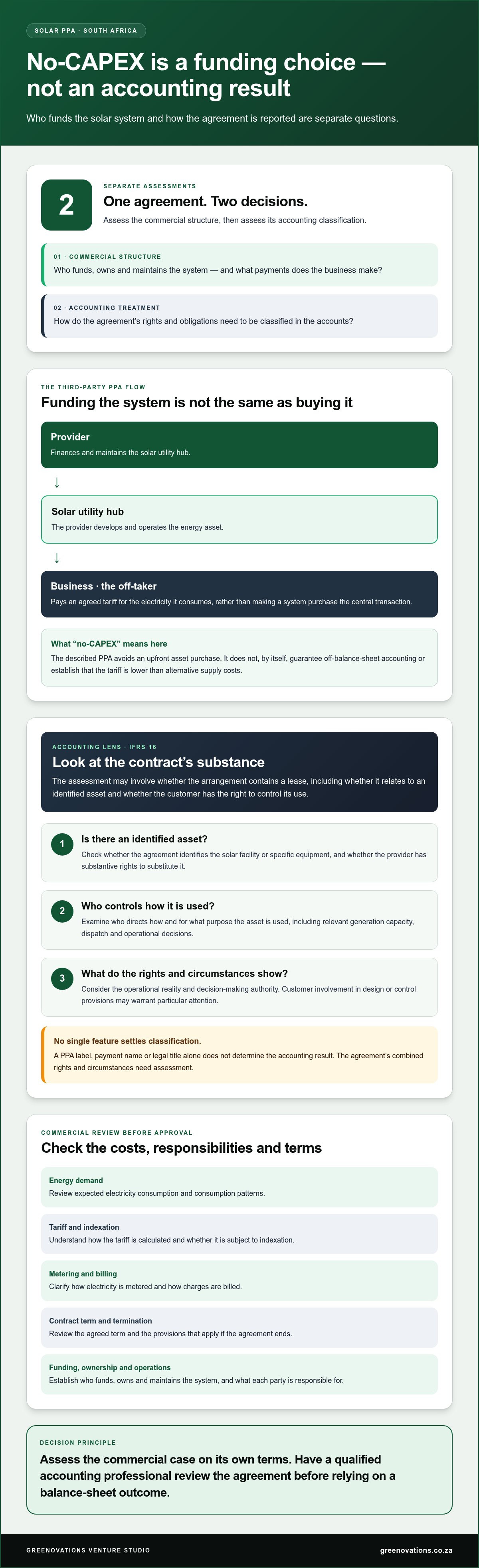
A solar PPA can remove the upfront capital outlay, but it does not guarantee off-balance-sheet treatment. For South African businesses assessing off-balance sheet solar financing South Africa, that distinction is decisive: the funding structure determines who pays for and owns the system, while accounting classification depends on the contract and its substance.
Preserving capital for core operations can be a clear commercial advantage. Under a third-party-funded PPA, the project provider finances and maintains the solar utility hub, while the business pays an agreed tariff for the electricity it consumes. This changes the timing and structure of cash outflows, but does not settle how the arrangement must be recognised in the accounts.
This guide explains how PPA payments work, why a qualified accounting professional must assess the agreement under IFRS 16, and how a PPA compares with owning or renting a system in terms of capital, risk and control. It also outlines the commercial and contractual points to resolve before approval, helping decision-makers distinguish a no-CAPEX structure from an accounting outcome.
Key Takeaways
- Off-balance sheet solar financing South Africa separates who funds the system from how the contract is classified in the accounts.
- A PPA avoids upfront asset purchase under the described model, but its accounting treatment depends on the agreement and requires professional assessment.
- Compare a PPA with ownership, rental and blended finance across funding, asset control, operating responsibility and accounting review.
- Assess energy demand, tariff calculation, indexation, metering, billing, contract term and termination provisions before approval.
- Greenovations Venture Studio finances, builds and maintains commercial and industrial solar utility hubs under multi-year PPAs, with off-takers paying agreed tariffs for consumed electricity.
What off-balance-sheet solar financing means for South African businesses
Off-balance-sheet solar financing South Africa describes a commercial structure in which a third party funds a solar utility hub, so the business buys electricity rather than purchasing the generating asset. This can avoid an upfront asset purchase, but the contract and its accounting treatment determine how the arrangement is reported. The phrase describes a possible accounting outcome, not a financing product that automatically removes obligations from the balance sheet. For foundational context, see What is off-balance-sheet financing?
Two assessments are needed. Commercially, consider who funds, owns and maintains the system, and what payments the off-taker must make. For accounting purposes, assess how the contract’s rights and obligations are classified. A third-party-funded project can avoid customer-funded construction without guaranteeing that the resulting agreement sits outside the customer’s balance sheet. A PPA label alone does not determine the accounting result.
Finance leaders should therefore look beyond the initial cash outlay. Consider how solar procurement affects capital allocation, operating budgets, leverage measures and applicable financing covenants. Buying an asset may compete with investment in production capacity, maintenance or other priorities. A contracted procurement structure changes the timing and nature of payments, but its obligations still need to be assessed against the business’s accounting policies and reporting requirements.
How a third-party solar PPA is structured
Under a third-party-funded PPA, a project company or provider finances and maintains the solar utility hub. The business, known as the off-taker, pays an agreed tariff for the electricity it consumes under the contract. The provider develops and operates the energy asset, while the customer’s commercial arrangement is for electricity procurement. This differs from buying the system, funding its construction and taking ownership of the generating asset.
The distinction affects both operations and finance. The off-taker pays for consumed kilowatt-hours under agreed terms, rather than making a system purchase the central transaction. The contract sets out the basis for those payments and each party’s responsibilities. It does not, by itself, establish how the arrangement must be recognised in the accounts.
Why businesses consider off-balance-sheet financing
Avoiding upfront CAPEX can preserve capital for core operations and other investment priorities. A PPA can also provide a defined basis for forecasting energy expenditure: the off-taker can model payments against expected electricity consumption and the contracted tariff. That can support budget planning, but it does not establish that the tariff will be lower than alternative supply costs or guarantee savings. Consumption patterns and contract terms remain central to the commercial assessment.
No-CAPEX procurement describes who funds the solar asset; it does not guarantee off-balance-sheet accounting. Treat these as separate approval decisions. Assess the project’s commercial case on its own terms, then have a qualified accounting professional review the agreement and determine its classification before relying on a balance-sheet outcome.
How PPA structure and IFRS 16 affect solar balance-sheet treatment
A power purchase agreement is a commercial structure, not an accounting conclusion. For off-balance sheet solar financing South Africa, assess the executed contract and the facts of the arrangement under applicable accounting standards, including IFRS 16 where relevant. A PPA may be described commercially as an operating expense because the customer pays for electricity. That label alone does not establish how the arrangement should be recognised in the financial statements.
IFRS 16 analysis considers whether an arrangement contains a lease. The assessment can involve whether the contract relates to an identified asset and whether the customer has the right to control its use. This requires more than checking who holds legal title or how payments are named. The rights granted by the agreement, the operational reality and the allocation of decision-making authority all matter. A PPA does not automatically create a lease, and its label does not automatically prevent one.
Which contract features warrant accounting scrutiny?
Review the agreement for language identifying the solar facility or specific equipment, and examine whether the provider has substantive rights to substitute the asset. Assess who directs how and for what purpose it is used, alongside provisions governing generation capacity, dispatch and operational decisions. Customer involvement in design or control provisions may warrant particular attention. No single feature settles classification: the accountant must assess the combined rights and circumstances.
For example, a contract may refer to electricity from a particular facility while leaving the provider responsible for operating it. That description alone is not enough to determine the accounting result. Reviewers need to establish whether the customer has rights over the use of an identified asset, or is purchasing electricity from an asset the provider directs and operates. The relevant evidence is the precise contractual rights, not a simplified description of the transaction.
What finance teams should document
Build an audit-ready file around the executed PPA and the complete project structure. Retain relevant asset schedules, contract appendices and amendments, together with a written accounting analysis that records the assumptions, evidence considered and conclusion. The analysis should explain how the contract’s asset identification, substitution, control and decision-making provisions were assessed. Involve the company’s accounting team and external advisers as appropriate, and revisit the conclusion if the contractual terms or facts of the arrangement change.
Keep the commercial case separate from the accounting conclusion. Management may document why a PPA supports capital allocation, energy procurement or operational planning, but that rationale does not replace the classification assessment. PPA classification must be assessed against the actual contract, not inferred from its title or payment label. For commercial and industrial businesses evaluating the infrastructure structure, Greenovations develops and maintains solar utility hub projects under multi-year agreements. Accounting treatment remains a separate professional assessment.
PPA, solar ownership, rental, or blended finance: compare the structures
These structures allocate capital, ownership and operating responsibility differently. The right comparison is not simply which option avoids a large initial payment. Assess who controls the asset, who carries delivery and maintenance responsibilities, how payments are structured, and what accounting review the agreement requires. The table summarises the distinctions; specific contractual terms can change how responsibilities are allocated.
| Structure | Funding source | Asset ownership | Upfront capital | Operating responsibility | Accounting review |
|---|---|---|---|---|---|
| EPC ownership | Business funds the project or arranges its own finance | Business owns the system | Business commits capital or takes on financing | Business retains responsibility, or contracts separately for operation and maintenance | Assess asset recognition, financing and applicable tax treatment |
| PPA | Third-party project finance | Provider or project company owns the hub | Structured to avoid customer upfront CAPEX | In Greenovations’ model, the studio maintains the hub | Review the actual contract and facts, including any IFRS 16 implications |
| Rental | Rental or equipment finance provider | Typically the lessor, subject to the agreement | Payments are made under contractual terms rather than an outright purchase | Set by the rental agreement; responsibilities may be allocated between parties | Assess the arrangement under applicable standards; the rental label is not determinative |
| Blended finance | Combination of funding sources with different objectives or risk-return profiles | Depends on the project and financing structure | Depends on how capital contributions and obligations are arranged | Depends on the project and its operating agreements | Review each financing instrument and the overall arrangement |
PPA versus direct solar ownership
With EPC ownership, the business funds or finances construction and retains the asset, giving it greater direct control over the system. This route can suit a company that prioritises asset control and is willing to allocate capital, manage delivery exposure and arrange ongoing maintenance. A PPA instead procures electricity from a third-party-funded asset. In Greenovations’ model, the studio finances and maintains commercial and industrial solar utility hubs, while the off-taker pays agreed tariffs for consumed electricity. This can suit a business that prioritises contracted electricity procurement and lower upfront CAPEX, but the contract label does not determine the accounting outcome.
Where rental and blended finance differ
Rental is a contractual arrangement for use of equipment in return for payments; the payment profile, ownership rights and operating duties depend on its terms. Blended finance describes a funding structure that combines sources with different objectives or risk-return profiles. It concerns how a project is financed, not necessarily how the off-taker buys electricity. Neither structure is interchangeable with a PPA, and neither automatically determines accounting treatment. For off-balance sheet solar financing South Africa, compare each proposal by its actual rights, obligations and allocation of risk, then assess the executed agreements with the company’s accounting advisers.
A due-diligence framework for assessing an off-balance-sheet solar PPA
Assess a PPA as an operating arrangement, a long-term commercial commitment and an accounting matter. A disciplined review tests the energy case first, then the contract, delivery responsibilities and reporting implications. This helps decision-makers distinguish a viable electricity procurement structure from assumptions about savings or off-balance-sheet treatment.
Commercial and operational contract review
- Establish the energy requirement. Review consumption patterns, demand timing and the proportion of electricity the project is expected to supply. Test the proposed arrangement against operational requirements, including how changes in demand could affect the commercial case.
- Reconstruct the tariff and payment mechanics. Identify how the tariff is calculated, whether and how it may be indexed, and how electricity is metered, verified, billed and reconciled. Trace the calculation from metered consumption to invoice so finance teams can identify assumptions, adjustments and potential billing disputes.
- Test delivery and operating obligations. Read the agreement alongside the project documents. Allocate responsibility for project delivery, operation, maintenance, performance, insurance and equipment replacement. Confirm how issues are reported, assessed and resolved under the agreed processes, rather than relying on informal expectations.
- Assess the contract lifecycle. Review the contract term, change provisions, termination rights and consequences, alongside transfer scenarios such as a business sale, site change or restructuring. Understand how each event could affect supply, payment obligations and continuity of the arrangement.
Make these checks specific to the operating context. For example, facilities teams can test whether the defined metering point reflects the site’s consumption and whether the billing process gives the business a practical way to verify charges. Legal and procurement teams can map remedies and responsibilities to the agreement, rather than assuming that every delivery or maintenance risk sits with the same party.
Accounting, governance and risk review
- Complete the accounting assessment. Give the executed contract and relevant project documents to the company’s accounting team and qualified external advisers for analysis under applicable standards, including IFRS 16 where relevant. Record the reasoning in an accounting memorandum. The commercial case is not a substitute for this classification analysis.
Before executive approval, document counterparty, delivery, tariff and operational risks, who is responsible for each risk, and the contractual mitigation or decision process. Finance should lead the commercial model; legal should assess rights and remedies; procurement should test contracting and payment mechanics; facilities should validate operational responsibilities. Keep the technical and commercial case, accounting memorandum and approval decision distinct, then bring them together in the investment record.
For off-balance sheet solar financing South Africa, approval should rest on the documented contract and risk allocation, not on a PPA label. Businesses assessing a third-party-funded project can explore Greenovations’ commercial and industrial solar utility hubs as a contracted electricity procurement structure.
How Greenovations structures no-CAPEX solar PPAs in South Africa
Greenovations structures commercial and industrial solar utility hubs as third-party-financed infrastructure projects. The studio finances, builds and maintains each project under a multi-year power purchase agreement (PPA). The off-taker procures electricity under the contract rather than purchasing the generating asset upfront. This changes how project capital is deployed; it does not predetermine how the agreement is classified in the business’s accounts.
From project development to contracted energy supply
The model combines infrastructure deployment and ongoing maintenance with a contracted electricity off-take. The agreement sets the tariff basis, and the off-taker pays for the kilowatt-hours it consumes at pre-agreed rates. Payments are therefore linked to electricity consumption under the contract, rather than to an upfront purchase of the solar utility hub.
This structure can support capital planning where committing upfront project capital would compete with operational requirements or other investments. Under the model, project funding and maintenance sit within the provider’s role. The commercial value still depends on the organisation’s energy demand and the agreed contract terms. A no-CAPEX structure is not, by itself, a promise of savings, a performance guarantee or an accounting outcome.
For finance and operations teams, connect projected consumption with the PPA’s tariff and payment mechanics. Review how the agreement defines consumed electricity and allocates operating responsibilities, then consider how those commitments fit the organisation’s energy procurement plan. The decision is about a long-term supply arrangement as well as capital allocation, not simply the removal of an initial asset purchase.
When to evaluate a Greenovations PPA
A Greenovations PPA is relevant to commercial and industrial organisations seeking solar procurement without upfront project capital expenditure. It merits evaluation where the business wants to direct capital towards core operations or other investment priorities while procuring electricity through an agreed tariff structure and allocating project maintenance under the contract.
Before progressing, align the proposal with actual energy demand, internal capital priorities and the operating responsibilities the organisation expects to retain. Finance, facilities, procurement and legal teams should review the commercial terms and contractual obligations. The company’s accounting team and qualified advisers should separately assess the executed agreement under applicable standards. A PPA can change how a project is funded and how electricity is procured; it cannot guarantee off-balance-sheet treatment.
For organisations assessing off-balance sheet solar financing South Africa, the decision should turn on the fit between energy requirements, capital strategy and contract terms, not on the label attached to the structure. Assess a no-CAPEX solar PPA for your business against those priorities before deciding whether to advance the project for approval.
Turn the financing decision into an approval-ready plan
Align energy procurement with the organisation’s capital priorities and approval process. Set out the operational need, commercial assumptions and responsibilities the business is prepared to retain. Keep the accounting assessment distinct, so the decision rests on both a credible project case and a properly reviewed contract. This is central to evaluating off-balance sheet solar financing South Africa without mistaking no-CAPEX funding for a guaranteed accounting outcome.
Greenovations’ commercial and industrial solar utility hubs are financed and maintained under multi-year off-take agreements, with payment based on pre-agreed tariffs for consumed kilowatt-hours. This gives businesses a defined structure to assess against their energy demand and investment priorities, without assuming a particular accounting classification.
Explore Greenovations’ commercial solar PPA model and consider how contracted energy procurement could fit your business. Start with clear commercial priorities and rigorous contract review to give your team a sound basis for moving forward.
Frequently Asked Questions
Does a solar PPA always qualify as off-balance-sheet financing?
No. A PPA’s name or payment description does not determine its accounting classification. For off-balance sheet solar financing South Africa, assess the executed agreement and the arrangement’s substance under applicable accounting standards. Do not treat a supplier’s description of payments as an accounting conclusion. Before approval, document the commercial rationale separately and obtain a contract-specific assessment from the company’s accounting team or qualified advisers.
Can a South African business use a PPA without buying the solar equipment?
Yes. A business can contract to procure electricity without purchasing the solar equipment itself. The agreement sets out how electricity is supplied and paid for, while ownership of the equipment remains with the project owner under that structure. A business can assess a PPA against its energy requirements without first budgeting to acquire the generating system. It should still review the agreement’s obligations and accounting implications.
How does IFRS 16 affect the accounting treatment of a solar PPA?
IFRS 16 may require a closer assessment of whether the agreement contains a lease. The analysis considers contractual rights and the facts, including whether an identified asset is involved and whether the customer controls its use. A contract for electricity is not automatically a lease, but calling it an energy purchase does not settle the issue either. The company’s accounting team should assess the executed documents and record the basis for its conclusion.
What happens if a solar PPA is classified as a lease?
If the assessment concludes that the PPA contains a lease, the business may need to recognise a right-of-use asset and lease liability in accordance with IFRS 16, subject to applicable requirements and any relevant exemptions. The effect can extend beyond presentation: reported assets, liabilities and financial ratios may change, potentially affecting internal measures or covenant monitoring. The accounting team should quantify the implications using the actual terms rather than relying on a generic estimate.
Is a solar PPA different from renting or leasing solar equipment?
Yes. A PPA is principally an agreement to procure electricity, with payments linked to the contract’s energy terms. A rental or equipment lease is principally structured around the use of equipment in return for contractual payments. The distinction can affect what the parties promise to provide and how responsibilities are allocated. Labels alone are not decisive; the full agreement and related documents determine the rights, obligations and accounting review required.
Can blended finance be used alongside a commercial solar PPA?
It can be structured alongside a PPA, but blended finance and the PPA address different parts of a project. Blended finance combines funding sources with differing objectives or risk-return profiles; the PPA sets out the commercial electricity off-take relationship. A project’s funding arrangements may affect its structure, but they do not automatically settle the off-taker’s accounting. Map each funding instrument and contractual obligation separately, then assess how the documents interact.
Who is responsible for maintaining a third-party-funded solar system?
Responsibility is determined by the contract, so the agreement should specify who arranges and pays for maintenance, equipment replacement and related operational work. In Greenovations’ commercial and industrial solar utility hub model, the studio finances and maintains the project under a multi-year agreement. The off-taker should understand any site-level duties or cooperation required by the contract and ensure facilities teams know how operational matters are handled.
Visual summary
Planning a project like this?
Talk to the Greenovations venture desk about a No-CAPEX structure.