Bankability depends on the contracts working as one system, not on a concession agreement in isolation. In renewable energy concession agreements in South Africa, risk is allocated across project documents, which may include a power purchase agreement, an implementation agreement, a grid connection agreement and a separate land lease. Public procurement and private offtake can involve different counterparties, so the allocation must reflect who controls each risk and which contract provides relief for time, cost or both.
That distinction matters: a project may begin commercial operation under its power purchase agreement (PPA) before meeting the contractor’s taking-over or completion requirements. This guide explains how concession structures, land tenure and project contracts divide responsibilities, and how public procurement differs from private offtake. It also covers practical pressure points, including grid delays, force majeure, battery integration and notice deadlines, that can affect revenue, delivery obligations and project-finance certainty.
Key Takeaways
- Map each material risk to the party able to manage it, then align notice deadlines and relief across the project contracts.
- Structure concession and land arrangements around the project’s operating obligations, tenure requirements and handback position.
- Distinguish public procurement from private offtake by identifying the buyer, revenue agreement and any government undertakings.
- Apply South Africa’s electricity framework to the project structure, including the rules governing new generation capacity and procurement.
Risk allocation across renewable energy project contracts
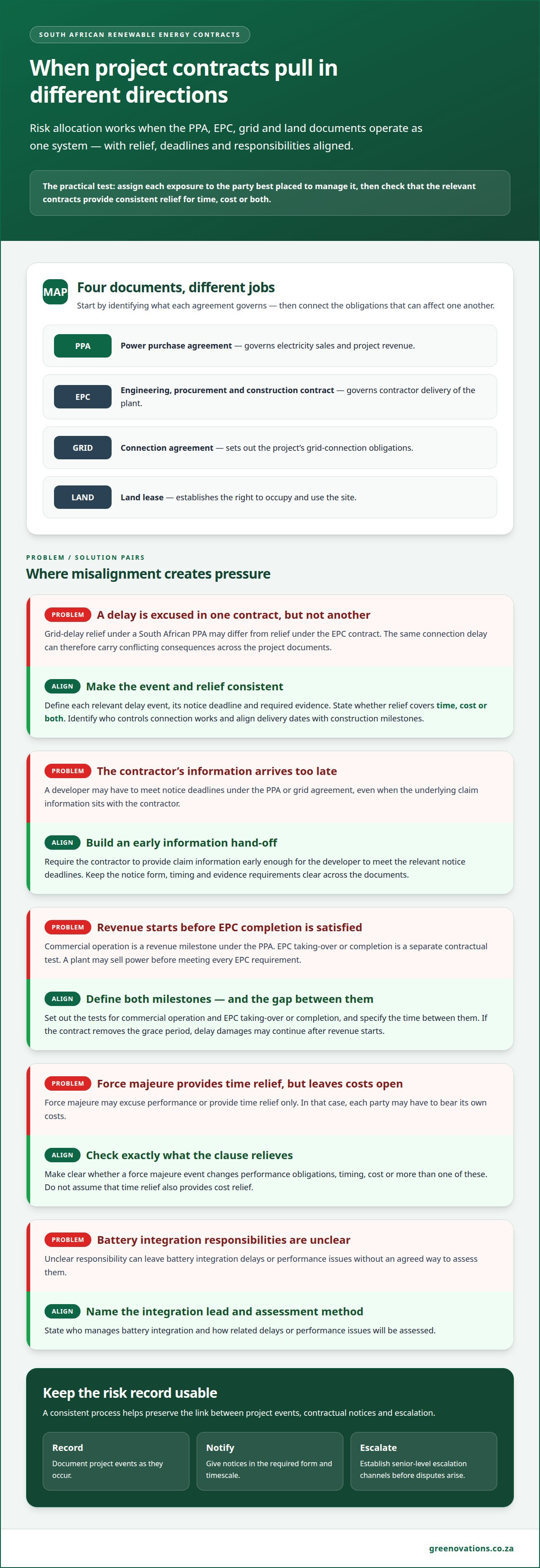
Risk allocation assigns each project exposure to the party best placed to manage it. In South Africa, a project company’s obligations may be spread across a power purchase agreement (PPA), an engineering, procurement and construction (EPC) contract, and separate grid and land documents. These agreements need to align: a delay excused under one contract may still trigger obligations under another.
A PPA governs electricity sales and revenue, while an EPC contract governs the contractor’s delivery of the plant. Grid-delay relief under a South African PPA may differ from relief under the EPC contract. Project documents should define each relevant delay event, its notice deadline and required evidence, then specify whether relief covers time, cost or both. The contractor may also need to provide claim information early enough for the developer to meet notice deadlines under the PPA or grid agreement.
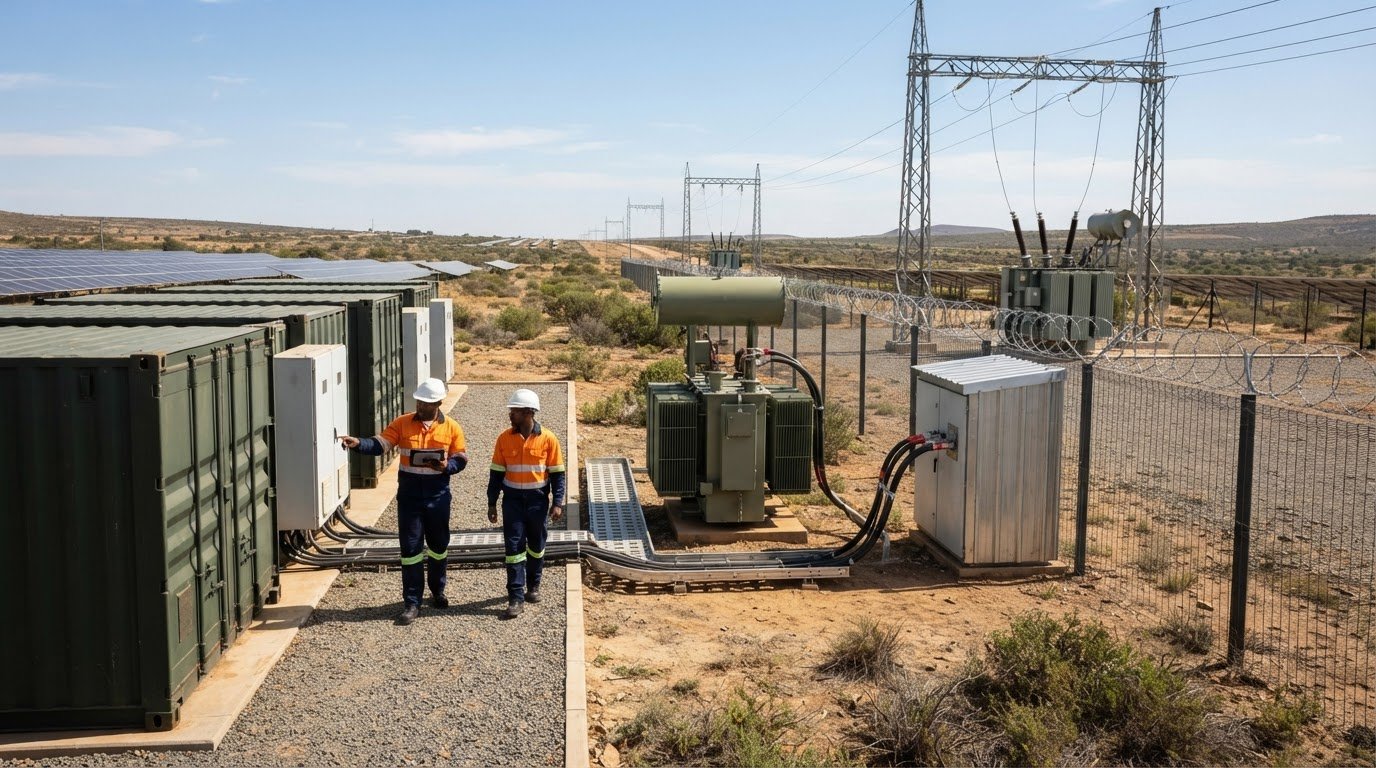
A connection agreement sets out the project’s grid-connection obligations, while a land lease establishes the right to occupy and use the site. Both may be separate from the main concession or PPA. Identify who controls connection works, site access and land tenure, then align delivery dates with construction milestones. For example, the developer’s grid agreement and the contractor’s completion schedule should not assign conflicting consequences to the same connection delay.
Commercial operation is a revenue milestone under a PPA; EPC taking-over or completion is a separate contractual test. A plant may begin selling power without satisfying every EPC requirement. If the contract removes the grace period between commercial operation and taking-over, delay damages may continue after revenue starts. Define both milestones, their tests and the time between them.
Force majeure is a contractual event that may excuse performance or provide time relief. In South African renewable energy contracts, it may provide time relief only, leaving each party to bear its own costs. Battery integration also needs explicit allocation: identify who manages integration and how delays or performance issues will be assessed. Record project events as they occur, give contractual notices in the required form and within the required timescale, and establish senior-level escalation channels before disputes arise.
Concession agreements
A South African renewable energy concession combines project rights and delivery obligations across multiple agreements. Its commercial scope needs to align with the procurement route, site rights and operating model.
Local-content thresholds and ownership commitments are distinct. South Africa’s REIPP programme set a 25% local-content threshold for onshore wind in bidding Round 1 and a 45% threshold for solar PV in bidding Round 3. Black economic empowerment and community ownership conditions must be read from the applicable procurement documents and project commitments; local-content percentages do not establish ownership requirements.
Concession agreement framework
A concession agreement grants defined rights to develop or operate an asset, subject to specified obligations. It should identify the facilities covered, the concessionaire’s responsibilities, performance standards, operating rights, and termination or handback arrangements. South African project teams should also define how the agreement interacts with procurement documents and related project contracts. Serve notices within the stated deadlines and in the required form, as a valid claim may depend on both.
Applicable laws and regulations
South Africa’s electricity legislation and new-generation regulations form part of the framework for renewable energy procurement. The Electricity Regulation Act No. 4 of 2006 was enacted in 2006 and amended in 2007; the initial REIPP procurement allocation was determined under section 34(1). The Electricity Regulations on New Generation Capacity were approved in August 2009, then issued in November 2010 and May 2011. Read the applicable procurement documents alongside these instruments.
Local participation requirements
Local participation provisions translate procurement commitments into project-level obligations. REIPP Round 3 solar PV projects reported local content of 54%, while onshore wind projects reported 47%; these reported outcomes differ from the respective 45% solar threshold and earlier 25% wind threshold. Treat local sourcing, black economic empowerment and community ownership as separate contractual topics. Identify the applicable bid commitments, responsible entities, evidence requirements and consequences for non-performance before execution.
Where industrial operations form part of delivery, industrial intelligence can sit alongside the project’s contractual and participation workstreams.
Public procurement and private offtake project structures
Public procurement selects projects through a government-led process; private offtake involves a direct contract with an energy buyer. The structure determines the bid route, revenue counterparty and applicable documents.
Bidder and developer eligibility
Eligibility is the set of qualification criteria and evidence required to submit or advance a bid. The applicable tender documents establish those requirements, so they govern rather than a single rule for every project. In the REIPPPP, a preferred bidder must provide the Department of Energy with proof of its NERSA generation-licence application within 14 days of award. That is a post-selection obligation, not a complete eligibility test.
Tariffs, prices and revenue
A tariff sets the price paid for electricity, while the power purchase agreement (PPA) structures the project’s principal revenue stream. Regulation 9 of South Africa’s New Generation Regulations provides that a buyer cannot enter into a PPA unless it represents value for money. As historical context, Round 3 recorded solar PV prices of R0.88 per kWh and wind prices of R0.66 per kWh. Those auction outcomes are not current tariff quotations.
Concession-awarding authorities
A concession-awarding authority is the public body named to run procurement and contract with the project proponent. South Africa’s initial REIPP allocation was determined by the Minister of Energy under section 34(1) of the Electricity Regulation Act. A municipality pursuing its own project must be identified as the procuring authority in that project’s documents; the national programme does not identify every municipal award.
Tender and contract documents
Official tender documents are the notice and procurement pack issued by the authority responsible for a specific process. For a live opportunity, use the authority’s current tender notice and associated bid documents to establish submission conditions and contract terms. Review the draft PPA and implementation agreement, where provided, and compare their obligations with the final award documents. A private offtake process instead centres on the buyer’s procurement materials and proposed agreement.
Which laws and regulations govern renewable energy concessions in South Africa?
South African renewable energy concessions operate within an electricity-law framework and procurement instruments. Read these alongside the tender and project agreements, as each governs a different layer of authority, selection and delivery.
The Electricity Regulation Act No. 4 of 2006 is the statute under which the initial REIPP allocation was determined. It was enacted in 2006 and amended in 2007. The Minister of Energy determined that initial procurement allocation under section 34(1). For a project team, this establishes the statutory basis behind the allocation, rather than the detailed commercial terms of an individual concession. Those terms must be read in the applicable procurement and contract documents.
The Electricity Regulations on New Generation Capacity are regulations concerning new generation procurement. They were approved in August 2009 and issued in November 2010 and May 2011. Read the relevant regulation alongside the project’s procurement documents, rather than treating a regulation date as a substitute for current bid terms. This separates the regulatory framework from the specific obligations offered to bidders and accepted by the selected project company.
Apply the framework in sequence: identify the statutory basis for the procurement, establish which regulations and procurement instruments govern the process, then review the tender and signed agreements. For example, the initial REIPP allocation traces to section 34(1), while the project’s PPA sets its commercial relationship with the offtaker. Keep those functions distinct. A procurement instrument does not replace the contract that allocates delivery, revenue and performance obligations.
For infrastructure projects moving from procurement requirements to operational delivery, discuss project implementation priorities. A clear separation between statutory authority, procurement conditions and contractual duties gives decision-makers a practical structure for reviewing execution risk.
Greenovations Venture Studio
Greenovations Venture Studio can be a practical partner when concession planning moves from contract allocation to infrastructure execution. It invests in and builds green-economy businesses for infrastructure needs across South Africa, with a focus on industrial innovation and infrastructure transformation.
For project teams, the key question is how operational assets and delivery models fit the agreed commercial structure. Greenovations’ offerings include Solar PV Utility Hubs, Drone-Powered Industrial Intelligence (GII), an Electric Vehicle Ecosystem, Sustainable Seating Infrastructure-as-a-Service and Solar PV Recycling. Its No-CAPEX model deploys infrastructure without upfront capital from partners, helping align project planning with capital structure and operational requirements.
Greenovations’ role is infrastructure and venture building, not legal advice on concession drafting or contract interpretation. Engage the studio when assessing how its offerings could support an operational project requirement. Contact Greenovations to discuss your project.
Turn contractual design into an execution plan
Use the next stage to turn renewable energy concession agreements in South Africa into an operational brief. Map the project’s commercial objectives against the infrastructure, delivery interfaces and capabilities needed for execution. This moves the focus beyond contract interpretation to the practical decisions that shape implementation.
Greenovations offers Drone-Powered Industrial Intelligence (GII), an Electric Vehicle Ecosystem and Sustainable Seating Infrastructure-as-a-Service. Each addresses a distinct infrastructure need, so the right fit depends on the project’s operational priorities, not the concession structure alone. A clear brief helps identify where a solution belongs and how it supports the wider project model.
To discuss how your project’s operational priorities connect with Greenovations’ offerings, contact Greenovations Venture Studio. A disciplined next step keeps execution decisions commercially focused.
Frequently Asked Questions
What are renewable energy concession agreements in South Africa?
In South Africa, renewable energy concession agreements grant defined rights to develop or operate an energy asset, together with delivery and operating duties. They are not interchangeable with a power purchase agreement (PPA): the PPA sets electricity sale and payment terms, while a concession may cover broader project responsibilities. Separate grid and land agreements may govern specific project interfaces.
How does the REIPPPP concession and procurement process work?
The REIPPPP uses public procurement to select preferred bidders for specified generation capacity. Bidders submit proposals against the applicable procurement documents, which set the process and project requirements. After preferred-bidder status is awarded, the bidder must provide the Department of Energy with proof of its NERSA generation-licence application within 14 days. The bid documents and resulting agreements then shape the project’s contractual obligations.
What are the typical concession terms, contract durations and renewal rules?
The concession agreement sets its own term, including when project rights begin and expire. Its clauses should state the operating period, any extension option and the conditions for exercising it. Renewal depends on an express contractual mechanism and should not be assumed. If no extension is exercised, the parties must follow the agreed expiry, asset handback and outstanding-obligations provisions.
What risks and termination provisions apply to renewable energy concession agreements?
Risk and termination provisions depend on the project contracts and the responsibilities allocated under them. The agreements should identify termination events, notice requirements, any opportunity to remedy a breach and the financial consequences of termination. For example, failure to meet a defined completion test may trigger a default process if the contract says so. Force majeure terms should clarify whether relief affects time, cost or both.
How do South African renewable energy concessions compare with power purchase agreements and leases?
A concession can govern broader project rights and duties; a PPA primarily sets the terms for electricity sales and buyer payments. A land lease gives the project company rights to use a site but does not, by itself, set electricity sales terms. A project may use all three: the concession for project scope, the lease for land tenure and the PPA for revenue.
What environmental, land-use, grid connection, and licensing approvals are required?
A REIPPPP preferred bidder must provide the Department of Energy with proof of its NERSA generation-licence application within 14 days of award. The applicable tender documents establish project-specific requirements; grid connection and site-use obligations are addressed in the relevant connection agreement and land lease.
Visual summary
Planning a project like this?
Talk to the Greenovations venture desk about a No-CAPEX structure.