
The option with lower upfront cost is not automatically cheaper over the full contract term. The solar PPA vs buying solar outright decision comes down to ownership and billing: with a PPA, you pay for the electricity the system generates; with an outright purchase, you pay for and own the system. A lease is a third option, usually with a fixed payment for using the system.
Payment structure affects how costs track with generation and what you own when the agreement ends. This comparison explains how PPAs and leases work in South Africa, how their billing differs, and which costs to include when comparing them with an outright purchase. Use the decision guide to assess upfront capital, payment predictability, system output and ownership, rather than comparing headline payments alone.
Key Takeaways
- Compare who owns the system during the agreement and what happens when the term ends; the end-of-contract terms affect the value of each option.
- Separate fixed lease payments from PPA charges tied to the electricity generated, then assess how each billing structure fits your operating costs.
- Compare the full cost over time, not just the upfront commitment. System output, contract pricing and ownership shape the financial outcome.
- Assess how solar incentives are treated in the agreement, and consider whether industrial intelligence or solar PV recycling is relevant to your wider infrastructure plans.
What do solar lease and PPA agreements look like?
A South African solar agreement sets out system ownership, payments and each party’s operating responsibilities. Compare these terms before weighing the financial options.
Power purchase agreements
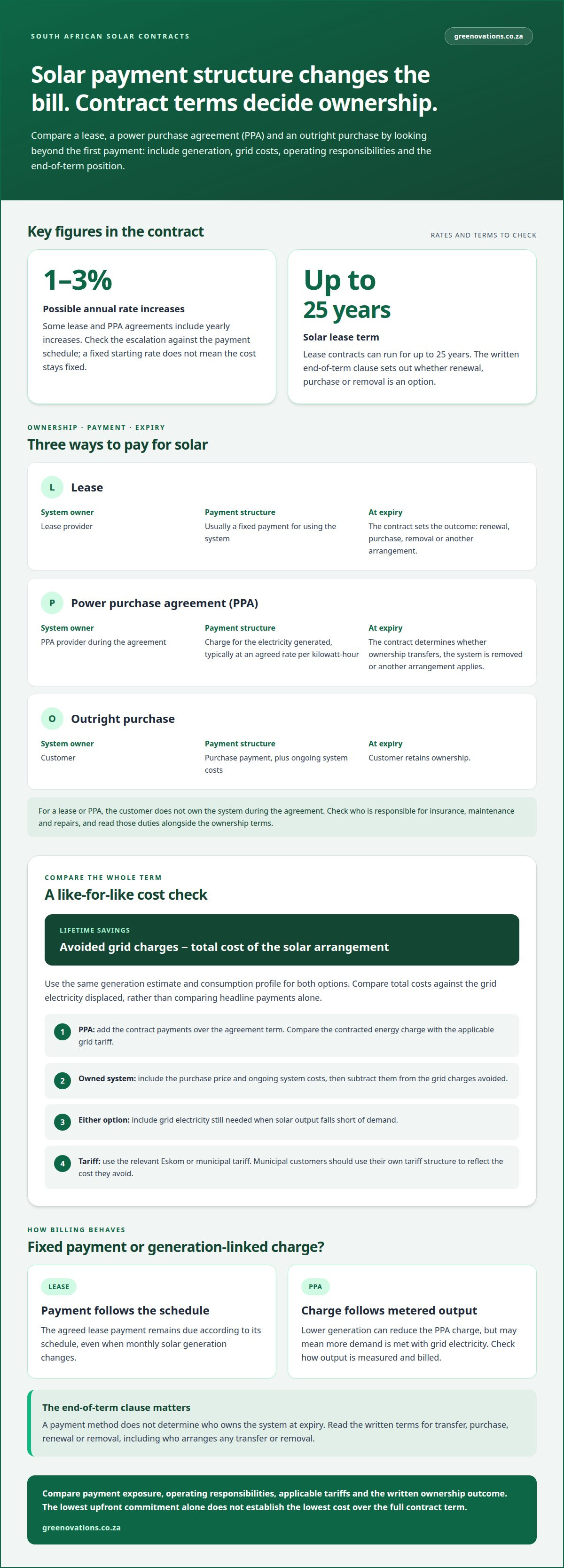
A power purchase agreement (PPA) lets a customer buy the electricity generated by a solar system without buying the equipment outright. The provider owns the system during the agreement, and the customer pays for its electricity, typically at an agreed rate per kilowatt-hour. Unlike a lease’s fixed payment, a PPA bill varies with generation.
Ownership and care of a PPA system
Under a South African PPA, the provider owns the system during the contract. The agreement should clearly assign responsibility for insurance, maintenance and repairs. Read these provisions together: ownership identifies who holds the asset, while the operating terms explain who arranges and pays for work. The customer pays for generated electricity, not ownership of the panels.
Agreement terms and end-of-term ownership
The contract sets the term, payment method, maintenance responsibilities and exit conditions. A lease generally charges for use of the system; a PPA charges for its electricity output. Neither structure gives the customer ownership during the agreement. At expiry, the end-of-term clause determines whether ownership transfers, the system is removed or another arrangement applies. Treat this as a key commercial term, not an administrative detail.
| Option | Who owns the system? | How is payment structured? | End-of-term position |
|---|---|---|---|
| Lease | Lease provider | Fixed payment | Contract terms apply |
| PPA | PPA provider | Per kilowatt-hour generated | Contract terms apply |
| Outright purchase | Customer | Purchase payment | Customer retains ownership |
Choose by comparing payment exposure, operating responsibilities and the written outcome for system ownership at expiry.
Comparing long-term costs with an outright purchase
The solar PPA vs buying solar outright comparison comes down to capital, contract payments and ownership costs. In South Africa, Eskom or municipal tariffs determine the grid costs that solar electricity can displace.
Lifetime costs of a PPA and outright purchase
With an outright purchase, the buyer pays for and owns the system. A PPA spreads payments across the electricity generated under the contract. To compare costs over the system’s lifetime, add the purchase price and ongoing system costs, then compare the total with PPA payments over the agreement term. Include the grid electricity still required in either case. The payment schedule alone does not show which option costs less overall.
Lifetime savings from a PPA or ownership
Lifetime savings equal avoided grid charges minus the total cost of the solar arrangement. For a PPA, compare the contracted energy charge with the applicable grid tariff. For an owned system, subtract purchase and operating costs from the grid charges avoided. Use the same generation and consumption assumptions for both options. This makes the solar PPA vs buying solar outright comparison meaningful, rather than a comparison of initial commitments alone.
Tariffs and solar savings
Eskom and municipal tariffs determine the value of grid electricity displaced by solar generation. For a system owner, a higher applicable tariff can increase the value of each unit generated. For a PPA customer, the difference between the grid tariff and contracted rate shapes the bill comparison. Municipal customers should use their own tariff structure, since an Eskom tariff may not reflect their avoided cost.
Build a like-for-like comparison:
- Use one generation estimate and consumption profile for both options.
- Include grid electricity needed when solar output falls short of demand.
- Add all PPA payments, or purchase and ongoing ownership costs.
- Compare each total with the grid costs it displaces.
This calculation shows how tariff exposure and payment structure affect the decision, beyond the upfront commitment.
Fixed monthly lease payments versus per-kWh PPA billing
A lease usually has a fixed payment, while a PPA charge varies with metered solar generation. Before comparing either option, review the payment formula, annual increases and exit clauses.
Contract terms and escalators
A lease sets a recurring payment for use of the system; a PPA bills each kilowatt-hour generated. Both agreements define the term, rate changes, maintenance duties and early-exit conditions. Some lease and PPA agreements include annual rate increases of 1-3% per year. Model each increase against the payment schedule: a fixed starting rate does not mean a fixed cost throughout the contract.
For a PPA, check how generation is measured and billed. Lower output can reduce the per-kilowatt-hour charge, but it can also mean more demand is met with grid electricity. A lease payment remains due according to its agreed schedule, even when monthly generation changes.
Lease terms and end-of-lease options
Solar lease contracts can run for up to 25 years. The end-of-term clause determines whether the customer can renew, purchase the system, or arrange its removal. These outcomes depend on the written agreement, not on the payment method alone. Compare each option’s conditions and responsibilities before signing, including who organises any removal or transfer.
For example, a lease with a purchase option differs from one that requires system removal at expiry. Payments may be predictable, but the final ownership position depends on the contract clause.
Selling a home raises a separate contract issue. A lease or PPA may require the agreement to transfer to the buyer, be settled before the sale or follow another process. The written transfer and termination clauses determine the available route. Include these terms in sale planning instead of assuming the system automatically transfers with the property.
Compare the options by mapping the payment schedule, annual increases, contract term and exit conditions. For a lease, focus on fixed charges and end-of-term choices. For a PPA, assess per-kilowatt-hour billing, generation-linked payments and the process that applies if the property changes ownership.
What are solar leases and PPAs-and how do they work?
Solar incentives affect a lease, PPA and outright purchase differently because system ownership differs. In a South African comparison, distinguish a tax benefit from a lower electricity charge: one affects project economics, while the other changes the customer’s bill.
Start with the agreement’s ownership clause. A customer who buys a system owns the asset; under a lease or PPA, the provider owns it during the contract. This matters because an incentive linked to ownership may belong to a different party. The contract’s pricing provisions determine whether any resulting commercial value benefits the customer.
Next, identify the incentive and the party eligible to claim it under the applicable South African tax rules. Do not assume that a general incentive creates savings for every customer. A lease payment or PPA rate may reflect project economics, but that does not establish that a tax benefit has been passed on. Compare the written rate with the agreement’s treatment of incentives.
Use a consistent sequence: identify the asset owner, establish which incentives apply to that owner, then assess whether the contract passes any value to the customer. For an outright purchase, include any eligible benefit in the buyer’s project calculation, rather than subtracting it from the electricity tariff. For a lease or PPA, distinguish provider-level benefits from customer-level savings. This avoids counting the same benefit twice.
Tax treatment and billing are separate. A PPA charge follows generated electricity, while a lease uses its agreed payment schedule; an incentive changes neither formula unless the contract says otherwise. Compare the stated rates and obligations, then assess the relevant tax treatment separately for the system owner.
For a wider infrastructure perspective, explore solar project considerations alongside the contract and incentive structure.
Greenovations Venture Studio: Drone-Powered Industrial Intelligence (GII)
Greenovations Venture Studio is a relevant partner when a solar decision forms part of a broader industrial infrastructure strategy. Its Drone-Powered Industrial Intelligence (GII) offering provides precision intelligence for operational and asset decisions, complementing energy planning rather than treating each investment in isolation.
For organisations considering solar assets across their lifecycle, Solar PV Recycling addresses the downstream material pathway. It does not determine whether a PPA or outright purchase is the better choice, but it can form part of wider infrastructure and end-of-life planning.
These offerings suit broader industrial and infrastructure planning, not a household rooftop installation. Contact Greenovations Venture Studio or visit greenovations.co.za to discuss your infrastructure priorities.
Align the solar decision with your wider infrastructure plan
Use the capital decision to set a broader infrastructure direction, not merely to choose a payment structure. For South African organisations, connect energy planning with operational priorities, asset requirements and future investment sequencing. This makes the choice between a solar PPA and buying solar outright part of a disciplined capital allocation process.
Greenovations Venture Studio’s Drone-Powered Industrial Intelligence (GII), Electric Vehicle Ecosystem and Sustainable Seating Infrastructure-as-a-Service address distinct infrastructure needs. Consider how these offerings relate to your organisation’s priorities when planning the next project step. A focused discussion can help identify where an infrastructure opportunity fits within your plans.
Contact Greenovations Venture Studio to discuss your infrastructure priorities and identify a practical next step.
Frequently Asked Questions
Should you choose a lease or a PPA?
Choose the structure that best fits your payment preferences and electricity use. A facility with steady daytime demand may benefit from a PPA’s generation-linked charge, while a site that prioritises a predictable scheduled payment may prefer a lease. For example, compare a production site’s daytime load with expected solar output before choosing a billing structure. The better fit depends on actual consumption, not a headline rate.
Which questions should you answer before you decide?
Map your operating requirements before comparing proposals. Establish when the site uses electricity, how much demand can shift into solar-generation hours and how much grid supply will still be needed. Then review the agreement’s metering method, rate changes, maintenance and insurance responsibilities, transfer provisions and early-exit calculation. For a multi-site business, assess each location separately because different load profiles can produce different commercial outcomes.
What are typical solar PPA rates and contract terms in South Africa?
South African PPA rates and contract terms depend on the project’s generation profile, customer demand, tariff structure and agreed commercial provisions. Compare the charge per kilowatt-hour with the applicable Eskom or municipal tariff, including any rate increases and remaining grid purchases. Assess the full payment schedule over the contract term, rather than treating the initial rate as the total cost.
What South African tax incentives or rebates apply to buying solar or signing a PPA?
Tax treatment depends first on who owns the system and how the transaction is structured. An outright buyer owns the asset, while a PPA customer buys generated electricity under an agreement. Separate asset-related tax treatment from electricity-bill savings, and assess the relevant taxpayer, asset treatment and current tax rules. Do not assume a tax benefit automatically reduces a PPA tariff.
What are the risks, escalation clauses, and early termination fees in South African solar PPA contracts?
Focus on how the agreement calculates future charges and exit obligations. An escalation clause can increase the contracted rate, while generation measurement and billing provisions determine how charges change with output. Review early termination calculations, transfer conditions, system-removal responsibilities and any buyout mechanism. If a business restructures or sells a property, these clauses determine the financial consequences of ending or transferring the arrangement before expiry.
Visual summary
Planning a project like this?
Talk to the Greenovations venture desk about a No-CAPEX structure.