
A solar PPA shifts the purchase from equipment to electricity. For a South African business, the agreement typically runs for around 20 years, with the solar provider supplying power and the business paying for the energy it uses. The solar PPA tariff structure sets how that energy is charged, including the rate per unit and any agreed escalation over time.
The headline tariff is only one part of the commercial decision. Your payments depend on how much energy you consume, how the contract applies its rate and escalation terms, and what happens if your business needs to exit, transfer or purchase the system. This guide explains how PPA energy charges work and what contract options mean, helping you assess the arrangement against your operating needs and long-term cost commitments.
Key Takeaways
- A solar PPA charges for electricity supplied under an agreement, rather than requiring the business to buy the system upfront.
- Assess the tariff alongside its escalation terms and your energy consumption to understand how charges may change over the agreement.
- Review exit and transfer provisions before signing, since they govern what happens if ownership or site requirements change.
- Some South African business PPA terms allow the system to be purchased from year five onwards; understand the purchase terms before relying on that option.
Early exit and transfer options
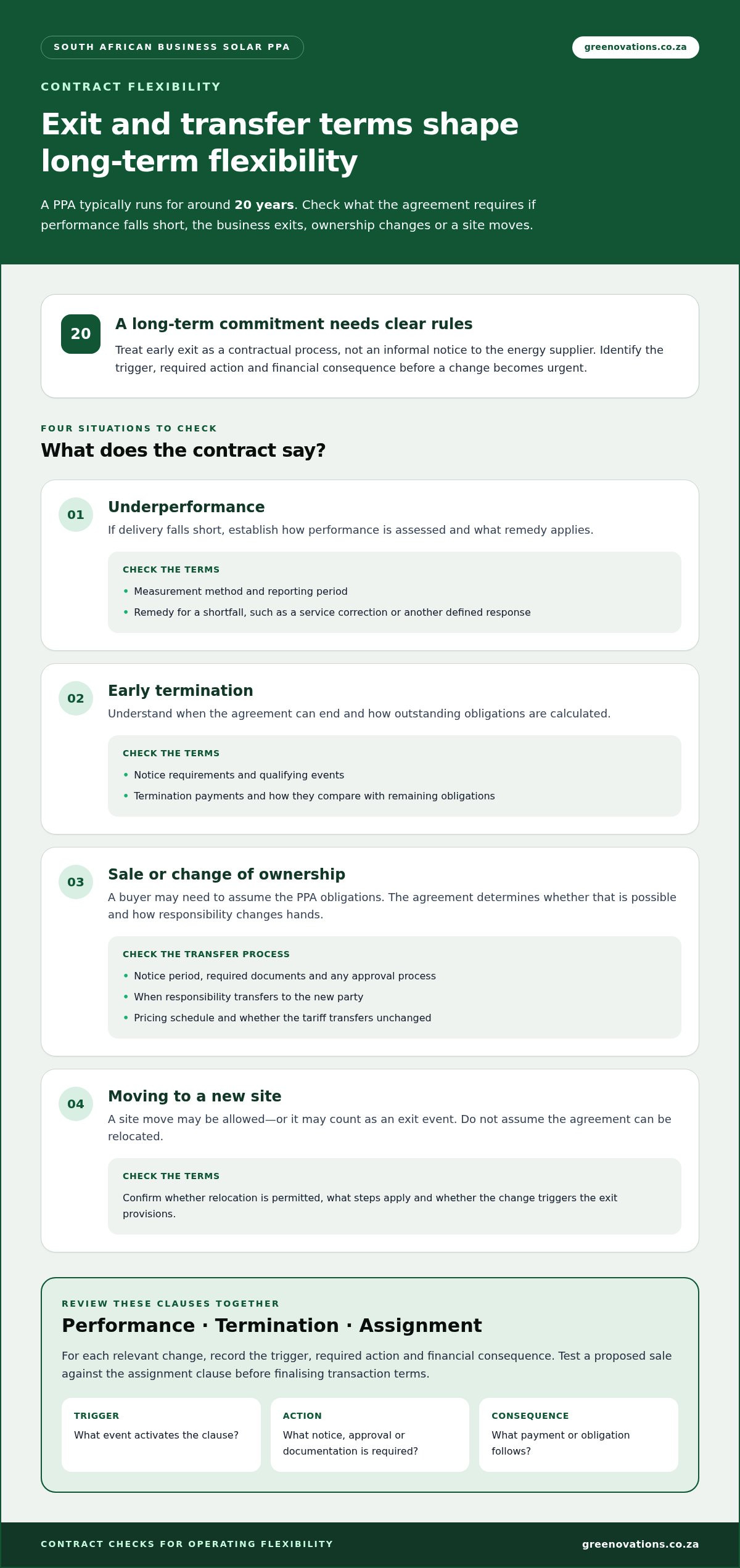
A South African business PPA typically runs for around 20 years, so exit terms affect long-term operating flexibility. The agreement should state how either party can end it, which events trigger termination, and how outstanding obligations are calculated. Treat early exit as a contractual process, not an informal notice to the energy supplier.
Underperformance and early termination create different risks. Check the performance commitment, how output is measured and what remedy applies if delivery falls short. Then review termination payments, notice requirements and conditions for transferring the agreement to a buyer or new site operator.
- For underperformance: identify the measurement method, reporting period and remedy. For example, establish whether the contract links a shortfall to a service correction or another defined response.
- For early termination: locate the clause setting out notice, qualifying events and payment calculations. Compare those terms with the remaining agreement obligations.
- For a site sale: follow the transfer procedure and identify any approval, documentation or assumption-of-obligations steps that the contract requires.
- For a site move: determine whether the agreement permits relocation or instead treats the change as an exit event.
Transferability matters when a business changes ownership. A buyer may need to assume the PPA obligations, but the agreement determines whether that is possible and what process applies. Before a sale, identify the notice period, required documents, approval process and date when responsibility changes. Do not assume the tariff transfers unchanged: read the transfer clause alongside the pricing schedule.
Review three contract sections together: performance, termination and assignment. Record each trigger, required action and financial consequence in a decision table. For example, test a proposed sale against the assignment clause before finalising transaction terms. This makes contractual exposure visible before a change in ownership, operations or site use becomes urgent.
How solar PPAs work
In South Africa, licensing and wheeling requirements depend on the project design and delivery route. On-site generation differs from electricity wheeled through a network. The PPA should allocate responsibility for approvals, network arrangements and operating obligations. Assess these obligations separately from the energy tariff.
A South African business PPA typically runs for around 20 years. The generator develops or owns the solar asset, while the customer buys electricity under agreed terms. With on-site supply, power serves the business premises. With wheeling, generation is delivered through network arrangements to another consumption point. The solar PPA tariff structure defines how the agreed energy charge applies.
Map the physical and commercial chain before signing. Identify the generating site, customer meter, delivery route and party responsible for each interface. Then record how measured output becomes billable energy, including how shortfalls and excess generation are treated. An off-site supply arrangement, for example, needs clear metering and settlement terms.
- Generation: identify the solar asset and its operating responsibilities.
- Delivery: distinguish on-site use from electricity wheeled to another premises.
- Billing: specify meter data, settlement and tariff calculation.
For a wheeled PPA, separate the energy charge from network and settlement arrangements. Specify how delivery data is reconciled with consumption data and which party manages each interface. For on-site supply, define the connection point and billing meter. The solar PPA tariff structure must align with these measurement and delivery terms.
Review the agreement in sequence: map the supply route, assign responsibilities, then test billing against a sample period. This can reveal gaps between electricity flows and commercial calculations before either party commits to the contract.
Licensing and wheeling requirements depend on the project design and delivery route, particularly whether supply is on-site or wheeled through a network. The PPA should assign responsibility for approvals, network arrangements and operating obligations.
Power purchase agreements typically have a tenor of 5 to 20 years. Use that range to compare the proposed commitment with the business’s planning horizon, rather than treating a familiar term as automatic. Confirm that the agreement’s duration, pricing mechanism and responsibilities remain clear across the full term, and ensure decision-makers assess the long-term commitment before signing.
Paying for energy consumed
South African solar PPAs can use fixed, annually escalating or time-of-use tariffs. The solar PPA tariff structure in the agreement sets the rate basis, adjustment dates and meter data used to calculate each invoice.
Compare the PPA with Eskom or municipal electricity charges on a like-for-like basis. Separate energy charges from demand, network and other bill components, then identify which costs solar consumption can displace.
The contract and invoice should explicitly address VAT, municipal charges and wheeling costs. The tariff alone may not show whether these are billed separately, so identify each charge and the party responsible for paying it.
There is no single rate that applies to every South African solar PPA in 2026. The R/kWh tariff depends on the supply arrangement, consumption profile, tariff design and escalation terms.
Calculate the total PPA cost by multiplying metered energy in each billing period by the applicable rate, then adding relevant charges. Compare the result with the bill components avoided over the same periods.
A solar PPA tariff charges for energy measured under the agreement. Its tariff schedule should define the meter basis, billing interval and adjustment method, so invoices can be reconciled against recorded consumption.
For annual escalation, apply the agreed percentage to the previous rate on each contract anniversary. The solar PPA tariff structure should specify the start date and whether increases compound from the preceding rate.
Demand charges reflect peak demand, while time-of-use tariffs apply different rates across periods. Wheeling fees can add delivery costs when generation serves another site, changing the effective cost of supplied energy.
South African business PPAs typically run for around 20 years. Minimum offtake, invoice due dates, late-payment terms and dispute procedures are contractual provisions; review them to understand payment obligations and cash-flow exposure.
There is no single typical South African solar PPA rate in R/kWh. The tariff depends on the supply arrangement, consumption profile, tariff design and escalation terms.
Purchasing the solar system during the agreement
A purchase option can turn a long-term PPA into system ownership. Under terms described for South African businesses, the owner may have the option to purchase the solar system from year five onwards. The contract must define the option date, purchase process and conditions for exercising it.
The option may apply during the remaining 15-year period of the PPA. Compare the purchase terms with the energy charges that would otherwise continue. Ownership changes who holds the asset, but it does not automatically remove operating responsibilities or other site costs. Read the purchase clause alongside the agreement’s maintenance, performance and exit provisions.
Use a structured review before exercising the option. First, identify how the purchase price is calculated and the date used to determine it. Then establish which obligations transfer with the system, including any continuing service or performance terms. Finally, compare expected post-purchase costs with the remaining PPA payments over the same period.
- Option window: record when the right begins and how long it remains available.
- Transaction mechanics: identify notice requirements, payment timing and documents needed to complete the purchase.
- Asset responsibilities: establish who manages operation, maintenance and performance after ownership transfers.
No-take, no-pay terms generally link payment to energy actually taken, rather than requiring payment for a fixed minimum volume. The contract should distinguish between energy not generated, energy delivered but not consumed, and energy the customer cannot accept. These situations allocate volume risk differently, so confirm how each affects invoices and other contractual obligations.
A production shortfall and a temporary drop in factory demand are different events. Check whether the agreement charges only for delivered and consumed energy, and how it treats curtailed output or access restrictions. A clear clause prevents assumptions about “no-take, no-pay” from replacing the actual payment formula.
Map purchase and offtake terms against your site’s operating plan before committing. Discuss infrastructure requirements as part of that assessment.
Greenovations Venture Studio advises that solar PPA systems should be sized according to a business’s energy consumption rather than the system’s potential energy production, making demand planning relevant to infrastructure requirements.
Greenovations Venture Studio: Drone-Powered Industrial Intelligence (GII)
Greenovations offers Drone-Powered Industrial Intelligence (GII) to help organisations assess industrial operations alongside infrastructure decisions. It may be relevant when a solar PPA forms part of a wider operational picture, rather than being a standalone tariff decision.
Keep the roles distinct: a PPA sets the commercial terms for electricity, while industrial intelligence is a separate capability. Use your tariff review to identify operational questions, such as how energy arrangements fit wider site requirements. Then assess whether GII addresses your industrial intelligence needs.
Greenovations also offers an Electric Vehicle Ecosystem, Sustainable Seating Infrastructure-as-a-Service and Solar PV Recycling. These are separate offerings, not PPA tariff components. Contact Greenovations to discuss Drone-Powered Industrial Intelligence (GII) for your operational assessment.
Put the tariff decision into your operating plan
A PPA decision should withstand more than a headline-rate comparison. Align the solar PPA tariff structure with your consumption profile, site plans and internal approval process, then test how its contractual assumptions affect operating decisions. This makes tariff review a disciplined commercial assessment, not a standalone energy exercise.
Before progressing, consolidate the questions that matter to your business: which cost components the tariff covers, how changes are applied and what flexibility the agreement preserves. Assign responsibility for resolving each point across finance, operations and procurement. This provides a clearer basis for assessing the agreement against your wider infrastructure priorities.
For organisations assessing industrial intelligence alongside these priorities, Greenovations Venture Studio offers Drone-Powered Industrial Intelligence (GII). Contact Greenovations Venture Studio to discuss whether this offering fits your operational requirements and next steps.
Frequently Asked Questions
What is a solar PPA?
A solar power purchase agreement is a contract under which a business buys electricity generated by a solar system at an agreed tariff, rather than buying the system itself. It sets the commercial terms for energy supplied and payment. Under Greenovations’ model, commercial and industrial off-takers pay pre-agreed rates for electricity consumed from on-site solar utility hubs, with projects financed and maintained through multi-year contracts.
What contract term, minimum offtake, and payment terms are common in solar PPAs?
South African business PPAs typically run for around 20 years. Minimum offtake, invoice due dates, late-payment terms and dispute procedures are set out in the contract.
Visual summary
Planning a project like this?
Talk to the Greenovations venture desk about a No-CAPEX structure.