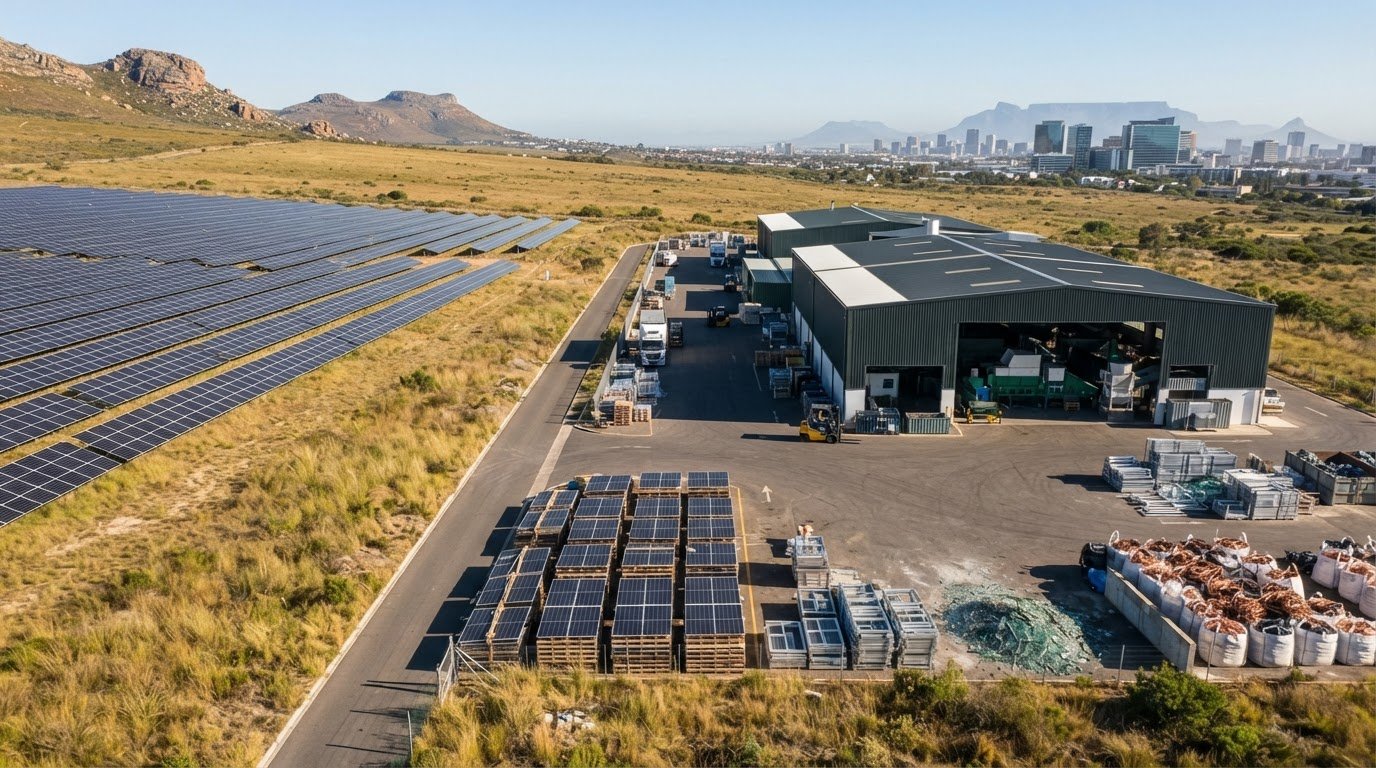
End-of-life solar modules are an asset-management issue, not merely a disposal task. This guide to solar PV recycling South Africa covers the commercial decisions involved in decommissioning at scale: how modules are handled, what shapes the process and how owners track where materials go. Unclear logistics, costs and records can turn an orderly transition into unmanaged waste and gaps in reporting.
Greenovations Venture Studio provides commercial solar PV recycling, including certified, auditable decommissioning and recycling. The service supports processing and material-recovery pathways for aluminium, copper, glass and silver concentrates. Residual fractions also need to be accounted for in the management plan.
This article gives asset owners a consistent basis for comparing end-of-life routes, from potential reuse to recycling and residual handling. It outlines the operational stages, material streams and records to consider, so you can assess options against cost drivers, operational control and auditable outcomes.
Key Takeaways
- Plan for end-of-life modules as assets with defined handling and recovery pathways, rather than treating decommissioning as a standalone disposal task.
- Map the project from asset identification and decommissioning through transport, processing and material segregation. The processing route depends on module composition and facility capability.
- Compare specialist PV recycling, general e-waste handling and disposal using consistent criteria, including traceability, material separation and residual handling.
- Scope quantities, condition, timing and site constraints before setting project controls. Distinguish recommended controls from verified South African legal obligations.
- Use this guide to assess solar PV recycling South Africa options and understand how Greenovations’ certified, auditable decommissioning and recycling supports managed recovery.
Why solar PV recycling in South Africa is a commercial asset-lifecycle issue
End-of-life modules need a planned route, not an improvised exit from the asset register. Solar PV recycling is the controlled processing of retired photovoltaic modules to recover materials for potential use in secondary markets. For commercial owners, solar PV recycling South Africa is an asset-lifecycle decision: it links retirement, replacement and decommissioning with logistics, processing and record-keeping.
Recycling recovers materials through controlled processing; disposal removes an item from use, whilst general waste management covers a broader waste stream. These routes are not interchangeable. A module’s composition and condition affect its handling and processing, while the receiving facility’s capabilities shape which material fractions can be separated. The choice has operational and commercial consequences, rather than being a final administrative step after generation stops.
South Africa’s solar market continues to develop, as outlined in Solar power in South Africa. Sector growth is useful context, but it does not replace site-level planning. Each portfolio needs its own assessment of asset condition, replacement timing and decommissioning constraints.
Why commercial solar assets need an end-of-life pathway
An end-of-life pathway gives operations, finance and asset-management teams a shared plan for modules approaching retirement. The asset register can identify equipment by location, quantity and condition. Maintenance records can help distinguish modules still in service from those already isolated or awaiting removal. Aligning these details with replacement and decommissioning schedules helps owners anticipate labour, access, storage and transport requirements.
This is separate from routine operational management. Maintenance decisions concern the performance and continued use of an operating asset. End-of-life handling begins when modules are removed from service and must be routed, documented and managed beyond the site. Treating these as separate workstreams helps prevent retired panels being left without a defined owner, destination or record trail.
What makes solar PV recycling a commercial decision
Assess the full set of cost and control factors, not just a headline fee. Relevant inputs include the quantity and condition of modules, site access, handling and transport, processing charges, material segregation and the documentation needed for internal oversight. These factors vary between projects, so a route that appears simple at one site may require more coordination or residual handling at another.
Recovered aluminium, copper, glass and silver concentrates may enter secondary industrial markets, but their value depends on processing and market conditions. Do not treat recovery as guaranteed revenue or assume it will offset project costs. Disposal may appear operationally simpler, but that does not establish its total cost or provide equivalent visibility into material outcomes. Compare routes using the same criteria: scope, logistics, traceability, recovered fractions and residual handling. This gives decision-makers a sound basis for setting budgets and responsibilities before decommissioning begins.
How commercial solar PV recycling moves from decommissioning to material recovery
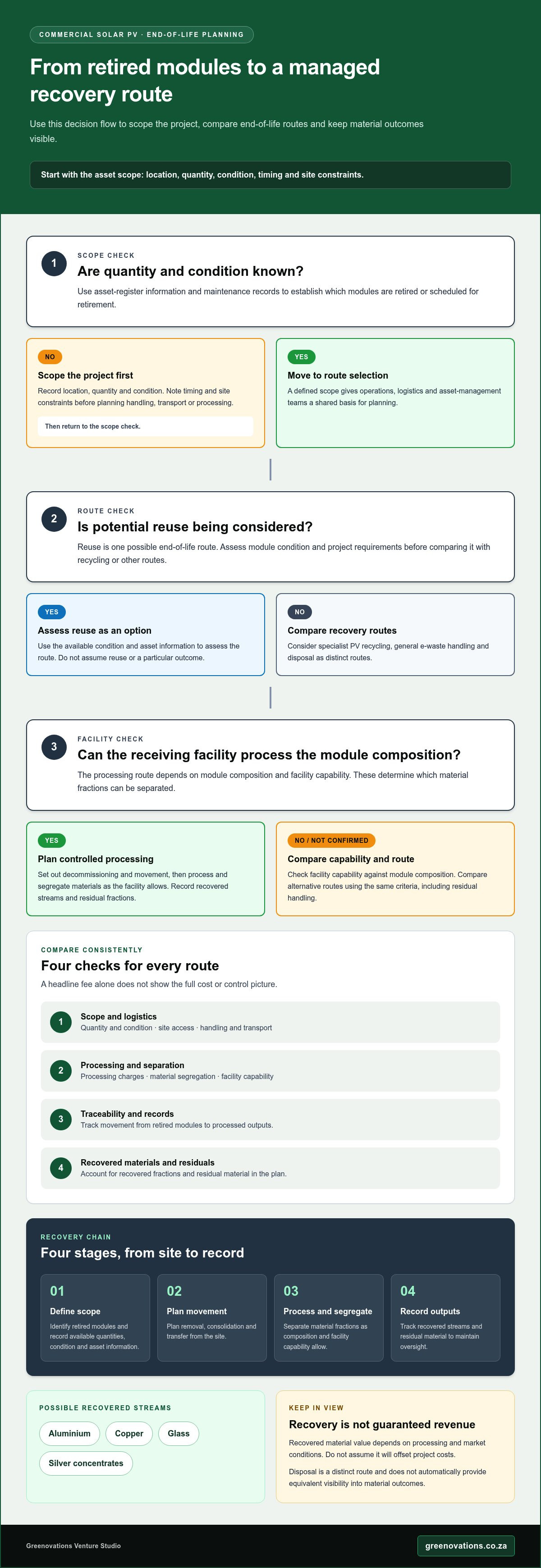
A controlled recovery chain starts before modules leave the site. Clear scope, planned handling and documented outputs connect decommissioning with material recovery, helping owners track what entered the process and what came out. The route depends on module composition and the receiving facility’s capabilities; no single sequence or output profile applies to every project.
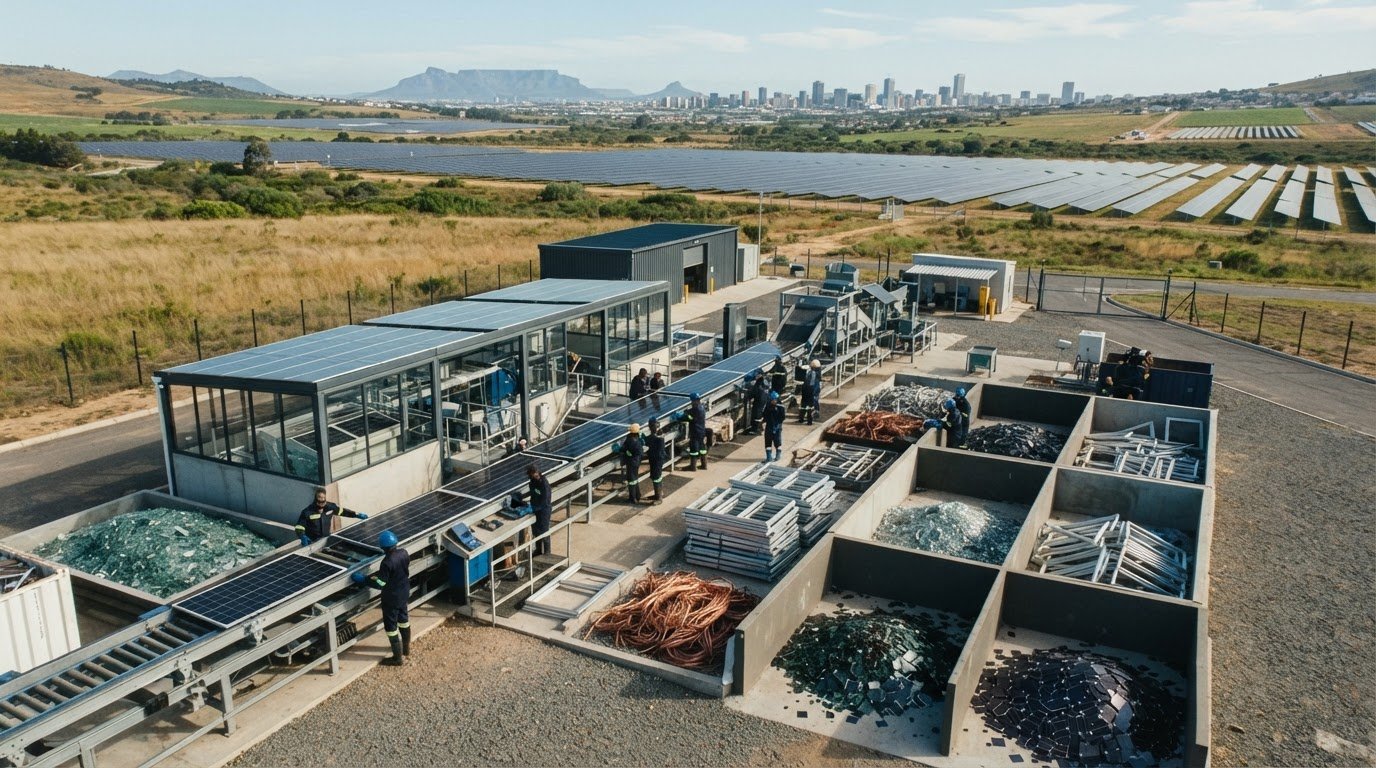
Commercial PV recycling identifies and removes retired modules, transports them for processing, then separates and records recoverable material streams and residual fractions.
The commercial recovery sequence
- Define the asset scope. Identify modules scheduled for retirement and record available quantities, condition and relevant asset information. This provides a practical basis for planning handling, transport and processing.
- Plan decommissioning and movement. Set out how modules will be removed, consolidated and transferred from the site. Requirements depend on project conditions, so treat these as planning stages rather than universal technical specifications.
- Process and segregate. At the receiving facility, modules enter a processing route suited to their composition and the facility’s capabilities. Components and material fractions are separated as the process allows.
- Record outputs. Track the movement from retired modules to recovered streams and residual material. This documentation helps owners maintain oversight of the project scope and outcomes.
This sequence also helps teams assign responsibilities across operations, logistics and asset management. For example, a project plan can identify who coordinates removal from the site, who arranges transport and which records capture processed outputs. That clarity supports project control, but does not predetermine recovery quantities or market value.
Which materials can be recovered from PV modules?
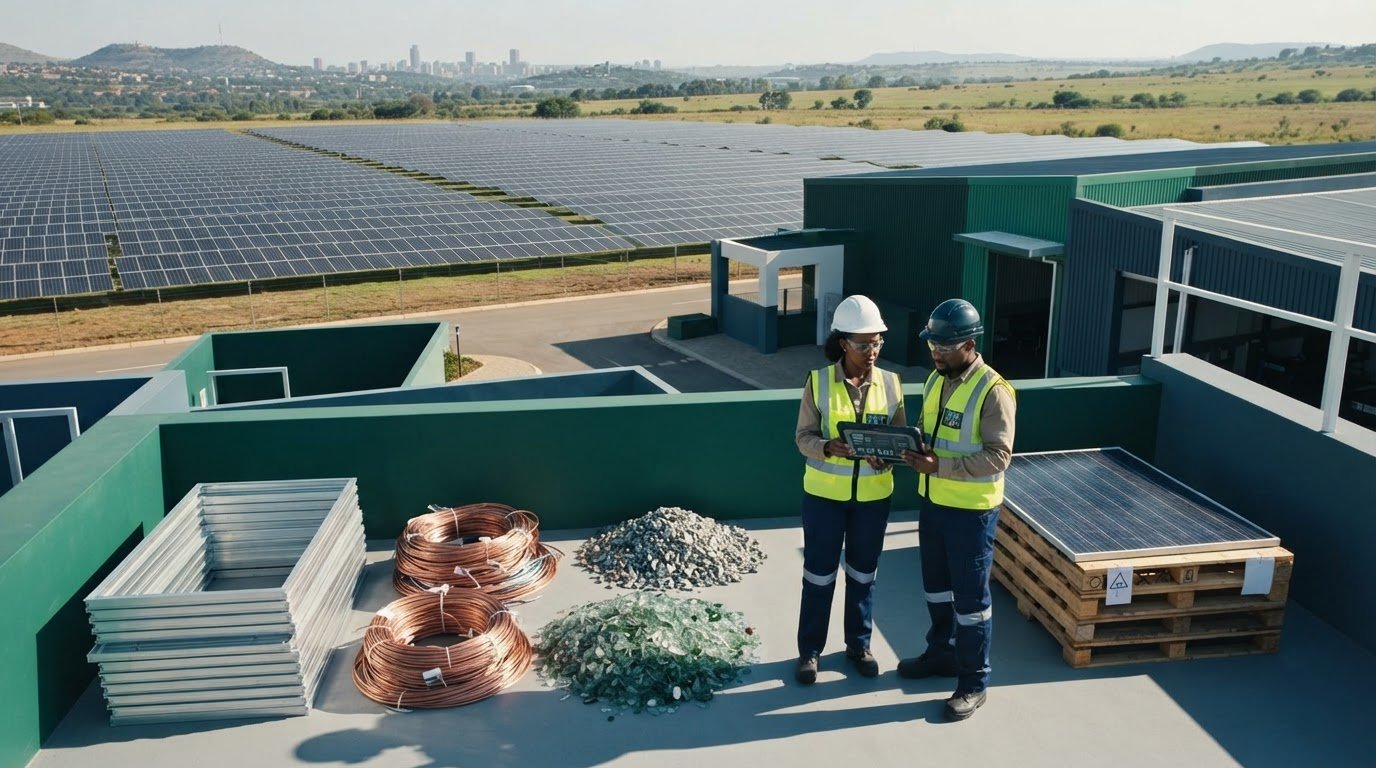
Recovery may include glass and aluminium, as well as copper and silver-bearing material where module design and the processing route allow. Aluminium is associated with module frames, while glass forms part of the panel structure. Copper and silver are found in electrical and conductive components, but the recoverable form and quantity depend on module composition and facility capability.
Treat these as material streams to track, not guaranteed yields or revenue. Project records can note which material categories were separated and how residual fractions were handled. Commercial assumptions about secondary-market value should reflect the actual processing route and market conditions. Avoid applying a generic composition percentage across a mixed portfolio unless it is supported by a relevant, dated source.
Industry coordination is also developing: ESI Africa describes a partnership for solar panel recycling and compliance in South Africa. For asset owners, the practical priority is a traceable project scope and clear output records. Greenovations provides commercial solar PV recycling with certified, auditable decommissioning and recycling, including recovery pathways for aluminium, copper, glass and silver concentrates. Explore commercial solar PV recycling as a managed route for end-of-life modules.
Compare solar PV recycling, general e-waste processing and disposal
These routes differ in scope, not just in name. A commercial comparison should establish what each route is set up to process, which material streams it separates, what records it produces and how it handles residual fractions. For solar PV recycling South Africa projects, assess these factors against current legal requirements, module condition and project economics before selecting a route.
| Decision factor | Specialist PV recycling | General e-waste processing | Disposal route |
|---|---|---|---|
| Processing scope | Focused on end-of-life photovoltaic modules and their material fractions. | May handle mixed electrical and electronic equipment; the scope for PV modules depends on the process. | Moves material out of use, subject to applicable requirements and the route used. |
| Material separation | Can be organised around PV-related streams such as glass, aluminium, copper and silver concentrates. | Separation depends on the facility’s equipment, process and accepted material scope. | Material recovery is not necessarily the route’s primary purpose. |
| Traceability | Project records can link the module scope to processing outputs. | Records and output detail depend on the service and processing arrangement. | Documentation depends on the route and applicable controls. |
| Residual handling | Residual fractions need to be identified and accounted for alongside recovered materials. | Handling depends on the process and the residuals it generates. | Destination and handling must align with verified requirements. |
Where specialist PV recycling differs from general e-waste handling
Specialist PV recycling is structured around module-specific processing and material recovery. General e-waste handling covers a broader category, but that does not mean every general processor lacks relevant controls or recovery capability. The key distinction is the documented scope: whether the route can account for PV modules as a defined input and describe the outputs and residuals it handles.
Use the comparison as a scope test, not a league table. Suitability depends on verified legal requirements, module condition and project economics. A defined project plan is more useful than assumptions about a facility’s capabilities.
How to assess the commercial trade-offs
Build a like-for-like cost view. Separate processing fees, transport, preparation or handling costs, and potential revenue from secondary materials. Treat recovered-material value as variable: market conditions and the actual processing route influence what can be sold, so do not assume it will offset costs.
The lowest immediate processing cost may not be the lowest lifecycle cost or provide the strongest governance position. A route with limited output information may offer less visibility, while a detailed recovery pathway may involve different logistics or processing charges. Compare the total scope and records as well as the initial fee, and assess residual handling explicitly.
For an operationally managed option, explore Greenovations’ commercial solar PV recycling approach, which includes certified, auditable decommissioning and recycling for commercial solar asset owners.
Plan a commercial solar PV recycling project with clear scope and controls
A controlled project starts before panels are removed. Define the asset scope, operational constraints, responsibilities and commercial assumptions early. Keep legal obligations distinct from internal project controls. For solar PV recycling South Africa projects, current requirements can depend on the waste classification and circumstances. Verify applicable South African rules using current authoritative sources before setting the compliance approach. The planning steps below are operational guidance, not legal advice.
Build the project scope before panels leave the site
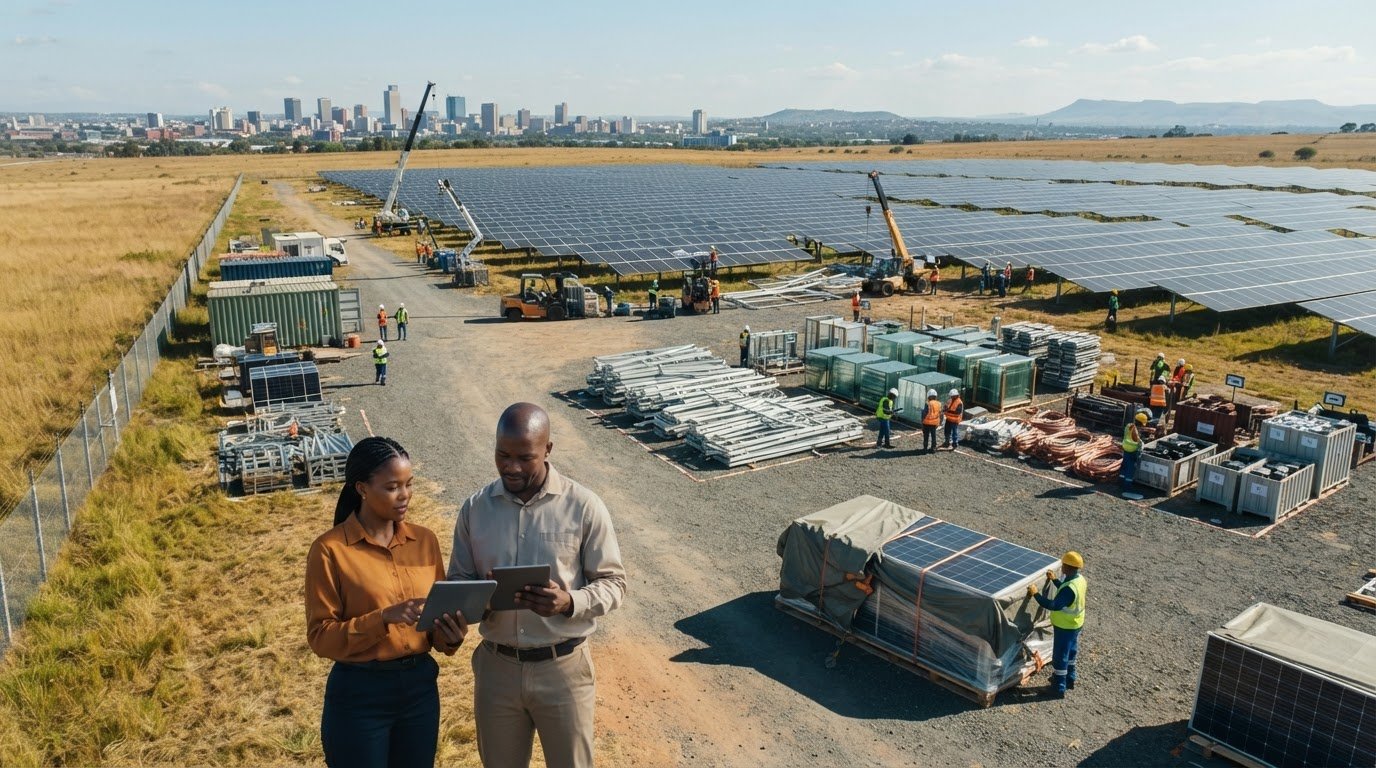
Start with an inventory that makes the work measurable. Record the site or asset group, module types where known, estimated quantities, condition and expected decommissioning timing. Note whether panels will be retired in one project or in phases. The aim is to give operations, logistics and processing teams a shared scope, not to assume every module follows an identical route.
- Confirm the assets. Reconcile modules due for removal against available asset records. Flag gaps in quantity, type or condition that could affect planning.
- Set the timing. Align the expected removal window with replacement activity, site access and other operational constraints.
- Record site conditions. Capture access limitations, handling requirements, consolidation arrangements and transport considerations relevant to the project.
- Define the information required. Bring together the scope, condition and logistics details needed to plan processing and movement. Update assumptions if the physical scope changes.
This sequence reduces avoidable uncertainty. For example, phased retirement may require different collection and consolidation arrangements from a single coordinated decommissioning, even if the overall module count is similar.
Set governance, records and commercial assumptions
Assign responsibility for coordinating the project, tracking the scope and recording material outputs. Establish how changes to quantities or timing will be captured, and how the final record will connect removed modules with recovered material streams and residual handling. These are recommended project controls, not prescribed statutory forms or a substitute for checking current requirements.
- Separate legal obligations from controls. Verify current South African requirements for the specific activity and waste classification. Keep that compliance assessment distinct from internal oversight measures such as approvals, quantity reconciliations and output records.
- Separate cost and revenue assumptions. Model processing fees, transport and project preparation costs as distinct items. Treat potential revenue from aluminium, copper, glass or silver concentrates as variable, not as a guaranteed offset.
- Maintain an auditable project trail. Keep a clear account of the agreed scope, changes, movements and reported outputs, with responsibilities defined across the project.
Greenovations structures its commercial solar PV recycling service around certified, auditable decommissioning and recycling for solar asset owners. This provides a managed framework for project scope and recovery pathways.
For a commercial route, plan certified, auditable solar PV recycling with Greenovations.
Greenovations’ solar PV recycling model turns decommissioning into managed recovery
Commercial asset owners need more than a destination for retired modules. They need an end-of-life service with a defined scope that manages decommissioning and recycling and supports oversight of the recovery pathway. Greenovations provides commercial solar PV recycling for solar asset owners, structuring the service around certified, auditable decommissioning and recycling of end-of-life panels.
This is a recovery service, not panel sales or general solar installation. It manages the transition from retired asset to processing and material recovery, with an auditable approach that helps owners maintain visibility over the project. For organisations assessing solar PV recycling South Africa options, a defined service scope can connect operational execution with commercial accountability.
A commercial service built around accountable end-of-life handling
Greenovations’ service is designed for commercial solar asset owners managing end-of-life panels. Decommissioning and recycling are connected stages within a managed project, rather than separate tasks left to ad hoc coordination. The certified, auditable approach supports owner oversight by providing a basis for tracking the work and its material-recovery pathway.
Auditable delivery does not mean every project produces identical outputs or guarantees a particular result. Module condition, composition and processing route affect recovery. A clearly scoped service helps align those variables with the owner’s operational requirements and record-keeping priorities.
How processing and recovered materials fit the model
The commercial model combines processing fees with potential secondary industrial sales of recovered materials. These are distinct revenue streams, not a promise that material sales will offset processing costs. The value of recovered fractions depends on the processing outcome and market conditions, so owners should treat any material revenue as variable in their project assumptions.
Stated recovery streams include aluminium, copper, glass and silver concentrates. These materials can enter secondary industrial markets, while the exact fractions and quantities depend on module composition and processing. The commercial case is built on a defined service scope and material pathways, not assumed recovery rates or guaranteed resale value.
For asset owners, the practical advantage is a structured relationship between decommissioning, processing and accountable recovery. Greenovations focuses on commercial end-of-life panels, bringing these stages into a service designed for managed execution. Project teams can use this structure to discuss quantities, timing, operating constraints and recovery pathways before panels leave service.
Set the next step around your portfolio’s scope and retirement schedule. Discuss a commercial solar PV recovery project with Greenovations to structure an end-of-life route around managed decommissioning and auditable recycling.
Put end-of-life planning on the asset agenda
The next decision is organisational: assign ownership of the end-of-life pathway before module retirement becomes an urgent operational task. Bring asset management, finance and site operations into the planning cycle early, so replacement timing, budget assumptions and decommissioning requirements are considered together rather than in separate workstreams.
For solar PV recycling South Africa projects, a prepared commercial brief can make the first recovery discussion more productive. Set out the portfolio scope, expected timing and site constraints, then identify the decisions still to resolve. This gives the project a practical starting point without assuming material revenues or a single route will suit every asset.
Greenovations works with commercial solar asset owners on end-of-life PV recovery. Discuss commercial solar PV recycling with Greenovations and take the next step towards a defined recovery pathway. With clear ownership and a well-scoped conversation, decommissioning can be planned as part of disciplined asset management.
Frequently Asked Questions
Can damaged solar PV panels still be recycled?
Yes, damaged panels may still be recyclable, depending on the damage, module composition and processing route. Breakage can change handling, transport and processing requirements, so record visible damage separately from intact modules when preparing the project scope. For solar PV recycling South Africa projects, this helps ensure the condition of damaged units is included in planning. The recovery outcome depends on the materials and processing capabilities involved.
Are solar panels reused before they are recycled?
Not necessarily. Reuse and recycling are separate pathways, and a retired panel should not be assumed suitable for continued operation simply because it remains physically intact. Reuse depends on its condition, performance and intended destination, whereas recycling processes material for recovery. For example, a module removed during a site upgrade may be considered for reuse if its operating condition and destination support that decision. Either route needs clear asset tracking.
Is solar PV recycling the same as electronic waste recycling?
No, the terms do not automatically describe the same processing scope. PV modules have material streams and construction features that may call for a dedicated recovery route, while general e-waste processing can cover a broader mix of products. Compare the accepted inputs, separated outputs, records and residual handling for the actual route. The label alone does not establish what happens to a particular module or how its outputs are accounted for.
Do all solar PV panels use the same recycling process?
No. Module construction, material composition, condition and the receiving facility’s capabilities can all influence processing. A portfolio containing different module types may therefore need to be documented by type rather than treated as a uniform batch. Recording available specifications and quantities before decommissioning helps define the recovery plan and identify information gaps. Do not assume one process or recovery yield applies to every panel without project-specific evidence.
Can solar panels be recycled if they are no longer producing electricity?
Yes, loss of electricity generation does not by itself determine whether a panel’s materials can be recovered. Operational performance and material recovery are different considerations. A retired module may still contain recyclable materials, subject to its composition, condition and the available processing route. Record why the panel left service and its observed condition. This gives the project a clearer basis for determining its end-of-life pathway without presuming every component will be recovered.
What happens to materials that cannot be recovered from a solar panel?
They remain residual fractions that need to be accounted for. Recycling does not mean every input becomes a saleable material. The handling route depends on the processing method and applicable requirements, so there is no universal destination to assume. In project records, distinguish recovered material outputs from residuals and document how each is managed. For South African projects, verify the current requirements relevant to the material and activity before finalising the handling plan.
Visual summary
Planning a project like this?
Talk to the Greenovations venture desk about a No-CAPEX structure.