
Adding stadium capacity need not start with a capital purchase. Stadium seating without upfront cost can be structured as a managed service: seating capacity is deployed in return for contracted operational fees under a multi-year agreement. The project still has a cost. The difference is how that cost is funded and accounted for.
For venue operators, major seating works compete with other capital priorities. Unclear operating obligations can also make a long-term commitment difficult to assess. A managed model can move the initial capital requirement into contracted fees, but its commercial case depends on a defined scope, clear accountability and terms that stand up to financial scrutiny.
This guide compares managed seating with outright procurement using the same evaluation framework. It explains how to define project scope, allocate operating responsibilities, set performance measures and review contract provisions before signing. The aim is to assess the full commitment, not just the absence of an upfront purchase.
Key Takeaways
- Assess stadium seating without upfront cost as a contracted procurement model, not a cost-free installation.
- Map the project from venue requirements through agreed scope and deployment to understand how managed capacity and operational fees are structured.
- Compare contracted fees, responsibilities and agreement duration with the capital and asset-control implications of an outright purchase.
- Use a practical checklist to separate seating performance requirements from operating duties and commercial terms.
- Clarify scope, accountability and contract provisions before moving from a seating assessment to deployment planning.
Stadium seating without upfront cost: the capital constraint and the alternative
Stadium seating without upfront cost is a managed procurement model. The venue avoids the initial capital spend on seating capacity and instead commits to contracted operational fees. It is not a free installation. The project agreement defines the capacity to be delivered, the services in scope, each party’s responsibilities and the fees payable over the agreement term.
A large seating requirement is rarely assessed in isolation. Stadium operators allocate capital across competing needs, including venue maintenance, safety-related works, infrastructure upgrades and other operational priorities. Buying seats directly can place the full acquisition and installation requirement against the capital budget when the project proceeds. A managed structure changes the timing and payment profile, but it does not remove the contractual obligation.
This approach follows the broader logic of Infrastructure as a Service (IaaS): access to defined infrastructure is arranged as a service rather than treated solely as a one-off asset purchase. Seating is physical infrastructure, so the comparison is not exact. The useful parallel is the commercial structure: capacity and responsibilities are set out in an agreement, with payment made through contracted fees rather than a single initial capital outlay.
What does no-upfront-cost stadium seating mean?
No-upfront-cost stadium seating is a managed arrangement in which a venue secures defined seating capacity without paying the full initial capital cost, then pays contracted operational fees under a project agreement. The fees are not the absence of a cost. The agreement sets out the project scope, operating responsibilities and term, so the venue’s commitment should be assessed across the full contract, not by the initial payment alone.
This differs from buying seats individually, where procurement centres on acquiring specified products, and from paying a supplier in instalments, where the purchase price is divided over time. A managed model is organised around contracted capacity and defined operational commitments. Payment timing, asset arrangements and responsibilities depend on the agreement, so compare the complete scope and obligations rather than just the first invoice.
Which venues might assess a managed seating model?
Stadium operators may assess managed seating when planning additional capacity, replacing existing seats or upgrading a venue. It can also be considered when decision-makers are balancing seating works against maintenance and other capital priorities across a venue portfolio. It is an alternative procurement structure, not an automatic substitute for direct purchase.
Begin with the budget and operating requirements. Record the seating need, the capital that a direct purchase would require at the outset, and the operating budget available for contracted fees. Then identify which duties the venue retains and which the agreement assigns elsewhere. This frames the decision around the total commitment, accountability and budget fit, rather than treating “no upfront cost” as a saving in itself.
How stadium seating Infrastructure-as-a-Service is structured
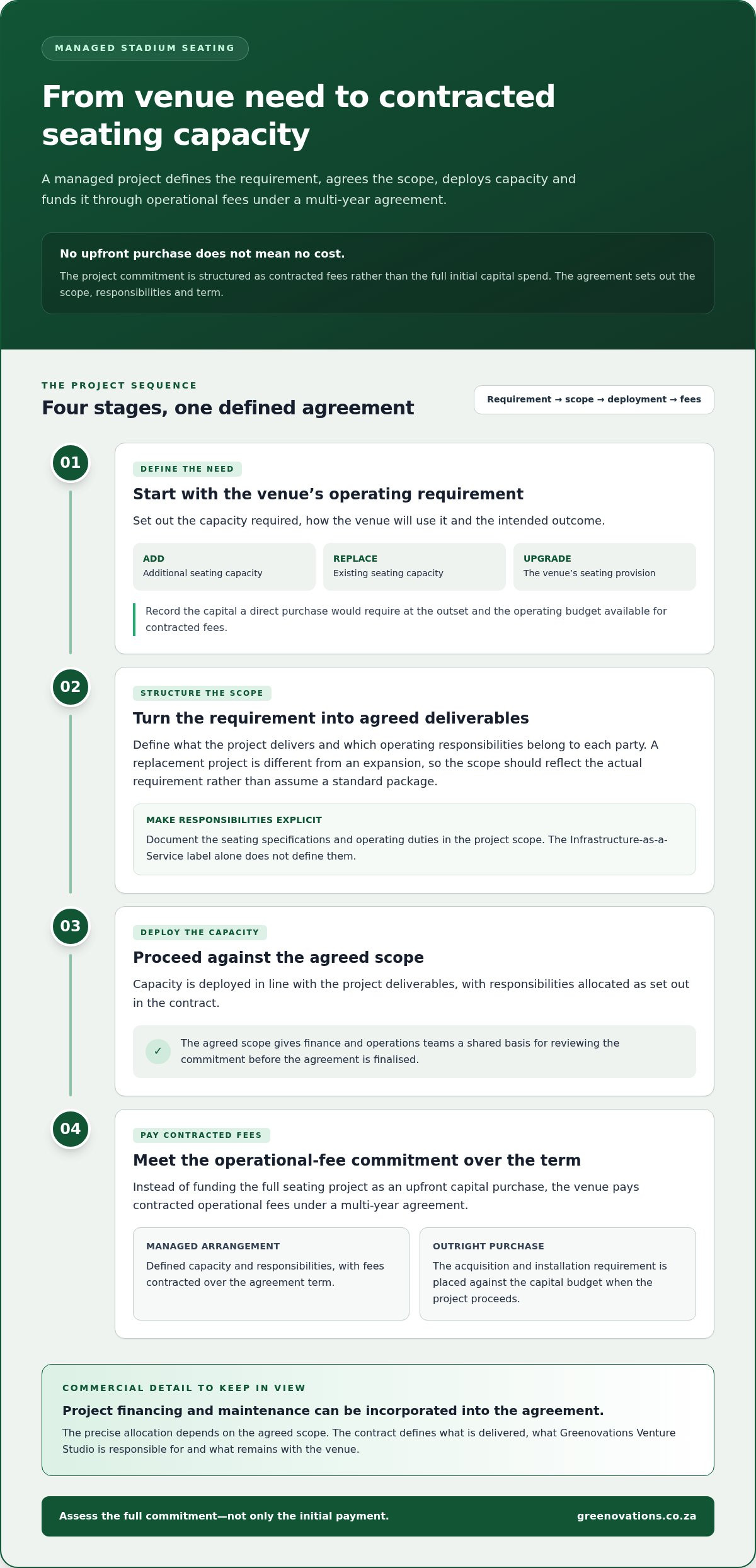
A managed seating project moves through clear commercial stages. The venue defines its requirement, the parties agree the scope and responsibilities, capacity is deployed, and the venue pays operational fees under a multi-year agreement. Setting out the financial and operating commitments before deployment helps decision-makers assess the project as more than a one-off product order.
Greenovations Venture Studio structures seating as Infrastructure-as-a-Service, with project financing and maintenance incorporated into the agreement. The precise allocation depends on the agreed scope. A managed model does not mean every venue receives identical seating, operating arrangements or contract terms. The agreement defines what is delivered, what Greenovations Venture Studio is responsible for and what remains with the venue.
- Define the need. Set out the required capacity, how the venue will use it and the intended outcome, such as adding seats, replacing existing capacity or upgrading the venue.
- Structure the scope. Translate the requirement into agreed project deliverables and operating responsibilities. This provides the basis for deployment planning and the commercial agreement.
- Deploy the capacity. Proceed against the agreed scope, with responsibilities allocated as set out in the contract.
- Pay contracted fees. Meet the operational-fee commitment over the agreement term instead of funding the full seating project as an upfront capital purchase.
From venue requirements to a defined seating scope
Start with the venue’s operating requirement, not a catalogue selection. Specify the capacity needed, the uses the seating must support and the outcome the project is intended to deliver. These details shape what the deployment includes and which responsibilities sit with each party. A written scope gives finance and operations teams a shared basis for reviewing the commitment before the agreement is finalised.
For example, replacing existing seating is a different project from adding capacity. The scope should reflect that difference rather than assume a standard package. Seating specifications and operating duties should be documented in the project scope, not inferred from the Infrastructure-as-a-Service label.
How contracted operational fees replace upfront capital spend
Under a multi-year agreement, the venue pays the operational fees set out in the contract. This changes the payment structure from an initial capital outlay to a contracted expense that can be included in forward budget planning. Predictable fees may help with planning, but the actual commitment depends on the agreed scope and terms. The model does not guarantee savings or a fixed tariff across projects.
Avoiding upfront capital spend changes when and how the project is paid for; it does not eliminate the project’s total contractual cost. Assess the full fee schedule, agreement term and allocation of maintenance and other responsibilities alongside the capital budget that a direct purchase would require. This makes the comparison more useful than focusing on the initial payment alone.
For venues assessing stadium seating without upfront cost, Greenovations Venture Studio’s managed seating infrastructure approach provides a structured route from requirements to contracted capacity. Review the agreement’s scope and accountability in detail; the financing structure alone does not resolve operational risk.
Managed stadium seating versus outright purchase: compare the commercial trade-offs
The choice is not simply between paying now and paying later. Outright procurement commits capital to a purchase, while managed seating structures capacity and operating responsibilities through a multi-year agreement. Compare both routes against the same criteria: initial funding requirement, payment profile, responsibility allocation and obligations over time. The right structure depends on the project scope and the venue’s priorities, not on one payment feature alone.
Assessment area
Outright purchase
Managed seating
Initial capital
The venue funds the purchase and associated project costs upfront.
The venue avoids the initial capital purchase; the project is funded through the managed arrangement.
Payment structure
Payment is made for the procurement, with any separate operating costs assessed independently.
The venue pays contracted operational fees under the agreement.
Responsibilities
The venue manages procurement and determines how ongoing responsibilities are handled.
Responsibilities, including maintenance, are allocated through the project agreement.
Duration
The purchase itself does not establish a multi-year service term; any additional arrangements are separate.
The model is structured through a multi-year agreement, with project-specific terms.
When outright seating procurement may fit the venue
Direct purchase may suit a venue with approved capital available and a clear preference for direct asset control. It may also fit an organisation prepared to manage procurement and decide how ongoing responsibilities will be handled. That control comes with the need to account for the full project scope and related operating requirements. Outright purchase is not automatically cheaper or simpler; its value depends on the venue’s funding position and capacity to manage the work.
When a managed seating agreement may fit better
A managed agreement may suit a venue seeking to preserve capital for competing priorities and plan seating expenditure through contracted operational fees. In return, the venue accepts a multi-year commitment rather than making a one-off purchase. Review what the agreement includes, how responsibilities are divided and what applies at the end of the term. These provisions determine the actual commercial and operating obligations, not the “managed” label alone.
For a useful comparison, apply the same seating requirement and project scope to both options. Then assess the capital impact, total contracted commitment, retained responsibilities and end-of-term position. A venue with available capital and a strong preference for direct control may favour procurement. A venue prioritising capital allocation and contracted operations may assess stadium seating without upfront cost through a managed model. Neither route is universally superior; the decision depends on funding priorities, scope and agreement terms.
How to evaluate a no-upfront-cost stadium seating proposal
Assess the proposal through two linked but distinct documents: the seating performance brief and the commercial operating agreement. The brief records what the seating must deliver for the venue. The agreement sets out what is included, who is accountable, how fees apply and how changes are managed. Keeping the two clear makes it easier to spot gaps before the project proceeds.
Define capacity, use case and delivery scope
Start with a written baseline: current seating capacity, intended capacity and the venue uses the project must support. Record the expected outcome, such as replacing existing seats or adding capacity, then specify relevant seating and mounting requirements in the project brief. Avoid broad descriptions on their own. A documented brief gives everyone a shared reference for reviewing scope, deployment assumptions and later changes.
- Capacity: Record the existing and required seating numbers, including any defined areas or project phases.
- Use case: Describe the venue activities the seating must serve and any operating conditions relevant to its use.
- Requirements: Set out the seating and mounting criteria the project must meet. Do not treat catalogue descriptions as a complete specification.
- Interfaces and assumptions: Identify venue-side dependencies, access arrangements or other operating interfaces that affect delivery. Document the assumptions behind the proposed scope.
- Included work and exclusions: Specify what the agreement covers and what falls outside it, so the project boundary is clear.
Assess fees, responsibilities and contract exposure
Evaluate contracted fees against the complete project scope and agreement term, not an isolated seat price. Avoiding an upfront capital purchase changes the payment structure; it does not remove the venue’s contractual commitment. Use the agreement to map responsibilities so operating teams can see who is accountable during deployment and ongoing operations.
- Fee basis: Record the contracted operational fees, payment schedule and the scope they relate to. Assess the commitment across the term, not just the periodic payment.
- Responsibility allocation: Identify each party’s stated duties for deployment, maintenance and ongoing operations. Do not assume a task is included unless the agreement assigns it.
- Change control: Review how scope changes are requested, assessed, approved and reflected in the commercial terms.
- End of term: Establish the agreement’s end-of-term provisions and any responsibilities or decisions that arise at that point.
- Performance versus service: Keep seating criteria, such as capacity and mounting requirements, distinct from service obligations and accountability measures.
A disciplined review turns stadium seating without upfront cost from a headline into an assessable procurement option. Use the same written requirements to test the proposal’s scope, fees and responsibilities before proceeding. To assess a Greenovations managed seating proposal, organise these requirements into a project brief and compare them with the agreement.
Move from seating assessment to a structured Greenovations agreement
Once the venue has assessed the commercial case, turn the findings into a project brief. Greenovations’ Sustainable Seating Infrastructure-as-a-Service deploys managed seating capacity without an upfront capital purchase, in return for contracted operational fees under a multi-year agreement. It is a structured procurement model, not a cost-free project. Fees, responsibilities and terms are defined for the specific project rather than assumed to follow a standard template.
Progress in sequence: document the venue requirement, establish the proposed seating scope, allocate operating responsibilities, review the agreement and then plan deployment. This gives finance, operations and infrastructure decision-makers a shared basis for reviewing the commitment before it becomes an operating plan.
What to prepare before structuring a project
A useful project brief brings the operating need and funding priorities together. Make it specific enough to shape a scope, while distinguishing confirmed requirements from assumptions that still need resolution.
- Seating requirements: Record current capacity, the capacity objective and the venue uses the project must support.
- Operational constraints: Describe relevant venue conditions, interfaces and requirements that could affect project planning.
- Capital priorities: Identify other commitments competing for capital and the role contracted operational fees could play in forward budgets.
- Contract considerations: Set out the agreement duration, responsibility allocation and operating provisions that matter to the venue.
- Decision-making roles: Identify the people responsible for finance, venue operations and infrastructure so each can assess the proposal within their area of accountability.
This preparation improves scope discussions and helps distinguish the venue’s required outcome from a particular solution. It also reduces the risk of assessing a proposal against incomplete or shifting assumptions.
What the agreement should make clear
The agreement should turn the project brief into a clear commercial and operating framework. It must define the seating scope, contracted operational-fee structure and agreement duration, then allocate responsibilities for project delivery and ongoing operations. State maintenance and other operating provisions explicitly rather than inferring them from general descriptions of a managed service.
- Scope and exclusions: Identify what is included, what is excluded and how changes to the agreed work will be handled.
- Fees and term: Set out the contracted fee structure and duration, together with the project scope to which they apply.
- Accountability: Allocate responsibilities across the parties and state the relevant operating provisions.
- End-of-term treatment: Document the provisions that govern the agreement’s conclusion.
Greenovations structures these agreements around the project rather than imposing uniform terms. Prepare the venue brief, then discuss a managed seating project with Greenovations. Before proceeding, resolve the scope, responsibilities and full contractual commitment, not only the absence of upfront capital spend.
Put the seating decision on a contract-ready footing
Turn the venue’s seating requirement into a decision that finance and operations teams can assess on the same basis. Set an internal review point for the proposed scope, fee commitment, responsibilities and agreement duration. This gives the venue a clear basis for deciding whether stadium seating without upfront cost aligns with its capital priorities and operating capacity.
Greenovations’ managed seating model structures capacity without upfront capital spend, with contracted operational fees under a multi-year agreement. The commercial commitment remains; its value depends on how the project is defined and whether the contract’s obligations work for the venue.
Bring the relevant decision-makers into the assessment before deployment planning. Assess a managed seating model for your venue with Greenovations and establish whether its scope and contractual commitments fit your requirements. A disciplined review gives your team a practical basis for moving forward.
Frequently Asked Questions
What does stadium seating without upfront cost mean?
Stadium seating without upfront cost means a venue secures managed seating capacity without paying the full installation cost as an initial capital outlay. Greenovations structures this through a multi-year agreement with contracted operational fees, so the seating is not free. For example, a venue planning a replacement project can assess whether this payment structure fits its requirements, then compare the project scope and fee commitment with other planned expenditure.
Can stadium seating be installed without capital expenditure?
A managed Infrastructure-as-a-Service arrangement can avoid an upfront capital purchase for seating deployment. The venue still takes on a contractual cost through the agreed operational fees, so “without capital expenditure” describes the initial funding structure, not a cost-free outcome. A practical assessment identifies which capital priorities remain funded and compares them with the fees, responsibilities and term for the seating project.
How does stadium seating Infrastructure-as-a-Service work?
The venue’s requirements inform a project scope and multi-year service agreement. Greenovations finances and maintains projects under its managed seating model, while the venue pays contracted operational fees. The agreement connects the seating requirement to the agreed scope and allocates responsibilities. This differs from ordering seats as a standalone purchase, which does not by itself define the same managed service arrangement.
Is no-upfront-cost stadium seating cheaper than buying seats outright?
Not automatically. The two approaches allocate payment and responsibilities differently, so a valid comparison uses the same seating requirement and project scope for each. Assess the managed fees over the agreement term, the venue’s retained duties and the financial assumptions behind a direct purchase. The managed model may preserve capital at the start, but weigh that benefit against the full contractual commitment rather than treating it as proof of a lower total cost.
What should a stadium seating agreement include?
A stadium seating agreement should define the capacity and project scope, operational-fee structure, term and each party’s responsibilities. It should also explain how changes are handled, which operating provisions apply and what happens at the end of the agreement. Compare the written terms with the venue’s project brief line by line to identify omissions or mismatches before deployment planning.
Who is responsible for maintaining managed stadium seating?
Greenovations’ managed seating model includes financing and maintenance of projects, while the agreement sets out the project-specific allocation of responsibilities. Use the contract to identify which maintenance activities are covered, how duties are divided and how changes to the agreed scope are managed. A clear allocation gives venue operations staff a basis for planning their own duties throughout the agreement.
Does no-upfront-cost seating mean the venue owns the seats?
No. The absence of an upfront capital purchase does not, by itself, establish ownership. The agreement determines how asset control is treated during the term and what applies when the contract ends. Before signing, review the ownership and end-of-term provisions and assess how they align with the venue’s longer-term infrastructure plans. A managed service is not the same as an outright purchase.
How can a venue assess whether managed seating is suitable?
A venue can assess suitability by matching its seating requirements and operating priorities against the proposed scope, contracted fees and multi-year commitment. For example, a venue with competing capital projects can consider whether operational-fee planning better fits its budget priorities, while also assessing whether the contract’s responsibilities are workable for its team. Compare that assessment with an outright purchase using the same project assumptions before deciding which structure fits.
Visual summary
Planning a project like this?
Talk to the Greenovations venture desk about a No-CAPEX structure.