Sustainable seating infrastructure as a service lets a venue secure managed seating capacity through a contract rather than funding the full installation upfront. It can be worth assessing when a large seating project competes with other capital priorities, but the change in funding structure is only one part of the decision.
Before comparing it with ownership, define what the venue needs and what the agreement must cover. Document the capacity required, how it will support planned venue use, which responsibilities sit with each party, and how fees and decisions will be managed over the contract term. Without those details, it is difficult to compare a contracted service with a purchase on a like-for-like basis.
This guide explains how managed seating works, what to include in scope, and how to assess it against direct procurement. You’ll consider capital allocation, operational fit, contract responsibilities and the evidence needed to substantiate outcomes. The aim is a practical commercial assessment: determine whether a contracted model meets your venue’s requirements, then set out the information needed to evaluate a project.
Key Takeaways
- Distinguish managed seating capacity from a one-off purchase by identifying what the contracted service is designed to deliver.
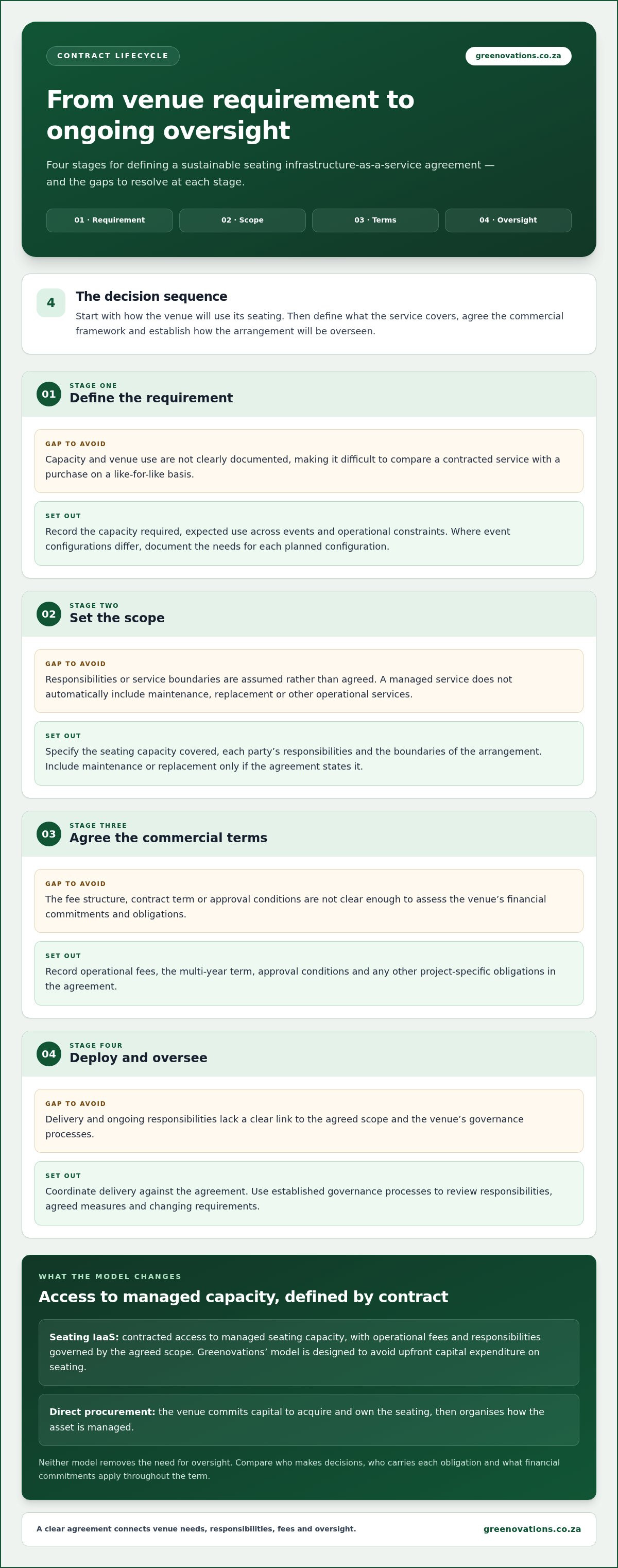
- Map the contract lifecycle from requirements definition through deployment and ongoing oversight, with responsibilities set out in the project agreement.
- Compare sustainable seating infrastructure as a service with direct ownership across capital treatment, operational responsibility, contract term and control.
- Test the model against your venue’s utilisation patterns, operating requirements, capital priorities and governance processes.
- Use an evidence-led fit assessment to determine whether Greenovations Venture Studio’s multi-year, operational-fee model aligns with your project’s requirements.
What sustainable seating infrastructure as a service means for venues
Sustainable seating infrastructure as a service is contracted, managed seating capacity delivered as an infrastructure service rather than a one-off equipment sale. A venue agrees a project scope and pays operational fees under a contract, which can be structured over multiple years. Greenovations’ model is designed to avoid upfront capital expenditure on seating, allowing venue partners to keep capital available for competing priorities.
The distinction is about more than who pays at the outset. With direct procurement, the venue owns the seats and arranges how the asset is managed. With an IaaS arrangement, the venue accesses seating capacity under agreed contractual terms, and the scope determines each party’s obligations. A managed service does not automatically include particular maintenance, replacement or other operational services. The project agreement needs to state which responsibilities are included.
Seating IaaS is contracted access to managed venue capacity, not a one-off purchase that transfers the asset and its management to the venue.
How seating IaaS differs from a conventional seating purchase
In a conventional purchase, the venue commits capital to acquire seating, then organises its management through its own operational arrangements. The venue has direct ownership, but also carries the associated decisions and obligations. Under IaaS, the commercial relationship is defined by a contract for managed capacity, with operational fees and responsibilities governed by the agreed scope. The Infrastructure as a Service (IaaS) concept offers a useful analogy: access to infrastructure is arranged as a service, although venue seating has different physical and contractual requirements from cloud computing.
For example, a stadium planning a seating project can compare the capital required for ownership and the internal effort to manage the asset with the contracted fee structure and defined responsibilities of IaaS. Neither model removes the need for oversight. Compare who makes decisions, who carries each obligation, and what financial commitments apply throughout the term.
Which venue stakeholders assess a managed seating model?
A sound assessment brings operational, financial and governance perspectives together before the venue commits to a model. Each group tests a different part of the arrangement:
- Venue and stadium operators assess required capacity and how seating delivery must align with visitor operations and planned venue use.
- Finance and procurement teams compare upfront capital requirements with contracted operational fees, review the multi-year commitment and assess how the arrangement fits procurement processes.
- Governance stakeholders examine accountability, reporting requirements, approval controls and the venue’s obligations across the contract term.
Assign someone to consolidate the answers. This helps prevent a financing decision from being mistaken for an operational plan. Define required capacity and operating context first, then establish which responsibilities, reporting arrangements and long-term commitments the agreement must address. Teams can then evaluate the same proposal against a shared set of requirements.
How sustainable seating IaaS is structured across the contract lifecycle
A sustainable seating infrastructure as a service agreement should translate venue requirements into a defined commercial and operational framework. Greenovations’ model uses contracted operational fees and multi-year agreements to provide managed seating capacity without upfront capital expenditure. The project agreement should specify the delivery scope, responsibilities, fees and governance arrangements. Working through these elements in sequence helps venue teams find gaps before making a commitment and gives them a basis for oversight throughout the term.
- Define the requirement. Document capacity needs, use patterns and operational constraints, including how seating delivery must align with the venue’s planned activities.
- Set the scope. Record the seating capacity covered, each party’s responsibilities and the boundaries of the arrangement. Do not assume maintenance, replacement or other services are included unless the agreement states so.
- Agree the commercial terms. Set operational fees, the multi-year term, approval conditions and any other project-specific obligations in the agreement.
- Deploy and oversee. Coordinate delivery against the agreed scope, then use established governance processes to review responsibilities, agreed measures and changing requirements.
Define capacity requirements and project scope
Start with the venue’s operating case, not a generic seating specification. Consider expected use across events, the capacity required for those uses and any practical constraints that could affect delivery. For example, if a venue uses different event configurations, document the capacity and operating requirements for each planned configuration instead of relying on one headline figure.
Translate those requirements into project documentation. Identify who approves scope changes, who owns each decision and what information must be reported during the agreement. A simple responsibility schedule can name the accountable party for each decision and show the approval route. This helps finance, procurement and operations teams assess the same proposal against a consistent record, rather than treating informal assumptions as contractual commitments.
Govern delivery and performance throughout the agreement
The contract should assign responsibilities and define review points before deployment begins. It should also set out how issues are escalated and how changes to scope are approved. These are governance provisions, not assumed service features. Distinguish operational measures accepted by both parties from performance guarantees. Do not infer a guarantee where the contract does not specify one.
Periodic governance reviews give the venue a formal opportunity to assess whether the agreed scope remains aligned with utilisation and operating requirements. If venue use changes, record a decision about the arrangement rather than assuming the service will adjust automatically. Keep review outcomes, agreed actions and accountable parties on file so that oversight remains traceable across the contract term.
Contracted operational fees can replace the need for an upfront seating capital purchase, converting the project into a planned operating commitment. For venues assessing this structure, Greenovations’ managed seating model is structured around contracted fees and multi-year agreements.
Managed seating IaaS versus direct ownership: a venue decision framework
Choose between ownership and a contracted service by comparing who commits capital, who carries operational responsibilities and how much control the venue needs. Sustainable seating infrastructure as a service changes the allocation of obligations; it is not simply a different way to price the same purchase. The right fit depends on venue requirements, governance capacity and the documented contract terms.
Capital treatment
Direct ownership: The venue funds a seating asset through an upfront capital commitment.
Managed IaaS: The venue pays contracted operational fees, structured to avoid upfront capital expenditure for seating capacity.
Operational responsibility
Direct ownership: The venue owns the asset and organises its management through its own arrangements.
Managed IaaS: Responsibilities are allocated in the project agreement. Do not assume particular operational services unless the scope sets them out.
Contract term
Direct ownership: The purchase establishes ownership, while ongoing management is handled separately by the venue.
Managed IaaS: Managed capacity is delivered under agreed contractual terms, including a multi-year agreement.
Control
Direct ownership: The venue retains direct ownership and control over procurement decisions, subject to its own governance.
Managed IaaS: Control and decision rights follow the agreed scope and contract. The venue must govern the service relationship over its term.
This comparison is a starting point, not a full financial model. Assess how an upfront CAPEX commitment compares with planned OPEX, then include the responsibilities and obligations attached to each option. For a useful internal comparison, list the venue’s requirements beside each model, identify the cost structure and contract commitments, and note which assumptions still need to be tested. A detailed CAPEX-to-OPEX calculation requires project-specific inputs and sits beyond this decision framework.
When direct ownership may better match venue priorities
Ownership can suit a venue that prioritises holding the seating asset and directing procurement decisions itself. It may also align with an organisation that has established internal capacity to manage the relevant infrastructure and wants those responsibilities to remain in-house. Direct control does not prove that ownership will cost less or be simpler to operate. The venue still needs to account for its capital priorities, internal resources and ongoing management obligations.
When a contracted seating service may be a stronger fit
A contracted model merits consideration when avoiding upfront capital expenditure for seating capacity is a priority and predictable operating expenditure fits the venue’s financial planning. The trade-off is a multi-year service agreement that requires clear governance, defined responsibilities and ongoing oversight. Assess whether the venue can manage that commitment and whether the contracted scope aligns with its operating requirements before selecting the model.
Make the decision against documented requirements, not a general assumption that one structure is inherently superior. Ownership may maximise direct control; a managed service may better align capital treatment with a venue’s operating priorities. The preferred model is the one whose financial structure, accountability and contractual obligations the venue can sustain.
How to assess whether seating infrastructure as a service fits your venue
Assess fit against evidence, not the appeal of moving a project out of the capital budget. Sustainable seating infrastructure as a service is relevant when the venue’s capacity needs, operating requirements and financial planning can be translated into a clear, governable agreement. Test the model against actual and planned use, then establish whether the organisation can manage its contractual obligations over the term.
Check commercial and operational readiness
Start with the venue’s requirements. Review current seating needs, expected utilisation and the assumptions behind future operating plans. Consider how demand differs between events or configurations, and whether the required capacity can be described clearly enough to inform a project scope. Where assumptions remain uncertain, record them and identify who will validate them instead of treating them as settled requirements.
Then map internal accountability. Finance should assess how contracted operating expenditure fits alongside other priorities; procurement should define the process for evaluating and approving the agreement; venue operations should set out how seating delivery must support planned use. Governance teams should identify approval thresholds and any executive or board decisions required for a multi-year commitment.
Before progressing, check that the venue can identify who will own contract oversight, manage scope decisions and maintain an auditable record of approvals. A contracted model needs active governance. If those responsibilities have no clear internal owner, the commercial structure may be difficult to manage even when the initial requirements appear suitable.
Set evidence and governance requirements
Define what the venue intends to monitor before agreeing reporting expectations. Operational indicators should relate to the project scope and venue requirements, such as the capacity covered or alignment with planned use. Select measures that both parties can define consistently and support with an identifiable source of evidence. Set the reporting frequency and name the accountable party in the project governance arrangements.
Apply the same discipline to sustainability and ESG objectives. Identify the outcome the venue intends to report, the measurement method, the evidence source and the party responsible for maintaining the record. A sustainability claim without a defined method is not a substantiated result. Avoid treating the service model itself as proof of environmental benefit; any reported outcome should be supported by project-specific evidence.
- Demand: Are capacity requirements and utilisation assumptions documented?
- Capital priorities: Does the operating-fee structure fit the venue’s financial planning?
- Governance: Are decision rights, approvals and oversight responsibilities assigned?
- Contract readiness: Can the venue define scope, reporting and long-term obligations?
- Evidence: Can operational and ESG indicators be measured and substantiated?
A strong fit exists when the venue can articulate its requirements, govern a multi-year agreement and report outcomes using credible evidence. Greenovations’ managed seating model uses contracted operational fees to provide seating capacity without upfront capital expenditure.
Greenovations’ sustainable seating IaaS model and next steps
Greenovations provides managed seating capacity for venues and stadium operators through contracted operational fees and multi-year agreements. The model is structured to avoid upfront capital expenditure by venue partners, addressing the funding pressure that arises when high seating installation costs compete with other priorities. It is not a retail seating catalogue or a one-off equipment sale. It is a contracted infrastructure arrangement shaped around the venue’s documented requirements.
The agreement is central to the model. It defines the project scope, responsibilities and operating terms, giving both parties a contractual basis for delivery and oversight. Sustainable seating infrastructure as a service can align managed capacity with venue requirements, but its practical value depends on how clearly those requirements and obligations are documented. The structure does not, by itself, establish specific maintenance, replacement or performance commitments. Those belong in the agreed project scope where applicable.
What the Greenovations model is designed to address
Large seating projects can create a substantial upfront capital demand. Greenovations’ contracted model shifts the commercial structure towards operational fees over a multi-year agreement, helping venue partners avoid an initial capital spend on seating capacity. This changes the timing and form of the commitment; it does not remove the need to assess the total contractual obligation or its fit with venue priorities.
Project definition remains decisive. Capacity, intended use and operating constraints should inform the scope, while responsibilities and relevant operating terms are set down in the agreement. Greenovations acts as an infrastructure project orchestrator rather than presenting a standard retail range. The project is assessed against operational requirements, not simply a list of seats.
What to prepare before discussing a project
A focused project discussion starts with a concise evidence pack. Bring the information that allows the venue and project team to frame the requirement, assess financial fit and identify the governance needed for a multi-year arrangement:
- Capacity and utilisation: Set out current seating needs, expected use patterns and the assumptions behind planned venue operations.
- Operating constraints: Describe the conditions that affect how seating capacity must align with venue requirements.
- Capital priorities: Identify competing projects and explain how an operational-fee commitment would be considered within the venue’s financial planning.
- Governance: Map decision-makers, approval routes, contract oversight and reporting expectations.
- ESG evidence: Specify any intended sustainability indicators, how they will be measured, the evidence source and who will report them.
This preparation makes the next step an evidence-led assessment, not a premature commitment. It can also surface gaps in utilisation assumptions, accountability or reporting before terms are finalised. Greenovations operates nationally across South Africa, with the project agreement setting out the relevant scope and operating terms for the venue.
For a project discussion grounded in your venue’s requirements, review Greenovations’ sustainable seating infrastructure service.
Turn your venue assessment into a clear project brief
Convert your assessment into a decision document that your operational, finance and governance teams can act on. Set out the venue’s requirements, the assumptions behind them, the decisions still outstanding and the evidence needed to evaluate the proposed arrangement. This gives internal stakeholders a common basis for reviewing sustainable seating infrastructure as a service and deciding whether to progress the project.
A strong brief does not need to resolve every detail in advance. It should make the venue’s priorities explicit and identify the contractual questions that require agreement before commitment. Include the capacity and operating assumptions, the proposed financial structure, the responsibilities that need to be allocated and the process for reviewing the agreement. This keeps the evaluation grounded in operational fit and accountable decision-making, rather than treating a change in funding structure as the whole case.
If your venue is ready to move from assessment to a project-specific discussion, discuss a managed seating model with Greenovations. A well-defined brief gives the conversation a practical starting point and helps your team take the next step with confidence.
Frequently Asked Questions
What is sustainable seating infrastructure as a service?
Sustainable seating infrastructure as a service is a contracted model for providing managed seating capacity to a venue. Rather than treating seating solely as equipment to purchase, the arrangement defines capacity and commercial terms through a project agreement. For decision-makers, the practical question is whether this structure fits the venue’s requirements and governance approach. The word “sustainable” should not be treated as proof of environmental performance without project-specific evidence.
How does seating infrastructure as a service work for a stadium?
For a stadium, the process starts by documenting the capacity needed for its planned uses and the operational requirements that affect delivery. The project scope and responsibilities are then set out in an agreement, including its operational fees and term. For example, a stadium with different event configurations can define the capacity and operating assumptions relevant to those uses before assessing the proposed arrangement. Ongoing oversight follows the responsibilities recorded in the agreement.
Can a venue avoid upfront capital expenditure with managed seating?
Yes. Greenovations’ managed seating model is structured to avoid upfront capital spend by venue partners. This does not mean the project has no cost: the venue enters a contracted operational-fee arrangement, with terms defined through a multi-year agreement. Finance teams should assess the planned operating commitment alongside other budget priorities, approval requirements and the venue’s ability to meet obligations throughout the agreement.
Is seating IaaS different from leasing or buying seats?
Buying seats is an asset purchase: the venue acquires ownership and arranges management through its own operating structure. Leasing generally grants use of an asset under contractual terms, whilst seating IaaS is framed around contracted access to managed seating capacity. Labels alone do not settle the distinction. The agreement determines the parties’ rights, responsibilities, payment structure and control, so compare the actual terms rather than relying on the name of the arrangement.
What responsibilities are covered by a seating infrastructure agreement?
The agreement covers the responsibilities it expressly assigns. It should make clear what seating capacity falls within scope, how operational fees and terms apply, who approves changes, and how the parties handle reporting and oversight. Responsibilities such as maintenance or replacement should not be assumed; they apply only if documented in the project agreement. A responsibility schedule can help venue teams identify accountable parties and distinguish included obligations from work outside the agreed scope.
How can a venue assess whether managed seating is commercially viable?
Assess viability by comparing the contracted commitment with the venue’s financial plan and operational requirements, not by looking at upfront expenditure alone. Test the arrangement against expected utilisation, planned venue use, internal oversight capacity and the approval process for a multi-year obligation. Finance and operations teams can record their assumptions separately, then identify where they depend on the same capacity or usage expectations. This reveals whether the proposal rests on a supportable operating case.
Does sustainable seating infrastructure as a service support ESG reporting?
It can support ESG reporting only where the project has defined, measurable indicators and credible evidence. The service model itself does not establish an environmental outcome. Before reporting, specify what will be measured, the evidence source, reporting frequency and accountable party. For example, a venue should distinguish a documented project activity from a measured environmental impact. This discipline helps prevent broad sustainability language from being presented as verified performance.
Visual summary
Planning a project like this?
Talk to the Greenovations venture desk about a No-CAPEX structure.